Growth or Profits: Which Matters More When Selling Your Business?

The high-stakes choice between scaling fast and staying profitable
As a business owner eyeing an exit, you’ve likely poured years into building something valuable. But here’s the reality check: buyers aren’t just impressed by rapid growth stories. They scrutinize your profitability just as closely. Chase growth at the expense of profits, and you risk undervaluing your company. Prioritize short-term profits over sustainable expansion, and you might scare off ambitious acquirers seeking scalable potential.
This tension defines modern M&A. Recent analysis reveals how capital structure—how you finance growth through debt or equity—and financial performance directly influence firm value. Firm size plays a moderating role, meaning smaller businesses can’t afford the same aggressive growth tactics as larger ones without solid profits backing them up. In Vietnam’s dynamic market and beyond, sellers who misunderstand this balance often leave millions on the table or watch deals collapse during due diligence.
Understanding growth versus profitability isn’t academic—it’s your leverage in negotiations. It shapes everything from valuation multiples to buyer interest. Get it right, and you position your business as a premium asset. Ignore it, and you’re just another growth-at-all-costs story with shaky fundamentals. Let’s break it down step by step to help you prepare effectively for a successful sale.
Table of Contents
- Why business owners need to understand growth vs profitability before selling
- Growth vs profitability from a seller’s perspective
- How investors view this issue
- Common seller mistakes
- Practical checklist or framework for business owners
- When should sellers start preparing
- How this connects to the overall business sale journey
Why business owners need to understand growth vs profitability before selling
Before listing your business, grasp this: M&A valuations hinge on future cash flows, not past headlines. Growth signals potential, but profitability proves execution. Buyers apply multiples to metrics like EBITDA, which captures profitability after normalizing expenses. A high-growth firm with razor-thin margins gets discounted because risks loom larger—customer churn, cash burn, scalability doubts.
Consider the data: capital structure and financial performance significantly impact firm value. Leverage too much debt for growth, and interest eats into profits, eroding value. For sellers, this means prepping financials to show profitable growth. Without it, even impressive revenue trajectories falter in buyer models.
Firm size moderates everything. Smaller companies (under $10M revenue) must prioritize profitability to build credibility. Larger ones can tout growth if profits follow. Misjudge your stage, and you undervalue yourself. Owners who align strategy early command higher multiples—often 20-50% premiums.
This knowledge prevents shocks. During teasers or NDAs, buyers probe: “How sustainable is that 50% YoY growth?” Weak profitability answers kill momentum. Proactive sellers forecast scenarios, stress-testing growth against profit erosion. It’s your first line of defense in a competitive buyer pool.
Ultimately, buyers buy earnings power. Growth amplifies it; profitability validates it. Sellers ignoring this face protracted processes or lowball offers. Master the balance, and you dictate terms.
Growth vs profitability from a seller’s perspective
From where you sit, growth feels intoxicating. New markets, hires, product launches—they validate your vision and attract suitors. But here’s the seller’s blind spot: growth often masks underlying issues. Reinvesting all profits into expansion starves cash reserves, inflates burn rates, and complicates owner transitions.
Many founders benchmark against unicorns, equating hyper-growth with desirability. Reality? Most M&A targets are mature SMBs where steady 15-25% growth with 20%+ margins shines brighter. Profitability funds organic expansion without dilution, appealing to strategic buyers seeking bolt-ons.
Your perspective shapes preparation. If growth-dominated, document unit economics—customer acquisition costs versus lifetime value. Prove scalability without endless capital. Profit-focused? Highlight reinvestment potential to counter ‘stagnant’ perceptions.
Sellers often undervalue profitability’s role in personal exits. Strong margins mean quicker payouts, less earn-outs. Growth-heavy models tie proceeds to future milestones, risking clawbacks if projections miss. Balance both for optimal terms: upfront cash plus incentives.
Track record matters. Consistent profitability amid growth demonstrates management depth, reducing founder dependency risks. Buyers pay up for businesses that run without you.
How investors view this issue
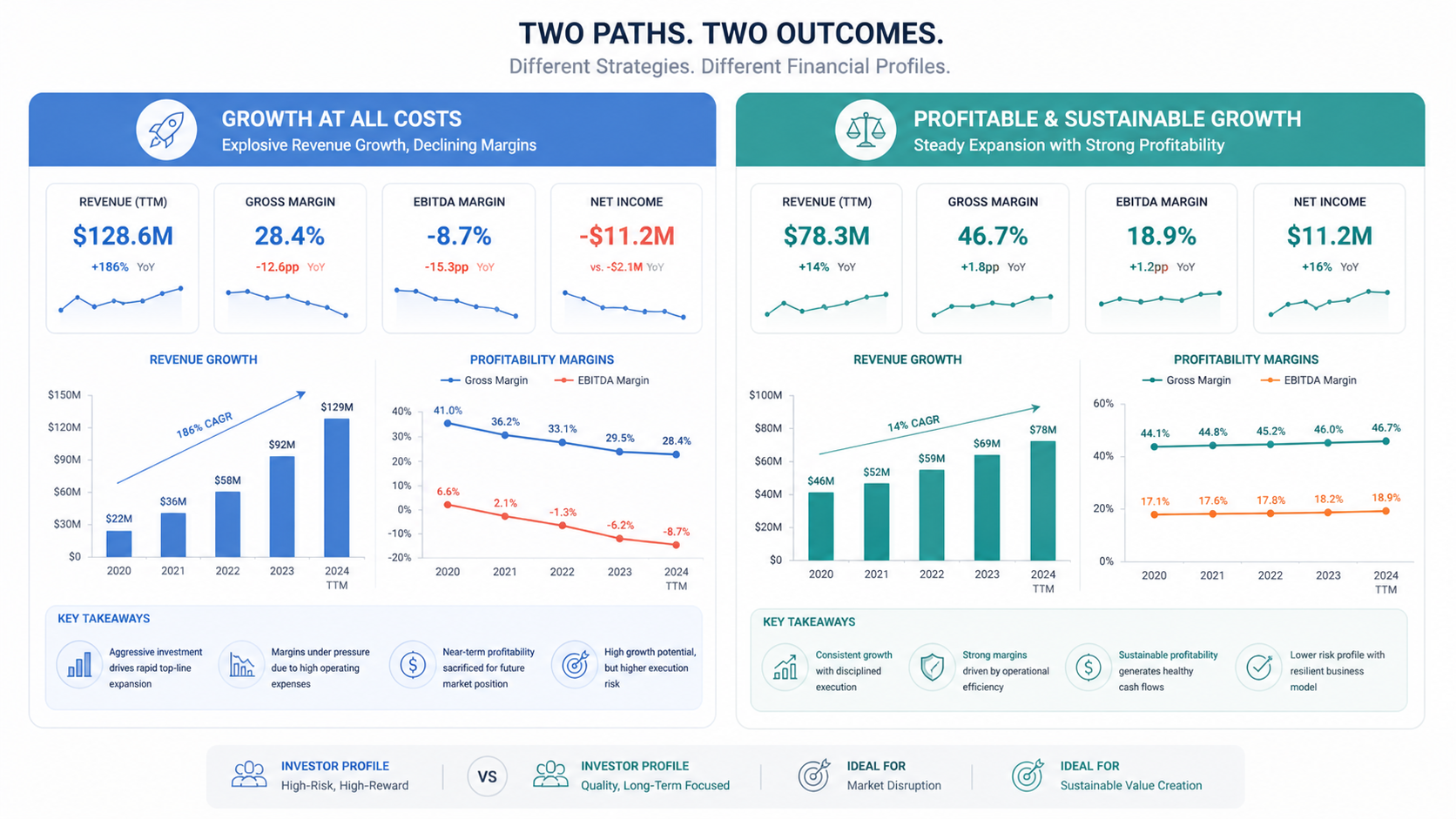
Buyers—PE firms, strategics, family offices—view growth and profitability through risk-adjusted return lenses. They model DCF or multiples on normalized EBITDA. Explosive growth boosts top-line projections but demands profitability to justify. Thin margins signal operational risks, compressing multiples from 8x to 4x overnight.
Capital structure is a red flag. High debt for growth amplifies returns in bull markets but craters value in downturns. Financial performance metrics like ROIC reveal efficiency. Strong performers fetch premiums; growth mirages get heavily discounted.
Firm size moderates buyer tolerance. Small firms (<$5M EBITDA) must show profitability first—growth second—to prove viability. Mid-market ($5-50M) buyers tolerate moderate growth if margins exceed 15%. Enterprises prioritize synergistic growth over pure profits.
Private equity favors ‘growth at a reasonable price’ (GARP): 20%+ CAGR with improving margins. Strategics seek profitable scale to integrate. Both demand evidence— trailing 3-year trends, sensitivity analyses.
In practice, buyers haircut growth forecasts by 30-50% unless profitability backs them. Sustainable models win. Sellers aligning to this view close faster, at better valuations.
Common seller mistakes
Sellers trip over growth obsession first. Pouring cash into unproven expansion erodes margins, alarming buyers. One founder scaled revenue 3x but slashed EBITDA 40%—deal valued 60% below peers. Lesson: growth without profits isn’t growth; it’s dilution.
Another pitfall: ignoring capital structure. Bootstrapped sellers resist debt, missing leverage benefits. Over-levered ones face covenant breaches, scaring buyers. Balance sheet health is non-negotiable.
Neglecting normalization kills trust. Aggressive growth accounting—capitalizing expenses, deferring maintenance—inflates figures temporarily but unravels in diligence. Buyers adjust downward, eroding credibility.
Size blindness: small firms mimicking large-growth plays fail. Profitability builds the base; growth scales it. Many skip profitability audits, assuming revenue dazzles.
For more on these, see our guides on key factors affecting business valuation and EBITDA in M&A.
Practical checklist or framework for business owners
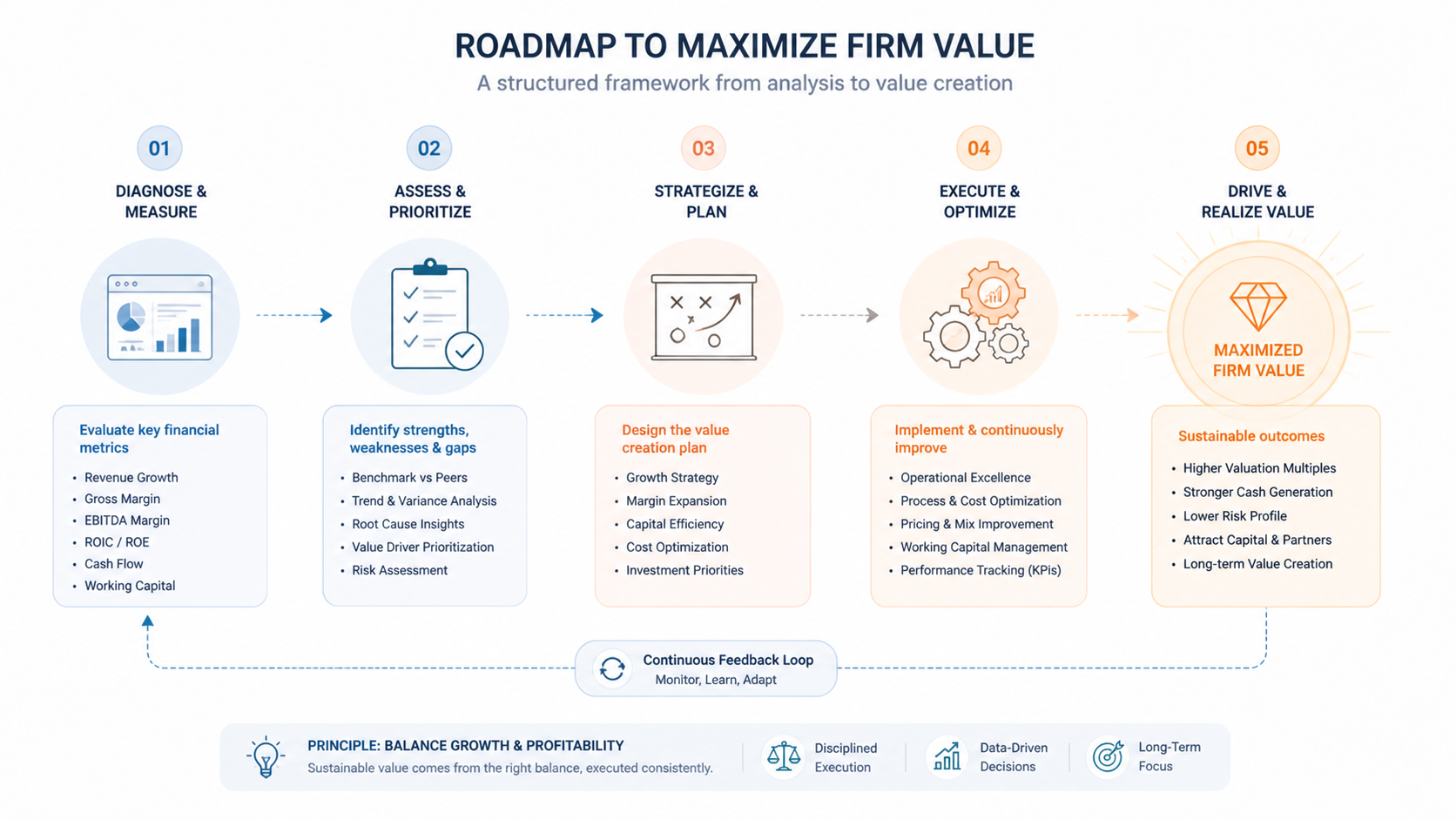
Assess your position with this step-by-step framework:
- Diagnose current state: Calculate 3-year CAGR for revenue/profits. Compute EBITDA margins. Review debt-to-equity ratio.
- Benchmark peers: Compare multiples via industry data. Aim for top-quartile profitability within growth peers.
- Optimize capital structure: Refinance high-cost debt. Build cash reserves for 6-12 months runway.
- Boost profitability levers: Cut non-core costs. Price optimize. Streamline operations without stunting growth.
- Prove scalable growth: Document customer metrics, pipeline. Run scenarios: base, optimistic, conservative.
- Financial cleanup: Normalize earnings. Eliminate one-offs. Prepare audited projections.
- Test sensitivity: Model 10-20% growth drops—ensure profitability holds.
- Build narrative: Craft story linking growth to profits. Back with data room ready.
Implement quarterly. Track KPIs: margin expansion, ROIC improvement. This framework turns weaknesses into strengths.
When should sellers start preparing
Start 18-24 months pre-market. Early allows organic fixes—margin tweaks, debt restructuring—without desperation. At 12 months, intensify: full financial audits, projection modeling.
If growth-heavy, allocate 6 months to profitability sprints. Size matters: small firms need longer ramps. Monitor macro: rising rates favor profits over growth bets.
Triggers: personal milestones, market windows. Delay, and rushed fixes raise suspicions. Early prep yields 15-30% valuation uplift.
How this connects to the overall business sale journey
Growth-profitability balance threads the entire M&A process. Pre-marketing, it shapes teasers highlighting normalized EBITDA. Valuation phase: multiples reflect it directly—check our valuation multiples guide.
Diligence exposes gaps; prepared sellers sail through. Post-LOI, earn-outs tie to growth-profit milestones. It underpins successful exits.
Integrate with readiness: data rooms, advisor teams. For terms, see our M&A glossary. Explore more at our M&A blog.
Assess your growth-profit balance today. Download our seller readiness checklist.
Ready to start your exit? Begin the journey for business sellers.
Need personalized advice? Book a confidential call with an M&A advisor.