Key Factors Affecting Business Valuation for Sellers

The true drivers of your business’s market value
As a business owner contemplating a sale, you’ve likely spent years building your company, pouring in sweat equity, strategic decisions, and countless late nights. But when it comes time to cash out, the valuation often feels like a black box. Why does one similar business fetch a premium while another struggles to hit expectations? The answer lies in a complex interplay of factors that buyers scrutinize under a microscope.
Understanding these elements isn’t just academic—it’s your leverage in negotiations. A PwC outlook signals a promising 2026 for global M&A activity, yet mid-year 2025 trends remind us that deal volumes hinge on macroeconomic stability and sector momentum. In Asia-Pacific, private equity reports highlight robust growth opportunities, but execution risks abound. Meanwhile, sectors like fragrances see M&A heating up in a $100B market, underscoring how industry dynamics swing valuations wildly.
For sellers, ignoring these can lead to painful discounts. ESG performance, for instance, increasingly drives corporate outcomes, with sustainability disclosures boosting firm value even in challenged industries like airlines post-Covid. Intangible assets, often overlooked, demand careful recognition in purchase price allocations during deals. And in emerging markets, factors like IT adoption and environmental reporting tie directly to performance resilience.
This guide breaks it down practically, empowering you to position your business for maximum value. Let’s demystify what buyers really care about.
Table of Contents
- Why business owners need to understand factors affecting business valuation before selling
- Factors affecting business valuation from a seller’s perspective
- How investors view these factors
- Common seller mistakes
- Practical checklist for business owners
- When should sellers start preparing
- How this connects to the overall business sale journey

Why business owners need to understand factors affecting business valuation before selling
Selling a business is a once-in-a-lifetime event for most owners. Yet, many approach it with optimism untempered by reality. Valuation isn’t a static number from a formula—it’s a negotiation shaped by buyer perceptions of risk and reward. Grasping the key factors equips you to mitigate downsides and amplify upsides.
Consider global M&A trends: A 2026 outlook points to renewed vigor, driven by stabilizing interest rates and strategic consolidations. But sellers who don’t align their business with these tailwinds risk being sidelined. In private equity-heavy regions like Asia-Pacific, reports forecast strong deal flow, yet only prepared companies command premiums.
Without this insight, you might undervalue growth levers like ESG integration, which demonstrably enhances corporate performance. Or fail to spotlight intangibles—brands, customer relationships, proprietary tech—that form the bulk of modern valuations. Telecom operators rethinking models amid digital shifts exemplify how adaptability influences buyer appetite.
Knowledge here prevents erosion: A 10-20% valuation gap from overlooked issues is common. It also sharpens your timing—entering the market when sector trends favor sellers, like the burgeoning net lease opportunities in Europe. Ultimately, this understanding turns a potential fire sale into a strategic exit.
Factors affecting business valuation from a seller’s perspective
From where you sit, valuation boils down to tangible and intangible elements that buyers probe relentlessly. Let’s dissect the core ones.
Financial Health and Predictability
Buyers obsess over normalized, recurring revenue. Consistent EBITDA growth trumps sporadic spikes. Prepare clean financials—read our guide on preparing financial statements before selling. Volatility from one-off events drags multiples down.
Market and Industry Trends
Positioning in high-growth sectors elevates value. Global M&A trends forecast optimism for 2026, with mid-2025 updates showing resilience. In Asia-Pacific private equity, momentum builds around tech-enabled plays. Fragrance markets at $100B lure consolidators, while Nike’s commitment to China sports growth despite headwinds highlights market resilience as a plus.
Operational Scalability
Can the business thrive without you? Owner dependency slashes value. Documented processes, diversified management, and tech adoption—like fintech or AI—signal scalability. Studies on SME performance in regions like Ninh Thuan underscore IT and governance as performance drivers.
Intangible Assets
Patents, customer loyalty, brands—these often exceed tangibles in worth. Proper recognition in purchase price allocation is crucial, as EY insights emphasize. Undocumented intangibles vanish in due diligence.
ESG and Sustainability
ESG isn’t buzz—it’s a value driver. Airline firm values post-Covid pivoted on sustainability efforts. Environmental disclosures paired with financial quality and IT boost performance, especially under strong governance. Vietnam’s Sustainability Reporting Awards highlight regional focus.
Risk Profile
Customer concentration, regulatory exposure, cyber risks—all deduct from value. Telecom reinvention efforts show how business model evolution counters disruption risks.
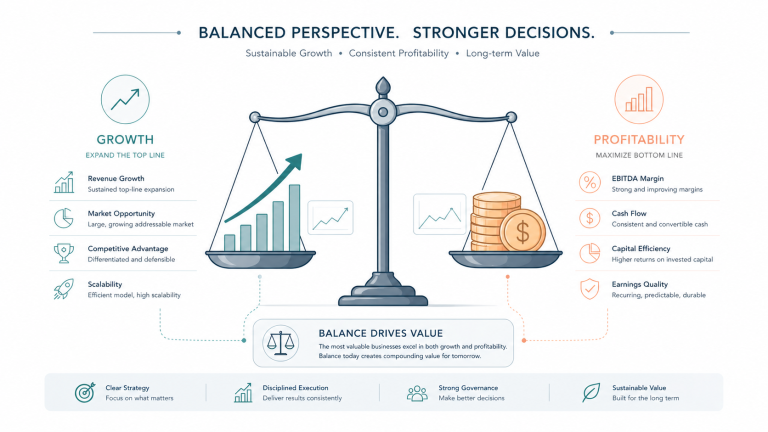
Balancing these elevates your multiple from 4x to 8x or more, depending on sector.

How investors view these factors
Buyers—PE firms, strategics, family offices—filter thousands of opportunities. Their lens is ruthless: future cash flows discounted for risks.
PE investors in Asia-Pacific prioritize AI-driven value creation for sustainability. PwC notes M&A upticks tied to macro recovery. Strategics eye synergies, like net lease unlocks in Europe for stable yields.
They model scenarios: Base case assumes trend continuity; stress tests probe downside. ESG scores now factor into multiples—strong performers command 10-15% premiums. Intangibles get valued via income or market approaches, but only if defensible.
Fintech adoption studies reveal perceived value versus risk as adoption predictors—investors bet on low-risk, high-value profiles. Corporate governance ensuring sustainability ties disclosures to outperformance.
In short, they buy conviction: Does this scale profitably with minimal intervention?
Common seller mistakes
Sellers sabotage value unwittingly. Here’s how to sidestep.
- Ignoring Normalization: Leaving personal expenses in financials inflates risk perceptions. Normalize early.
- Neglecting Intangibles: Failing to inventory and appraise non-physical assets leads to under-recognition.
- Timing Mismatch: Selling into downturns, oblivious to M&A outlooks like PwC’s 2025/2026 signals.
- ESG Blind Spots: Overlooking disclosures in sustainability-focused markets erodes premiums.
- Poor Data Rooms: Incomplete docs trigger doubts. See our common mistakes first-time sellers make.
Avoid these via proactive audits—check our M&A glossary for terms like PPA.
Practical checklist for business owners
Systematize preparation with this framework.
- Financial Audit (Months 1-3): Normalize P&L, project 3-5 years conservatively.
- Asset Inventory (Month 2): List intangibles with valuations.
- ESG Assessment (Month 3): Benchmark disclosures against peers.
- Operational Review (Months 4-6): Eliminate dependencies, automate processes.
- Market Scan (Ongoing): Track trends like Asia PE or global M&A outlooks.
- Risk Mitigation (Month 6): Diversify customers, compliance check.
- Valuation Benchmark (Month 9): Run DCF, comparables.
Download our seller readiness checklist for details. Tailor to your scale—SMEs focus on governance per performance studies.
When should sellers start preparing
Now. Ideally 12-24 months pre-market. Our 12-month preparation checklist outlines phases. Early movers align with uptrends, like 2026 M&A positivity.
Triggers: Approaching retirement, market peaks, personal shifts. Delaying amplifies mistakes.
How this connects to the overall business sale journey
Valuation factors thread the entire M&A process—from teaser to close. Strong fundamentals attract better buyers, per how M&A works in real life.
Prep feeds teasers, due diligence validates, negotiations leverage insights. Post-close, they ensure smooth transitions. Explore more at our M&A blog or Vietnam M&A Market.
Ready to unlock your business’s full potential? Download our seller checklist.
Take the first step toward your exit. Start your M&A journey.