Operational Due Diligence Explained: Essential Guide for Sellers

Operational due diligence: The hidden key to maximizing your business sale value
In the high-stakes world of mergers and acquisitions, operational due diligence often flies under the radar for many business owners. While financial audits and legal reviews grab the headlines, it’s the deep dive into your company’s day-to-day operations that can make or break a deal. Imagine pouring years into building your business, only to see buyers slash their offers—or walk away entirely—after uncovering inefficiencies in your supply chain, outdated processes, or scalability issues. This isn’t hypothetical; it’s a reality for countless sellers who overlook this critical phase.
Operational due diligence examines how your business truly runs: from production workflows and IT systems to employee capabilities and customer fulfillment. Buyers aren’t just buying assets; they’re acquiring a living machine that must integrate seamlessly into their operations. For sellers, preparation here isn’t optional—it’s essential to demonstrate reliability, uncover hidden value, and mitigate risks that could erode your valuation by 20-30% or more.
As an M&A advisor with years navigating cross-border deals, I’ve seen firsthand how proactive sellers turn potential red flags into green lights. This guide breaks it down practically, empowering you to approach your exit with confidence. Whether you’re in manufacturing, services, or tech, understanding operational due diligence positions you to command premium terms.
Table of Contents
- Why business owners need to understand operational due diligence before selling
- Operational due diligence from a seller’s perspective
- How investors view this issue
- Common seller mistakes
- Practical checklist or framework for business owners
- When should sellers start preparing
- How this connects to the overall business sale journey
Why business owners need to understand operational due diligence before selling
Business owners often focus on top-line growth and EBITDA multiples when eyeing a sale, but operational due diligence reveals the operational backbone that supports those numbers. Without a solid grasp, sellers risk surprises that derail negotiations. Buyers conduct this review to validate if your reported performance is sustainable and scalable post-acquisition.
Consider the ripple effects: Inefficient operations can signal higher integration costs, leading to post-deal value destruction. Proactive understanding allows you to quantify efficiencies upfront, like streamlined supply chains that boost margins by double digits. It also highlights value-creation levers, such as capacity management strategies that optimize resource use without added capital.
For international sellers, especially in dynamic markets, this diligence uncovers geopolitical or regulatory operational risks that could impact continuity. Ignoring it leaves you vulnerable to aggressive price chips. By mastering the basics, you shift from reactive seller to strategic partner, fostering trust and accelerating deal timelines.
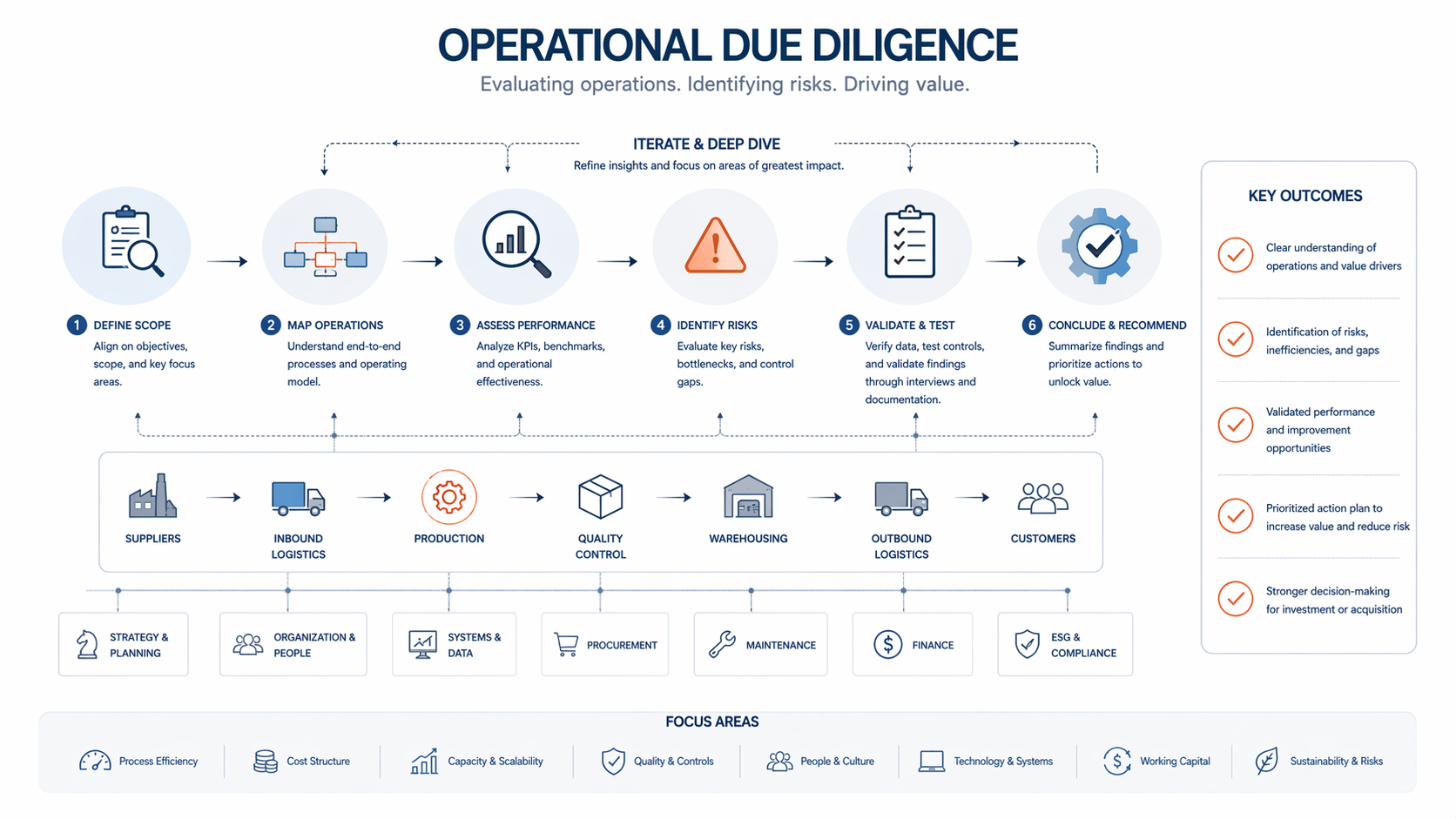
Operational due diligence from a seller’s perspective
Key areas include process documentation, where clear SOPs demonstrate repeatability. Employee skill matrices reveal dependency risks, while customer retention metrics prove operational stickiness. In evolving deal landscapes, redefining this diligence means emphasizing agility—think digital tools for real-time tracking.
Sellers should view it as a health check. Strong operations not only justify valuations but reveal upsides, like AI-driven optimizations transforming value creation. Prepare narratives around these: How your hospital-like capacity strategies ensure peak performance during peaks. This perspective turns scrutiny into a valuation booster.
How investors view this issue
Investors approach operational due diligence with a synergy lens: Can your operations enhance theirs? Private equity firms, per Asia-Pacific trends, prioritize scalable models with minimal friction. They ask pointed questions before signing: Is vendor concentration a risk? How resilient are you to strikes or supply shocks, as seen in global mining cases?
Culture plays a pivotal role too—mismatched operational ethos can erode synergies. Buyers model post-deal scenarios, factoring in integration costs that could wipe out projected returns. In banking sectors with rapid evolution, they seek tech-enabled ops for competitive edges. Geopolitical blind spots in cross-border deals amplify scrutiny, potentially destroying valuations overnight.
Ultimately, investors seek assurance of sustained performance. Robust ops signal lower execution risk, commanding higher multiples.
Common seller mistakes
Sellers frequently stumble by treating ops as an afterthought. One pitfall: Undocumented processes, forcing buyers to assume high remediation costs. Another: Overlooking IT legacy systems that hinder scalability.
Neglecting supply chain mapping exposes hidden dependencies, inviting deep discounts. Failing to address employee turnover metrics raises talent flight fears. In cross-border contexts, ignoring local compliance—like Vietnam business law nuances—triggers halts.
Cultural misalignment, often downplayed, unlocks or unlocks performance. Rushing without capacity audits, as in healthcare ops, misses value. And skipping AI potential in value creation leaves low-hanging fruit untapped. These errors compound, turning strong financials into suspect propositions.
Practical checklist or framework for business owners
Here’s a actionable framework to prepare. Start with a self-audit, then layer in documentation.
- Map core processes: Document workflows from procurement to delivery. Identify bottlenecks using value-stream mapping.
- Assess supply chain resilience: List top vendors, diversification levels, and contingency plans. Quantify disruption impacts.
- Evaluate IT and tech stack: Inventory systems, cybersecurity, and scalability. Test integrations with common platforms.
- Review capacity and scalability: Model peak loads, like hospital strategies for surge management. Project growth without proportional costs.
- Analyze workforce: Skill matrices, turnover rates, key-person risks. Succession plans for leaders.
- Culture and change readiness: Surveys on adaptability. Alignment with buyer archetypes.
- Customer operations: Fulfillment SLAs, retention drivers, churn analysis.
- Compliance and risks: Operational adherence to laws, geopolitical scans.
- Value levers: AI opportunities, efficiency metrics. Benchmark against peers.
- Mock diligence: Simulate buyer Q&A. Prepare data rooms with visuals.
This checklist, refined from real deals, positions you ahead. For deeper prep, explore our 12-month preparation checklist.
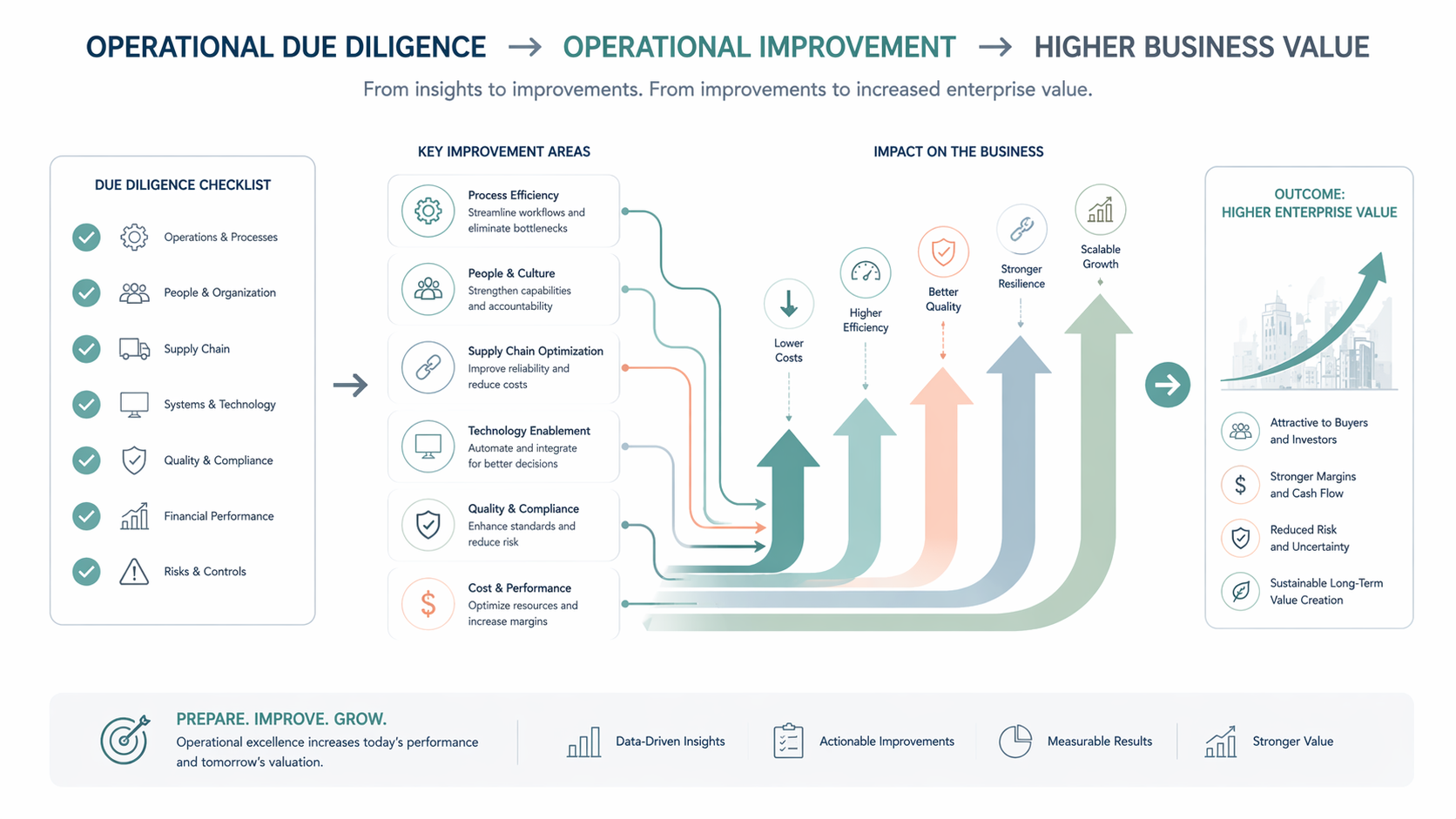
When should sellers start preparing
If deal timelines compress, prioritize high-impact areas like processes and capacity. Download our seller readiness checklist to timeline it. In fast-evolving sectors like banking, ongoing ops tuning keeps you sale-ready anytime.
How this connects to the overall business sale journey
Operational due diligence slots mid-process, post-IOI but pre-definitive agreements. It informs valuation bridges and reps/warranties. Links to financial DD via normalized EBITDA, legal via compliance ops.
Integrates with full journey: Prep phase builds the foundation, as in how M&A works in real life. Post-close, strong ops ease transitions. Visit our M&A blog for more on M&A glossary terms.
Ready to strengthen your operations for sale? Download our seller checklist.
Start your M&A journey today. Get an initial assessment or book a confidential call with our advisors.