What Is a Teaser in M&A and How Should Sellers Write One?

The first document buyers see can quietly shape the entire deal
For many business owners, the first serious step in selling a company is not a valuation model, a management presentation, or a data room. It is a short, anonymous document known as a teaser. Although it may look simple, a teaser in M&A has an important job: it gives potential buyers enough information to become interested, without revealing the identity of the company too early.
This balance is harder than it sounds. If the teaser says too little, serious investors may ignore the opportunity. If it says too much, the seller may expose sensitive information to competitors, employees, suppliers, or customers before there is any real commitment from a buyer. In a sale process, confidentiality is not a formality; it protects valuation, negotiating leverage, and business stability.
A well-written teaser helps business owners attract the right type of buyer, create controlled competitive tension, and start conversations from a position of strength. A weak teaser can do the opposite: invite the wrong buyers, create confusion, or make the business look less attractive than it really is.
Understanding how a teaser works is therefore not just a technical M&A detail. It is part of preparing the market to see your company in the right way.
Table of Contents
- Why business owners need to understand a teaser in M&A before selling
- A teaser in M&A from a seller’s perspective
- How investors view this issue
- Common seller mistakes
- Practical checklist or framework for business owners
- When should sellers start preparing?
- How this connects to the overall business sale journey
Why Business Owners Need to Understand a Teaser in M&A Before Selling
A teaser in M&A is a short, confidential marketing document used at the beginning of a sale process. It is usually sent to selected potential buyers before the buyer signs a non-disclosure agreement. Because the buyer has not yet accepted formal confidentiality obligations, the teaser is normally anonymous. It should describe the opportunity without naming the company or disclosing information that would allow the company to be easily identified.
For a seller, this document matters because it forms the buyer’s first impression. In M&A, first impressions are commercial, not cosmetic. A buyer quickly forms a view on whether the company is large enough, profitable enough, strategic enough, scalable enough, or differentiated enough to justify further time. If the opportunity is unclear, the buyer may pass before asking questions.
At the same time, the teaser is not supposed to tell the full story. It is not a business plan, an information memorandum, or a due diligence pack. Its purpose is to open the door to qualified conversations. It should make the buyer think, This may be relevant to us; we should sign the NDA and learn more.
Owners need to understand the teaser because it sits at the intersection of three practical objectives:
- Creating interest: The document must communicate why the business is worth a buyer’s attention.
- Protecting confidentiality: The document must avoid exposing identity, customers, pricing, employees, suppliers, or trade-sensitive information.
- Filtering buyers: The document should help separate credible buyers from casual, underqualified, or purely curious parties.
This is especially important when a company operates in a concentrated market, serves a small number of recognizable customers, owns sensitive technology, or has competitors who might be tempted to use the process as a way to gather intelligence. In those situations, a teaser that is too specific can create avoidable risk.
Business owners sometimes underestimate the teaser because it is short. But in a controlled sale process, short documents often carry high strategic weight. A teaser is like the opening move in a negotiation: it does not decide the whole outcome, but it can strongly influence the path that follows.
If you are preparing to sell and want a broader view of what should be ready before approaching buyers, it may help to review a seller readiness checklist before drafting the teaser.
A Teaser in M&A from a Seller’s Perspective
From a seller’s perspective, a teaser is not merely a summary of the business. It is a positioning document. It translates the owner’s company into the language buyers use when screening opportunities.
Most owners describe their business through years of effort, relationships, operational details, and personal history. Buyers, however, initially evaluate opportunities through a different lens. They ask: What sector is this? How large is the business? How profitable is it? What makes it defensible? Why is it for sale? What growth remains? What risks might appear later?
A strong teaser bridges that gap. It respects the reality of the business while presenting it in a concise investment format.
Typically, a teaser includes several core elements:
- Anonymous company overview: A short description of the business, sector, customer type, and market position without revealing identity.
- Key financial highlights: Revenue, EBITDA, growth rates, gross margin, or other metrics, usually shown at a high level and often rounded.
- Investment highlights: The reasons a buyer should care, such as recurring revenue, strong customer retention, proprietary capabilities, market growth, or expansion potential.
- Growth opportunities: Practical areas where a new owner could create additional value, such as geographic expansion, new channels, cross-selling, professionalization, or capital investment.
- Transaction perimeter: A broad indication of what is being considered, such as majority sale, full sale, strategic partnership, or capital raise, if appropriate.
- Next step: A simple process instruction, usually that interested parties may sign an NDA to receive further information.
The seller’s challenge is to decide what to include and what to withhold. For example, saying that the company is a “leading B2B industrial services provider in Southeast Asia” may be acceptable. Saying that it is “the only certified maintenance provider for a named global manufacturer in a specific province” may allow the buyer to identify the company immediately. The right level of detail depends on the market, the company’s visibility, and the buyer universe.
A teaser should also be honest. It should not exaggerate growth, hide obvious concentration issues, or present temporary performance as if it were recurring. Over-polishing the story may create short-term buyer interest, but it can damage credibility later when the buyer reviews the information memorandum, management presentation, and due diligence materials.
In M&A, credibility compounds. A disciplined teaser sets expectations that later documents can support. An inflated teaser creates a gap between marketing and reality, and that gap often becomes a negotiation problem.
For business owners, the right mindset is simple: the teaser should make the company look attractive because the business is genuinely attractive, not because the document is clever.
How Investors View This Issue
Investors read teasers quickly. A corporate development team, private equity fund, family office, or strategic buyer may review many opportunities in a single month. They are not reading the teaser as a company brochure. They are screening for fit.
In the first pass, buyers usually look for several signals. The first is size. A business may be excellent but too small or too large for a particular buyer’s mandate. The second is sector relevance. Strategic buyers want to know whether the company fits their existing business, customer base, geography, or product roadmap. Financial investors want to know whether the company fits their investment criteria, holding period, return profile, and operational capability.
The third signal is quality of earnings. Even before formal due diligence, buyers look for hints about revenue consistency, margin stability, working capital intensity, and cash generation. A teaser that shows revenue growth but avoids profitability altogether may raise questions. A teaser that presents EBITDA without context may also feel incomplete if the industry is known for volatile margins.
The fourth signal is defensibility. Buyers want to know why the company can continue performing after a transaction. Is the business dependent on the founder? Are customer relationships institutional or personal? Is the company protected by process know-how, licenses, contracts, brand, distribution, technology, or scale? A teaser does not need to answer everything, but it should point toward a credible value story.
The fifth signal is transaction seriousness. Buyers can sense when a seller is only testing the market without preparation. Vague language, inconsistent numbers, weak formatting, and unclear next steps suggest that the process may be inefficient. Serious buyers prefer serious sellers, because disciplined processes reduce wasted time.
This does not mean the teaser should be complex. In fact, many effective teasers are only two pages. The key is clarity. A buyer should be able to understand the opportunity, the broad financial profile, and the reason to engage within a few minutes.
Investors also pay attention to what the teaser does not say. If the document avoids mentioning customer concentration in an industry where concentration is common, the buyer may assume there is an issue. If growth is described in ambitious language but no historical numbers are shown, the buyer may question whether the growth has already happened or is only projected. If management depth is emphasized but the founder appears central to every customer relationship later in the process, trust may weaken.
A teaser therefore works best when it is selective but not evasive. It should invite the buyer into a deeper conversation, not set up a surprise.

Common Seller Mistakes
Many teaser problems come from understandable instincts. Owners naturally want to present the company in the best possible light. They also want to protect confidentiality. The difficulty is that either instinct can go too far.
1. Revealing the Company Too Early
The most serious mistake is including details that identify the company before an NDA is signed. This can happen through named customers, exact locations, unique product descriptions, recognizable awards, photos, employee numbers in a niche market, or overly specific financial details. Even if the company name is not written, a competitor may be able to infer the identity.
Confidentiality leaks can create real damage. Employees may become anxious. Customers may ask whether service continuity is at risk. Suppliers may change credit terms. Competitors may use the rumor to unsettle relationships. For this reason, the teaser must be drafted with a practical question in mind: Could someone in the industry identify us from this information?
2. Writing Like a Sales Brochure
Some teasers are full of adjectives but light on substance. Phrases such as “highly unique,” “best-in-class,” “world-class,” or “unlimited potential” rarely help unless supported by facts. Sophisticated buyers discount promotional language quickly.
A better approach is to use specific but safe evidence. Instead of saying “exceptional customer loyalty,” the teaser might refer to “longstanding relationships with blue-chip customers” if that is accurate and non-identifying. Instead of “explosive growth potential,” it might say “clear expansion opportunities through additional distribution channels and underpenetrated regional markets.”
3. Providing Too Much Financial Detail
A teaser should show enough financial information to help buyers assess fit, but not so much that it becomes a mini due diligence package. Exact monthly revenue, customer-level profitability, detailed cost structure, or sensitive pricing information should normally be withheld until later stages.
At the teaser stage, high-level annual figures or rounded ranges are often sufficient. The goal is to show scale and direction, not expose the company’s commercial engine before the buyer has committed to confidentiality.
4. Hiding Obvious Issues
Some sellers are tempted to omit anything that might reduce buyer interest. This can be dangerous. If a major issue will inevitably appear later, such as high customer concentration, founder dependency, pending regulatory pressure, or unusual working capital needs, the seller should think carefully about how and when to frame it.
The teaser does not need to disclose every risk. However, the overall positioning must remain consistent with reality. If the entire investment story depends on “diversified revenue” but the largest customer accounts for a significant portion of sales, the process may lose credibility once diligence begins.
For a deeper look at what buyers typically test after the teaser stage, sellers can read what investors look for during due diligence.
5. Failing to Define the Target Buyer
A teaser should be written for the intended buyer universe. A strategic buyer may care most about synergies, customers, technology, capacity, or geographic expansion. A financial investor may focus more on recurring earnings, management depth, cash conversion, and scalability. A family office may care about stability, governance, and long-term ownership fit.
If the teaser tries to appeal to everyone, it may feel generic to everyone. The seller does not need separate documents for every buyer, but the core message should be aligned with the most likely buyer types.
6. Treating the Teaser as an Isolated Document
The teaser is only the first layer of the story. It must connect logically to the confidential information memorandum, management presentation, data room, financial model, and due diligence responses. If each document tells a different story, buyers will notice.
For example, if the teaser emphasizes stable recurring revenue, the data room should support this with customer retention data, contract terms, repeat purchase patterns, or cohort analysis. If the teaser emphasizes operational scalability, the buyer will expect evidence in systems, processes, team structure, and capacity planning.
This is why teaser drafting should not happen at the last minute. It forces the seller to clarify the investment story before going to market.
Practical Checklist or Framework for Business Owners
Before writing a teaser, sellers should step back and answer a few strategic questions. The document should not begin with formatting. It should begin with positioning.
Step 1: Define the Transaction Objective
Are you seeking a full exit, a majority sale, a minority investor, a strategic partner, or a staged transition? The teaser does not always need to disclose every detail, but the advisor and seller must know the objective. The type of transaction influences the buyer universe and the language used.
Step 2: Identify the Buyer Universe
List the categories of buyers most likely to be interested. These may include local competitors, regional consolidators, multinational strategic buyers, private equity funds, search funds, family offices, or industry-adjacent companies. Each group evaluates opportunities differently.
Once the buyer universe is clear, the teaser can be written to answer the questions those buyers are most likely to ask.
Step 3: Protect Identity and Sensitive Information
Review every line from the perspective of an informed competitor. Remove or generalize details that could reveal the company too early. This may include exact location, named customers, exclusive supplier relationships, unusual product names, photos, case studies, niche certifications, or market share claims that are easy to trace.
A useful test is to ask: If this teaser were forwarded to someone in the industry, could they identify the company within five minutes? If the answer is yes, the teaser is too specific.
Step 4: Select the Right Financial Metrics
Choose the financial information that demonstrates scale, profitability, and trend without over-disclosing. Depending on the business, this may include:
- Revenue for the last three years, shown in rounded figures or ranges
- EBITDA or adjusted EBITDA, if reliable and supportable
- Gross margin, if it is a key indicator of business quality
- Revenue growth rate, if growth is a central part of the story
- Recurring revenue or repeat revenue, if relevant and clearly defined
- Customer retention or contract visibility, if safe to disclose anonymously
Avoid using metrics that sound impressive but cannot be defended later. If an adjustment is material, make sure it can be explained in the next stage. Buyers accept legitimate adjustments, but they expect consistency and evidence.
Step 5: Build a Clear Investment Thesis
The teaser should answer one central question: Why is this company worth buying? The answer may come from market growth, customer relationships, proprietary capability, margin profile, operational platform, regulatory licenses, distribution reach, technology, brand, or consolidation potential.
Good investment highlights are specific enough to be meaningful but broad enough to preserve confidentiality. For example:
- Strong position in a growing B2B services niche with repeat demand
- Established customer base across resilient end-markets
- Experienced second-layer management team supporting founder transition
- Opportunity to expand through underdeveloped sales channels
- Operational platform capable of supporting additional volume with limited incremental overhead
These points are not empty claims if the seller can support them later with evidence. That is the standard owners should apply.
Step 6: Keep the Structure Clean
A teaser should be easy to read. Most buyers prefer a concise two-page format with clear headings, selective charts, and controlled detail. Overly dense documents can make the opportunity look unfocused.
A practical structure may include:
- Anonymous headline describing the opportunity
- Short company overview
- Key investment highlights
- High-level financial snapshot
- Market or growth overview
- Transaction rationale or next step
The writing should be professional, direct, and restrained. The goal is not to impress buyers with language. The goal is to help them make a fast, confident decision to continue.
Step 7: Ensure Consistency With Later Materials
Before sending the teaser, compare it against the information memorandum outline, financial model, and expected due diligence evidence. If the teaser makes a claim, the seller should know where that claim will be supported later.
This discipline reduces the risk of credibility gaps. It also makes the entire process smoother because the teaser becomes the first chapter of a coherent sale story, not a standalone advertisement.
Owners who are still mapping the broader sale process may find it useful to review the complete process of selling a business before finalizing the teaser.
When Should Sellers Start Preparing?
Sellers should start thinking about the teaser earlier than most expect. The actual writing may happen shortly before buyer outreach, but the substance of the teaser depends on preparation that often takes months.
If the teaser is going to highlight clean revenue growth, the seller needs reliable financial statements. If it will emphasize recurring revenue, the seller needs a defensible definition of recurring revenue and supporting customer data. If it will present management depth, the business must have a team that can operate beyond the founder. If it will describe expansion potential, there should be a credible growth plan rather than a vague aspiration.
In practice, owners should begin preparing the underlying story at least several months before launching a sale process. For more complex businesses, earlier preparation is better. The reason is simple: buyers do not only buy what the company is today; they buy what they believe can be sustained and grown after closing. The teaser is the first place where that belief is introduced.
Preparation also helps the seller avoid rushed decisions about confidentiality. If the teaser is drafted under time pressure, owners may either disclose too much or remove so much detail that the opportunity becomes bland. A thoughtful process allows the seller to test different levels of disclosure, refine the buyer list, and align the teaser with the overall transaction strategy.
There is also an internal preparation dimension. Before sending any teaser, the seller should consider who inside the company knows about the potential sale, how information will be controlled, and what should happen if a market rumor emerges. In many founder-led companies, confidentiality is not only about the document; it is about process discipline.
A good practical timeline looks like this:
- Six to twelve months before outreach: Clean financial reporting, review customer concentration, strengthen management information, and identify value drivers.
- Three to six months before outreach: Define transaction objectives, buyer universe, key positioning, and likely diligence questions.
- One to three months before outreach: Draft the teaser, prepare the NDA, build the information memorandum, and organize the initial data room.
- Immediately before outreach: Finalize the buyer list, confirm confidentiality protocols, and ensure all claims in the teaser are supportable.
This timeline is not rigid, but it reflects a useful principle: the teaser should be the result of preparation, not a substitute for preparation.
How This Connects to the Overall Business Sale Journey
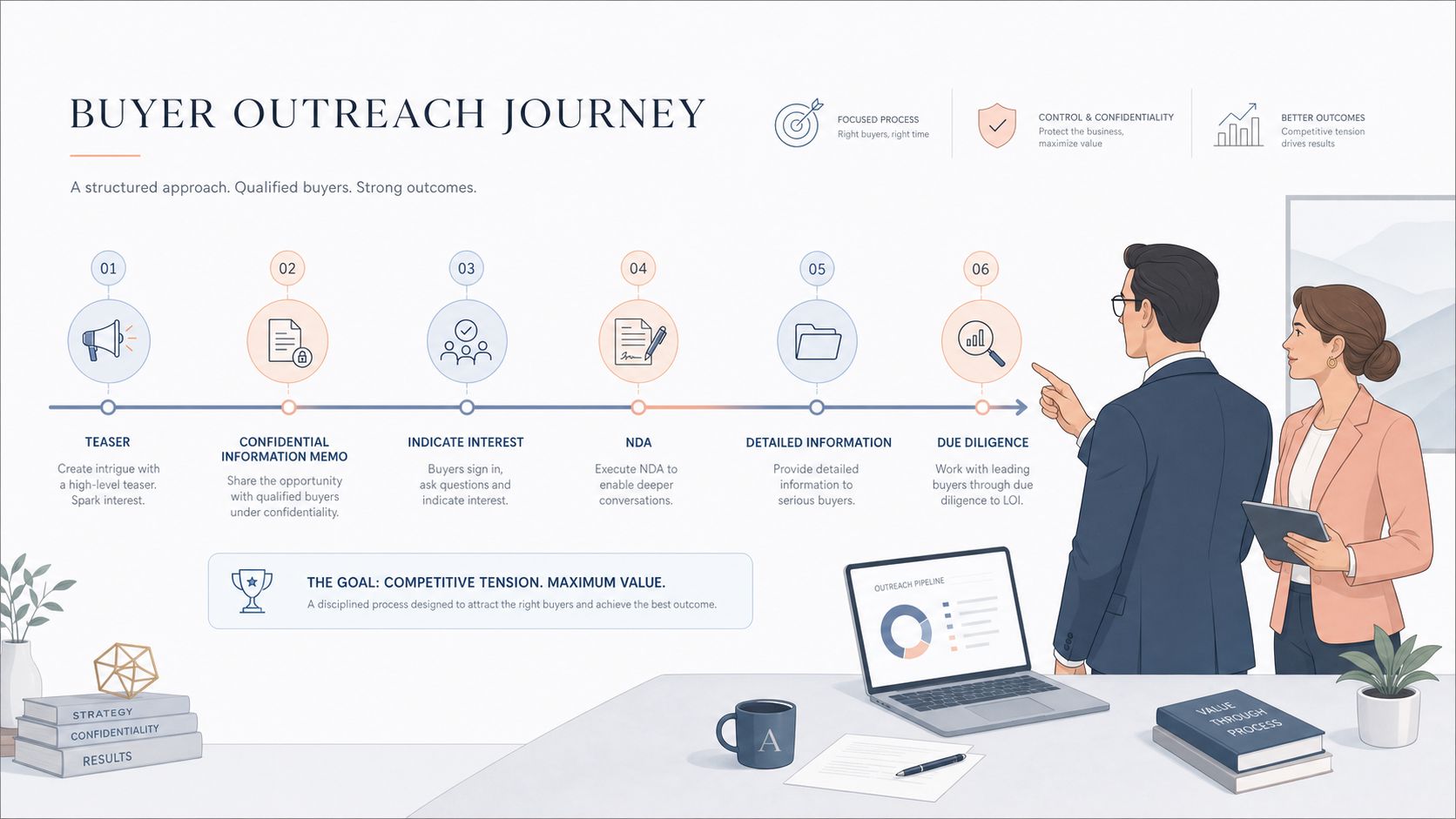
The teaser is only one document, but it plays an important role in the full M&A journey. It sits near the beginning of the process, before the buyer has access to detailed information. If the teaser works, interested buyers sign an NDA and receive more complete materials, such as the confidential information memorandum. From there, the process may move into management meetings, indicative offers, due diligence, final negotiations, and closing.
Because the teaser comes early, it shapes the quality of the buyer pool. A clear and credible teaser can attract buyers who understand the opportunity and are prepared to engage seriously. A vague or poorly targeted teaser may bring in buyers who are curious but not committed, or who are not suitable for the transaction the seller actually wants.
The teaser also influences valuation indirectly. It does not determine price by itself, but it affects buyer interest, competitive tension, and the initial framing of the company’s value. If the teaser communicates the company’s strengths clearly and credibly, more qualified buyers may enter the process. If several serious buyers are engaged, the seller may have better leverage when discussing valuation, structure, and terms.
However, a teaser cannot fix deeper issues. If the company has weak financial controls, unresolved legal problems, unclear ownership, excessive founder dependency, or poor documentation, those issues will surface later. The teaser may open the door, but due diligence decides whether buyers remain confident.
This is why sellers should view the teaser as part of a connected preparation system. The investment story, financial evidence, legal readiness, operational data, and management narrative should all support each other. A buyer should feel that each stage provides more detail, not a different version of the truth.
For owners who are unsure whether their business is ready to be introduced to buyers, it may be sensible to get an initial assessment before launching a formal process.
Final Thoughts for Business Owners
A teaser in M&A is short, but it is not casual. It is the first controlled signal to the market. It tells buyers what kind of opportunity they are being invited to consider, while protecting the seller from premature disclosure.
The best teasers are concise, credible, and strategically selective. They do not reveal the company too early. They do not oversell. They do not bury buyers in detail. Instead, they present the business in a way that helps the right buyers say, Yes, this is worth a closer look.
For sellers, the real question is not simply “How do we write a teaser?” The better question is: What do we want the right buyer to understand first? Once that answer is clear, the teaser becomes much easier to draft and much more effective.
Prepare before buyers ask difficult questions. Download our seller checklist.
Considering a sale and unsure where to begin? Start your M&A journey.