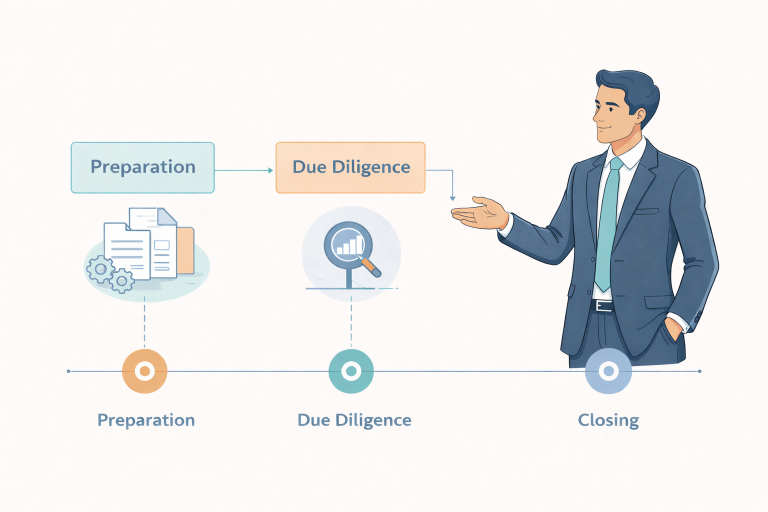
M&A vs Raising Capital: How Business Owners Should Decide

Introduction: Why Many Founders Confuse Selling With Fundraising
When business owners start exploring strategic options for their company, two paths often appear at the same time:
- Sell the company through an M&A transaction
- Raise capital from investors to continue growing
At first glance, these options can look similar.
Both involve investors.
Both bring external capital into the business.
Both require sharing information about the company.
Yet the reality is that M&A and raising capital represent fundamentally different decisions about the future of a business.
One path involves transferring ownership to new operators.
The other involves bringing in partners to help grow the company while the founder continues leading it.
Many founders struggle with questions such as:
- Should I sell the company or continue building it?
- Is raising capital better than exiting now?
- What do investors expect in each scenario?
- Which option creates more long-term value?
Understanding the differences between M&A and capital raising allows business owners to make strategic decisions with greater clarity.
This article explains how both paths work, how investors evaluate them, and how founders can decide which direction best aligns with their goals.
Table of Contents
- Why business owners need to understand M&A vs fundraising before selling
- M&A vs raising capital from a seller’s perspective
- How investors view acquisitions vs investments
- Common founder misunderstandings about selling vs fundraising
- A practical framework to decide between M&A and raising capital
- When should founders evaluate these options?
- How this decision connects to the overall business sale journey
Why Business Owners Need to Understand M&A vs Fundraising Before Selling
Many founders assume the decision between selling and raising capital can be made quickly.
In reality, this choice shapes the long-term future of both the company and the founder.
Selling through M&A typically means:
- Ownership transfers to the buyer
- The founder exits fully or partially
- The company becomes part of a larger strategy
Raising capital, on the other hand, means:
- The founder remains responsible for growth
- Investors expect significant expansion
- The business continues operating independently
Without understanding the differences between these paths, founders may:
- Enter investor discussions with unclear intentions
- Misinterpret acquisition offers
- Raise capital when an exit would be better
- Delay selling until the company’s value declines
Learning how these options differ helps founders approach strategic decisions with a clearer view of risk, responsibility, and opportunity.

M&A vs Raising Capital From a Seller’s Perspective
From the founder’s perspective, the main difference between selling and fundraising comes down to ownership, control, and long-term commitment.
Selling Through M&A
When a founder sells a business through M&A, they are transferring ownership to another party.
The buyer becomes responsible for the company’s future strategy and operations.
For the founder, this usually results in:
- Liquidity (cash from the sale)
- Reduced operational responsibility
- Transition into a new phase of life or career
Depending on the deal structure, the founder may stay involved for a transition period or retain a minority stake.
However, the key change is that the company is no longer solely under the founder’s control.
Raising Capital
Raising capital typically involves selling a minority stake in the business to investors.
Instead of exiting, the founder continues building the company with additional financial resources.
In this scenario:
- The founder remains the primary operator
- Investors expect strong growth
- Governance becomes more structured
Capital raising allows founders to scale the business further but also introduces new responsibilities and expectations.
Investors will expect measurable progress toward larger future outcomes.
The Core Difference
In simple terms:
M&A is an exit strategy.
Fundraising is a growth strategy.
Both can be valuable paths depending on the founder’s goals.

How Investors View Acquisitions vs Investments
Investors approach acquisitions and capital investments with different objectives.
Understanding these motivations helps founders interpret investor behavior during negotiations.
Acquisition Investors
Buyers in an M&A transaction aim to own and operate the business.
Their primary concerns include:
- Operational integration
- Risk reduction
- Predictable cash flow
- Strategic alignment with existing businesses
Acquirers may be:
- Strategic corporate buyers
- Private equity firms
- Industry competitors
These investors evaluate whether the company fits into their long-term strategy.
Growth Investors
Investors who provide capital typically focus on future growth potential.
They are less interested in immediate control and more interested in scaling the business.
These investors may include:
- Venture capital firms
- Growth equity investors
- Strategic minority investors
Their goal is to increase the company’s value significantly before a future exit.
In many cases, that exit may later occur through M&A or an IPO.
Differences in Investor Expectations
Acquisition investors often expect:
- Immediate operational control
- Predictable earnings
- Integration with their existing portfolio
Growth investors expect:
- Rapid expansion
- Scalable business models
- Large future exit opportunities
Because of these differences, the type of investor involved shapes the direction of the company.
Common Founder Misunderstandings About Selling vs Fundraising
Many founders encounter confusion when considering these options.
Mistake 1: Assuming Fundraising Is Always Better Than Selling
Raising capital can create exciting growth opportunities, but it also increases pressure and expectations.
Some founders discover they prefer the stability of an exit rather than years of additional growth targets.
Mistake 2: Waiting Too Long to Sell
If founders focus exclusively on fundraising, they may delay selling until:
- market conditions change
- growth slows
- valuation declines
Timing often plays a major role in successful exits.
Mistake 3: Believing Investors and Buyers Are the Same
Although both provide capital, their incentives differ significantly.
Buyers want to own the business.
Investors want the business to grow dramatically.
Confusing these motivations can lead to misaligned negotiations.
Mistake 4: Underestimating Post-Investment Governance
After raising capital, founders typically operate under stronger governance structures such as:
- investor board seats
- reporting requirements
- strategic oversight
This shift can be challenging for founders used to operating independently.
A Practical Framework to Decide Between M&A and Raising Capital
Business owners can evaluate these options using a simple framework.
Founder Goals
Ask yourself:
- Do I want to continue operating the company for several more years?
- Am I motivated to scale the business significantly?
If the answer is yes, fundraising may be appropriate.
If the answer is no, selling may be more suitable.
Market Opportunity
Consider whether the market still offers major growth potential.
If the company is entering a high-growth phase, raising capital may unlock greater future value.
If growth is stabilizing, a strategic sale may capture value at the right moment.
Personal Priorities
Founders should also consider:
- lifestyle goals
- risk tolerance
- long-term ambitions
Some entrepreneurs thrive on scaling businesses, while others prefer to transition to new ventures.
Capital Requirements
If significant capital is required to reach the next stage of growth, external investment may be necessary.
However, if the business already generates stable profits, an acquisition may provide a more efficient exit.

When Should Founders Evaluate These Options?
Ideally, founders should begin evaluating strategic options two to three years before making a major decision.
Early planning allows time to:
- strengthen financial reporting
- improve operational structure
- explore investor relationships
- understand market demand
By preparing early, founders can choose between selling and fundraising from a position of strength rather than urgency.
How This Decision Connects to the Overall Business Sale Journey
Understanding the difference between M&A and capital raising is an important step in the broader journey of building and exiting a company.
Earlier stages of this journey include:
- developing seller readiness
- understanding valuation drivers
- learning how M&A transactions work
As founders explore strategic options, they may decide whether to:
- raise capital and continue building the company
- pursue a partial sale
- execute a full exit through M&A
Each path represents a different chapter in the life of the business.
Founders who understand these options clearly are better equipped to make decisions that align with both business performance and personal goals.
If you are exploring whether to sell your company or continue growing it:
Download the Seller Readiness Checklist
or explore
These resources help business owners understand every stage of the M&A process and prepare for successful strategic decisions.