Should You Sell 100% or Partial Ownership? A Seller’s Guide

Deciding your exit: full ownership sale or partial stake retention?
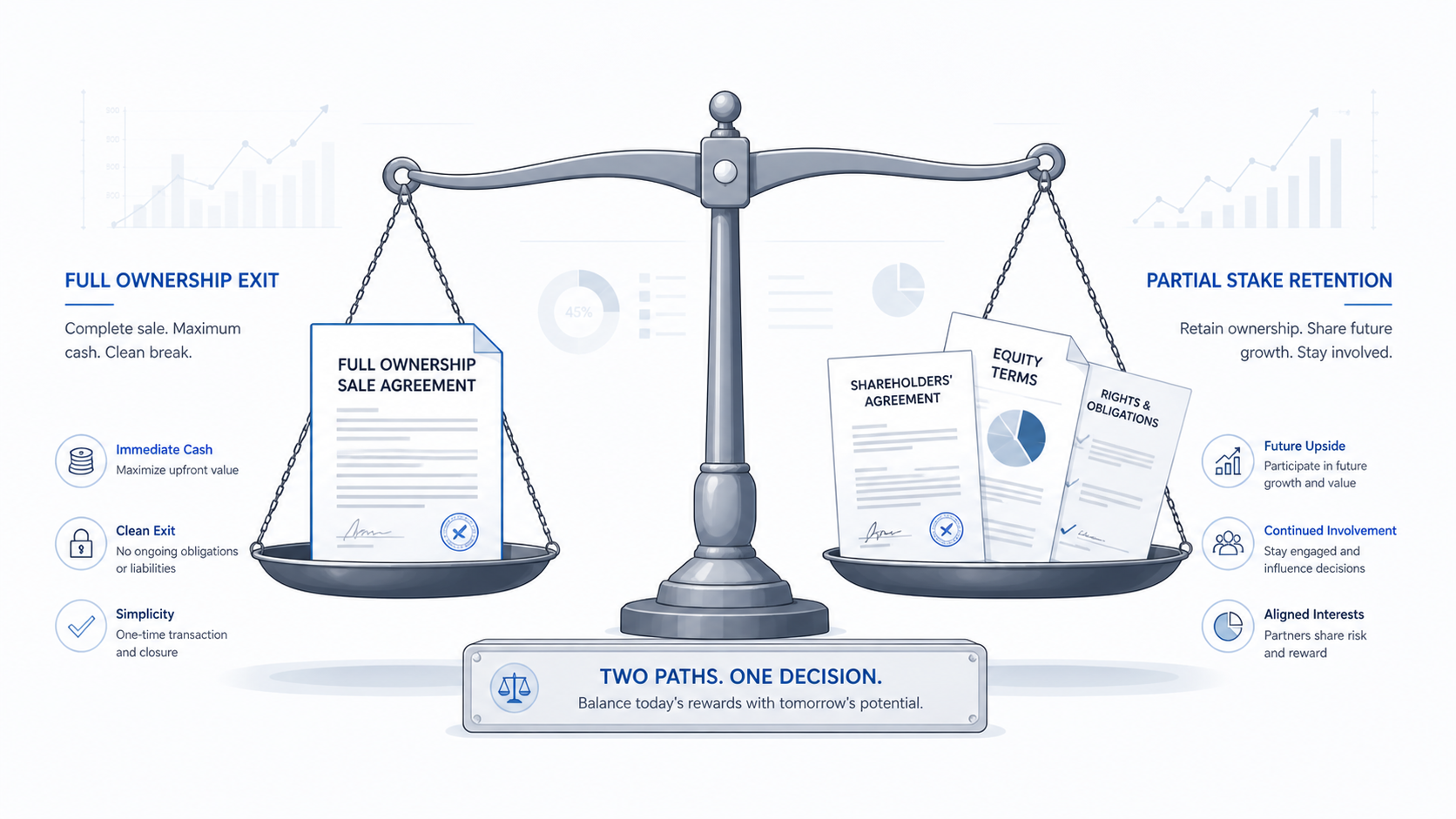
As a business owner contemplating an exit, one of the most pivotal decisions you’ll face is whether to sell 100% of your company or retain a partial ownership stake. This choice isn’t just about the immediate financial payout—it’s about your future involvement, risk exposure, control, and long-term wealth creation. Many sellers rush into a full sale seeking a clean break, only to regret losing influence over a business they built. Others opt for partial sales to stay in the game, but find themselves sidelined by new majority owners.
Consider the trade-offs: a full sale delivers liquidity and freedom, allowing you to diversify investments or pursue new ventures without ongoing obligations. Yet, it severs your equity upside if the company skyrockets post-sale. Partial sales, often through joint ventures or minority stakes, keep you aligned with growth but introduce complexities like diluted decision-making and potential conflicts with buyers. Evidence from entry mode decisions highlights how formal institutional distances—such as regulatory or political differences—influence these choices, as seen in Japanese firms navigating international expansions.
This decision shapes your post-exit life and the business’s trajectory. Getting it wrong can lead to undervaluation, stalled deals, or personal dissatisfaction. In this guide, we’ll break it down practically, drawing on real-world M&A dynamics to help you weigh options objectively.
Table of Contents
- Why business owners need to understand full vs partial sales before selling
- Full vs partial sales from a seller’s perspective
- How investors view this issue
- Common seller mistakes
- Practical checklist for business owners
- When should sellers start preparing
- How this connects to the overall business sale journey
Why business owners need to understand full vs partial sales before selling
Understanding the nuances of selling 100% versus a partial stake is crucial because it directly impacts your financial outcome, tax implications, and personal freedom. Without clarity, sellers often accept suboptimal deals—either leaving money on the table or committing to unwanted ongoing roles.
Full sales typically command higher multiples for control premiums, as buyers pay extra for unrestricted decision rights. Partial sales, however, can unlock value incrementally, allowing staged exits that match market conditions. In volatile economies, retaining a stake hedges against downside while sharing upside.
Moreover, this choice affects deal structuring. Full acquisitions simplify due diligence but demand comprehensive warranties. Partial deals involve shareholder agreements, drag-along rights, and governance clauses that can bind you for years. Early awareness prevents surprises that derail negotiations.
For family-owned or founder-led businesses, emotional factors amplify the stakes. Selling fully might feel like abandoning your legacy, while partial retention preserves influence—but only if terms protect your voice. Data from cross-border entries underscores this: firms adjust modes based on institutional gaps, favoring partial entries in high-distance environments to mitigate risks.
Ultimately, misalignment here leads to 20-30% valuation discounts or deal collapses. Proactive evaluation ensures you enter discussions empowered, maximizing terms that fit your life goals.
Full vs partial sales from a seller’s perspective
From the seller’s viewpoint, a full sale offers immediate liquidity and closure. You cash out entirely, eliminating operational risks and enabling reinvestment elsewhere. This appeals to owners nearing retirement or those burned out from daily management. Post-sale, you’re free to travel, advise others, or start anew without liability overhang.
Yet, full exits cap your reward. If the business grows 5x under new ownership, you miss that windfall. Taxes hit harder too—capital gains on the entire proceeds without installment deferral options common in partial deals.
Partial sales shine for growth-oriented owners. Selling 40-60% injects capital for expansion while keeping skin in the game. You retain board seats, dividends, and exit upside. This structure suits strategic buyers seeking partnerships, not outright control.
Drawbacks include shared governance. Minority stakes risk irrelevance if buyers consolidate power. Liquidity is partial—you can’t fully diversify. Ongoing reporting and disputes drain time.
Realistically, choose based on your timeline and risk tolerance. If exit is 12-24 months away, partial might bridge to a full sale later. For quicker cash, full is straightforward. Always model scenarios: project cash flows under both paths, factoring growth rates and your discount rate.

How investors view this issue
Buyers prioritize control and risk-adjusted returns, viewing full versus partial through alignment lenses. Strategic acquirers often prefer 100% for seamless integration, avoiding holdout sellers blocking synergies. Financial buyers like PE firms favor majority stakes (70-90%) for active management, using earn-outs to bridge gaps.
Partial deals attract when full control is unnecessary or costly. Tech investors take minority stakes in high-growth startups, betting on milestones. In emerging markets, institutional distances prompt cautious partial entries—Japanese evidence shows disaggregated formal distances (regulatory, corruption) sway toward joint ventures over wholesales.
Investors scrutinize seller intent. Full sellers signal confidence in handover; partial ones suggest dependency or skepticism. They demand anti-dilution protections, veto rights, and exit clauses in partials.
Valuation diverges: full sales fetch 10-20% premiums; partials discount for illiquidity (20-40% minority discounts). Buyers model scenarios, stress-testing growth with/without your involvement.
Key takeaway: position your preference as value-adding. Full sellers emphasize clean transitions; partial ones highlight your irreplaceable expertise.
Common seller mistakes
Sellers frequently err by defaulting to full sales without exploring partials, missing hybrid opportunities. Others cling to stakes emotionally, scaring off control-seeking buyers and prolonging sales cycles.
A classic pitfall: undervaluing governance in partials. Without robust shareholder agreements, sellers lose sway post-close. Another: ignoring tax drag—full sales trigger immediate taxes; partials allow deferral via structures like preferred equity.
Many overlook market timing. Partial sales suit bull markets for future full exits; fulls fit downturns when buyers seek bargains. Failing to benchmark—compare multiples from similar deals—leads to anchored expectations.
Neglecting personal fit: post-sale roles in partials breed resentment if undefined. Rushing without advisor input amplifies biases. Check our factors that increase chances of a successful business exit for more on avoiding these traps.
Practical checklist or framework for business owners
Evaluate full vs partial systematically:
- Assess personal goals: Retirement? Growth partner? Rank liquidity, control, involvement on a 1-10 scale.
- Financial modeling: Forecast proceeds under scenarios (base, upside, downside). Calculate after-tax NPV.
- Business readiness: Founder-dependent? Partial risks obsolescence. Scalable ops favor full sales.
- Market scan: Buyer types—strategics want full; VCs partial. Check comps via valuation multiples.
- Legal/tax review: Model structures (JV, preferred stock). Consult pros early.
- Term sheet simulation: Draft mock terms. Test drag-alongs, board seats.
- Stakeholder buy-in: Align family/key employees.
- Exit horizon: Partial for 3-5 years; full for now.
Score options; threshold at 70/100 advances to market.
Ready to prepare? Download our seller checklist.
When should sellers start preparing
Begin 18-24 months pre-sale. Early modeling reveals optimal path, builds data room, and grooms for partial/full appeal. Partial prep involves interim governance; full focuses on transition plans.
If partial, negotiate pilots now. For full, de-risk ops. Read exit strategy planning for timelines.
How this connects to the overall business sale journey
This decision anchors your M&A process. It influences teaser crafting, buyer targeting, and diligence. Full sales streamline to close; partials extend with governance.
Integrates with valuation—control premiums matter. Ties to data room prep via ownership docs. Post-decision, start your M&A journey.
Explore more at our M&A blog or book a confidential call.
Take the first step: Begin the exit process.