Legal Preparation Before Selling a Business: Essential Steps for Sellers

Hidden legal risks that could derail your business sale
As a business owner contemplating a sale, you’ve likely spent years building your company into a valuable asset. But just when you think you’re ready to cash out, legal oversights can turn your exit into a nightmare. Imagine discovering undisclosed liabilities or tangled contracts right as a buyer is about to sign—deals crumble, valuations plummet, and months of effort vanish.
This isn’t rare. Sellers often underestimate how thoroughly buyers dissect legal foundations. A single unresolved dispute or non-compliant structure can scare off investors, trigger renegotiations, or even invite lawsuits post-sale. Proactive legal preparation isn’t optional; it’s the shield that protects your hard-earned equity.
In this guide, we’ll break down the essentials from a seller’s viewpoint, highlight buyer expectations, and arm you with a practical framework. Whether you’re a first-time seller or refining your strategy, mastering these steps ensures smoother negotiations and higher proceeds.
Table of Contents
- Why business owners need to understand legal preparation before selling
- Legal preparation from a seller’s perspective
- How buyers view this issue
- Common seller mistakes
- Practical checklist for business owners
- When should sellers start preparing
- How this connects to the overall business sale journey

Why business owners need to understand legal preparation before selling
Legal preparation forms the bedrock of any successful business sale. Without it, even the most profitable companies face rejection. Buyers prioritize risk mitigation, and legal red flags signal potential future costs that erode value.
Consider the core reasons: first, compliance with local regulations ensures your business operates cleanly, avoiding fines or shutdowns that buyers inherit. Second, clear ownership of assets like intellectual property prevents disputes that could halt operations. Third, resolved contracts and liabilities mean no surprises post-closing.
Neglecting this phase often leads to deal fatigue, where prolonged due diligence exposes issues, causing buyers to walk away. Sellers who invest early in legal housekeeping not only attract more interest but also command premium valuations—sometimes 20-30% higher due to perceived stability.
Understanding these dynamics shifts your mindset from reactive fixes to strategic positioning. It’s about presenting a turnkey operation that buyers can integrate seamlessly, minimizing their legal exposure.
Legal preparation from a seller’s perspective
From where you stand, legal prep might feel like tedious paperwork amid exciting sale prospects. Yet it’s your opportunity to uncover and resolve issues that could otherwise diminish your payout.
Start with a full audit of corporate structure. Verify incorporation documents, shareholder agreements, and governance records are up-to-date. Ensure no dormant entities or mismatched registrations exist, as these confuse buyers.
Next, tackle contracts. Review customer, supplier, and employee agreements for change-of-control clauses that might trigger terminations. Renegotiate or obtain consents where needed. Employment contracts deserve special attention—identify key personnel risks and non-compete enforceability.
Intellectual property demands rigorous inventory: patents, trademarks, copyrights, and trade secrets. Confirm ownership, registration status, and no infringement claims. Data privacy compliance, especially under evolving regulations, is non-negotiable.
Don’t overlook litigation history. Disclose all past, pending, or threatened suits transparently. Settle minor disputes pre-sale to clean the slate.
Tax matters intersect heavily here. Gather records for audits, ensuring no outstanding liabilities. Structures like holding companies require extra scrutiny for transferability.
Finally, real estate and assets: title deeds, leases, and encumbrances must be pristine. This holistic review not only mitigates risks but often reveals untapped value, like underutilized IP.
Sellers who treat this as a business improvement project emerge stronger, ready for due diligence scrutiny.
How buyers view this issue
Buyers approach legal due diligence with forensic precision, viewing it as a litmus test for your business’s integrity. Strategic acquirers, private equity firms, or corporates allocate teams to unearth liabilities that could justify price cuts or walkaways.
They seek warranties and indemnities backed by solid prep. Clean legal docs signal competent management, boosting confidence. Conversely, gaps—like unfiled annual returns or ambiguous IP ownership—raise alarms about hidden costs.
Private equity buyers fixate on scalability risks: do contracts allow seamless integration? Corporates worry about regulatory approvals and antitrust hurdles. Family offices scrutinize governance for ethical continuity.
Quantitative lenses matter too. Buyers model legal risks into valuation, deducting estimated remediation from EBITDA multiples. A well-prepped seller flips this: transparency accelerates closing, sometimes shaving months off timelines.
In essence, buyers see legal prep as insurance against post-acquisition headaches. Deliver it impeccably, and you position your business as low-risk, high-reward.
Common seller mistakes
First-time sellers frequently stumble into legal pitfalls that sabotage deals. One prevalent error is assuming “no news is good news”—failing to proactively audit reveals issues only during buyer diligence, eroding trust.
Another: ignoring employee matters. Overlooking vested options, unfair dismissal risks, or pension shortfalls invites claims. Read our post on common mistakes first-time sellers make for more insights.
Contract oversights abound: evergreen clauses without termination rights or unassigned licenses create integration nightmares. Tax complacency—deferring filings or ignoring transfer taxes—triggers disputes.
IP neglect is rampant; sellers undervalue software code or domain ownership, leading to recharacterization of assets. Litigation under-disclosure backfires via warranties, exposing you to clawbacks.
Rushing without experts: DIY approaches miss nuances like cross-border compliance. Finally, poor documentation—scattered files delay processes, frustrating buyers.
Avoid these by engaging counsel early, fostering a culture of meticulous records.
Practical checklist for business owners
Here’s a step-by-step framework to guide your legal prep. Treat it as a roadmap, ticking off items systematically.
Phase 1: Corporate Housekeeping (Months 1-3)
- Review articles of incorporation, bylaws, and shareholder registers.
- Update annual filings, board minutes, and resolutions.
- Confirm director/officer compliance and D&O insurance.
Phase 2: Contracts and Commercial Agreements (Months 3-6)
- Compile all material contracts; flag assignment issues.
- Secure consents for change-of-control where required.
- Audit licenses, permits, and regulatory approvals.
Phase 3: IP and Intangibles (Months 4-7)
- Inventory all IP; file missing registrations.
- Conduct freedom-to-operate searches.
- Document trade secrets and NDAs.
Phase 4: Employment and HR (Months 5-8)
- Review employment contracts, benefits, and equity plans.
- Assess termination liabilities and non-competes.
- Ensure health/safety and data protection compliance.
Phase 5: Litigation, Tax, and Assets (Months 6-9)
- List all disputes; resolve or provision.
- Audit tax returns for 5-7 years; clear arrears.
- Verify asset titles, leases, and encumbrances.
Phase 6: Data Room and Disclosures (Months 9-12)
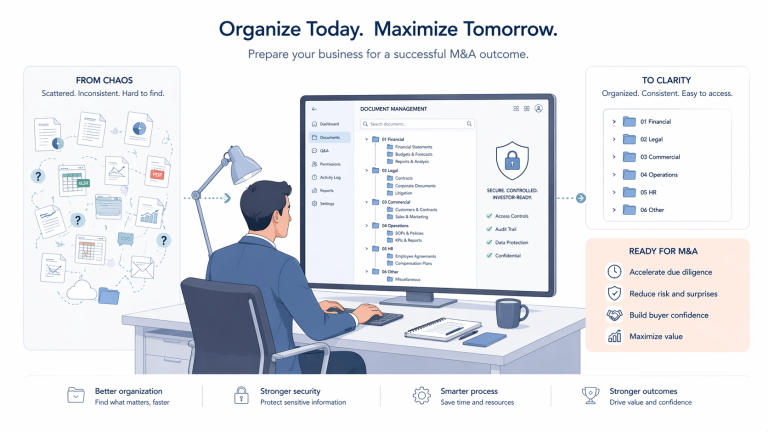
- Organize virtual data room with indexed files.
- Draft disclosure schedules and warranties.
- Obtain legal opinion letters if applicable.
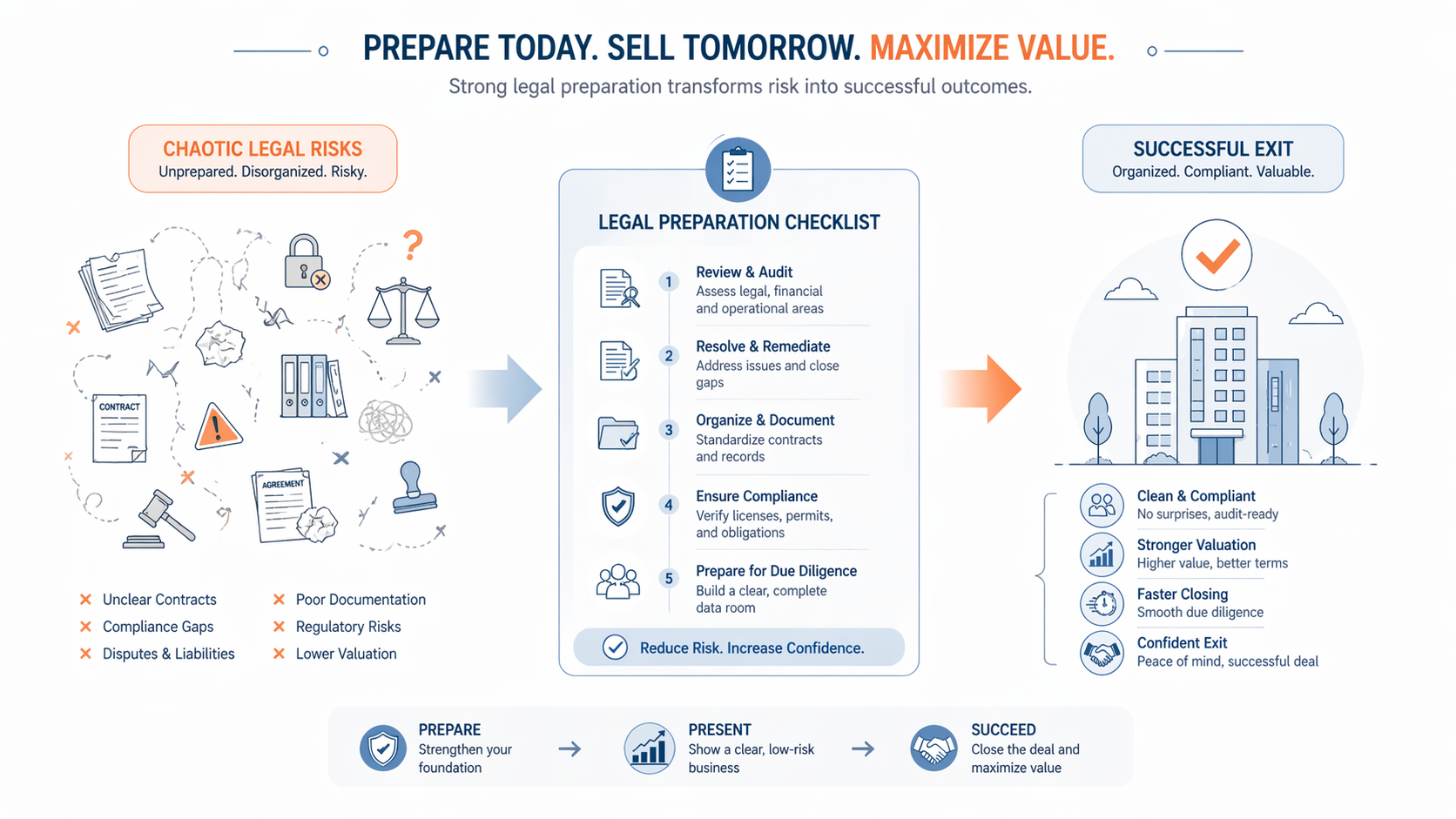
For a broader view, check our 12-month preparation checklist. Consult the M&A glossary for key terms.
When should sellers start preparing
Timing is critical—begin 12-24 months before marketing your business. Early action allows issue resolution without pressure, aligning with financial cleanups detailed in preparing financial statements.
If deal momentum builds faster, compress to 6-9 months, but risks mount. Monitor triggers like market windows or personal milestones to initiate.
Quarterly reviews keep momentum; tie to annual audits for efficiency.
How this connects to the overall business sale journey
Legal prep interlocks with financial readiness, founder transition (see founder dependency risks), and timing decisions like when to sell.
It’s phase two of seller readiness: post-strategy, pre-diligence. Seamless integration maximizes value across the journey—from valuation to closing.
Explore more at our M&A blog.
Ready to get started? Download our seller checklist.
Take the next step confidentially. Start your M&A journey or book a confidential call.