Preparing Customer Contracts Before Selling Your Business

Overlooked customer contracts: The silent deal-killers in business sales
In the high-stakes world of mergers and acquisitions, business owners often focus on financials, operations, and market positioning when preparing to sell. Yet, customer contracts frequently emerge as the overlooked linchpin that can either smooth the path to a successful exit or unravel the entire deal. Imagine pouring years into building a loyal customer base, only for a single ambiguous clause or unrenewed agreement to trigger buyer hesitation, slashed valuations, or outright withdrawal during due diligence.
Recent market dynamics underscore this urgency. M&A liquidity is showing signs of improvement, with expectations of further boosts from stock market upgrades. Japanese capital is ramping up activity in Vietnam, targeting strategic acquisitions. At the same time, discussions around developing markets for intangible assets highlight the value locked in customer relationships. Even sectors like life insurance are flashing new signals, potentially sparking more deals. In this environment, pristine customer contracts aren’t just paperwork—they’re your competitive edge.
For sellers, the challenge lies in transforming these documents from potential liabilities into assets that reassure buyers of revenue stability and transferability. Poorly managed contracts can expose risks like customer churn, disputes, or dependency on key clients, eroding trust and value. This guide breaks it down practically, drawing from real-world M&A trenches to help you audit, optimize, and position your contracts for maximum appeal.
Table of Contents
- Why business owners need to understand customer contracts before selling
- Customer contracts from a seller’s perspective
- How investors view this issue
- Common seller mistakes
- Practical checklist for business owners
- When should sellers start preparing
- How this connects to the overall business sale journey
Why business owners need to understand customer contracts before selling
Customer contracts form the backbone of your recurring revenue, often accounting for 70-90% of a service-based or SaaS business’s value. Buyers scrutinize them not just for current income but for future predictability. A single poorly drafted agreement can signal operational risks, legal vulnerabilities, or customer dissatisfaction, prompting buyers to demand discounts or walk away.
Consider the ripple effects: Non-transferable contracts force renegotiations post-close, delaying integration and inflating costs. Expiring deals without auto-renewals raise churn fears. Concentration in a few clients amplifies dependency risks. In Vietnam’s evolving M&A landscape, where liquidity is improving and foreign investors like Japanese firms are active, buyers have options—they won’t tolerate sloppy contracts.
Understanding these documents empowers sellers to mitigate valuation gaps. Clean contracts demonstrate governance, scalability, and low-risk handovers. They shift buyer focus from doubts to synergies, potentially adding millions to your exit price. Neglect them, and you’re handing leverage to the other side.
From experience, sellers who proactively address contracts close 30-50% faster with fewer concessions. It’s not about perfection but transparency and control—key to navigating due diligence unscathed.
Customer contracts from a seller’s perspective
As a seller, view your contracts through a lens of transferability, enforceability, and value preservation. Start with the basics: Are they written, signed, and current? Verbal agreements or emails won’t cut it—buyers demand formal documentation.
Key elements to self-assess:
- Duration and renewals: Long-term contracts with auto-renewals signal stability. Short-term or at-will deals invite scrutiny.
- Revenue recognition: Ensure terms align with your financials. Mismatches erode credibility.
- Termination clauses: Buyer-friendly (no onerous penalties) but seller-protective during transition.
- Change of control provisions: Explicitly allow assignment to new owners without customer consent where possible.
- Performance metrics/SLAs: Realistic guarantees that won’t haunt the buyer post-sale.
Inventory all contracts: Top 20 customers first, then others. Categorize by type—service, supply, licensing—and flag anomalies like key-man dependencies. In contexts like intangible asset M&A, these relationships are gold; treat them accordingly.
Sellers often underestimate renewal rates. Track historical data to project post-sale retention, bolstering your pitch.
How investors view this issue
Buyers approach contracts with forensic precision during diligence. Strategic acquirers prioritize customer stickiness; financial buyers stress cash flow certainty. They model scenarios: What if 20% churn post-close? Can they assume contracts seamlessly?
Red flags include:
- High concentration: Top client >30% revenue? Massive risk.
- Disputes or amendments: Signals instability.
- Non-standard terms: Hinders scalability.
- Expired/unsigned: Potential revenue leakage.
In Vietnam, with Japanese capital pushing M&A and improving liquidity, investors seek low-friction targets. Life insurance market signals suggest sector-specific scrutiny on policyholder contracts. Buyers engage lawyers early, requesting data rooms with full contract suites.
They value diversity—broad, loyal base over whales. Positive signals like multi-year deals with escalators boost multiples. Provide summaries upfront: Contract aging reports, concentration charts, assignment readiness.

Common seller mistakes
Sellers trip up repeatedly on contracts, costing deals dearly. First, procrastination: Waiting until LOI to review means rushed fixes and exposed weaknesses. See our post on common mistakes first-time sellers make for more pitfalls.
Second, overlooking small clients: Buyers aggregate risks; a pattern of sloppy minor contracts implies systemic issues.
Third, ignoring side letters/amendments: These hidden gems alter terms—disclose them or face fraud claims.
Fourth, poor documentation: Missing signatures or originals halts diligence. Verbal deals? Convert or exclude revenue.
Fifth, no customer notifications plan: Surprising clients post-close risks backlash.
Avoid these by systematizing early. Link to mistakes first-time sellers make reveals how peers recovered.
Practical checklist or framework for business owners
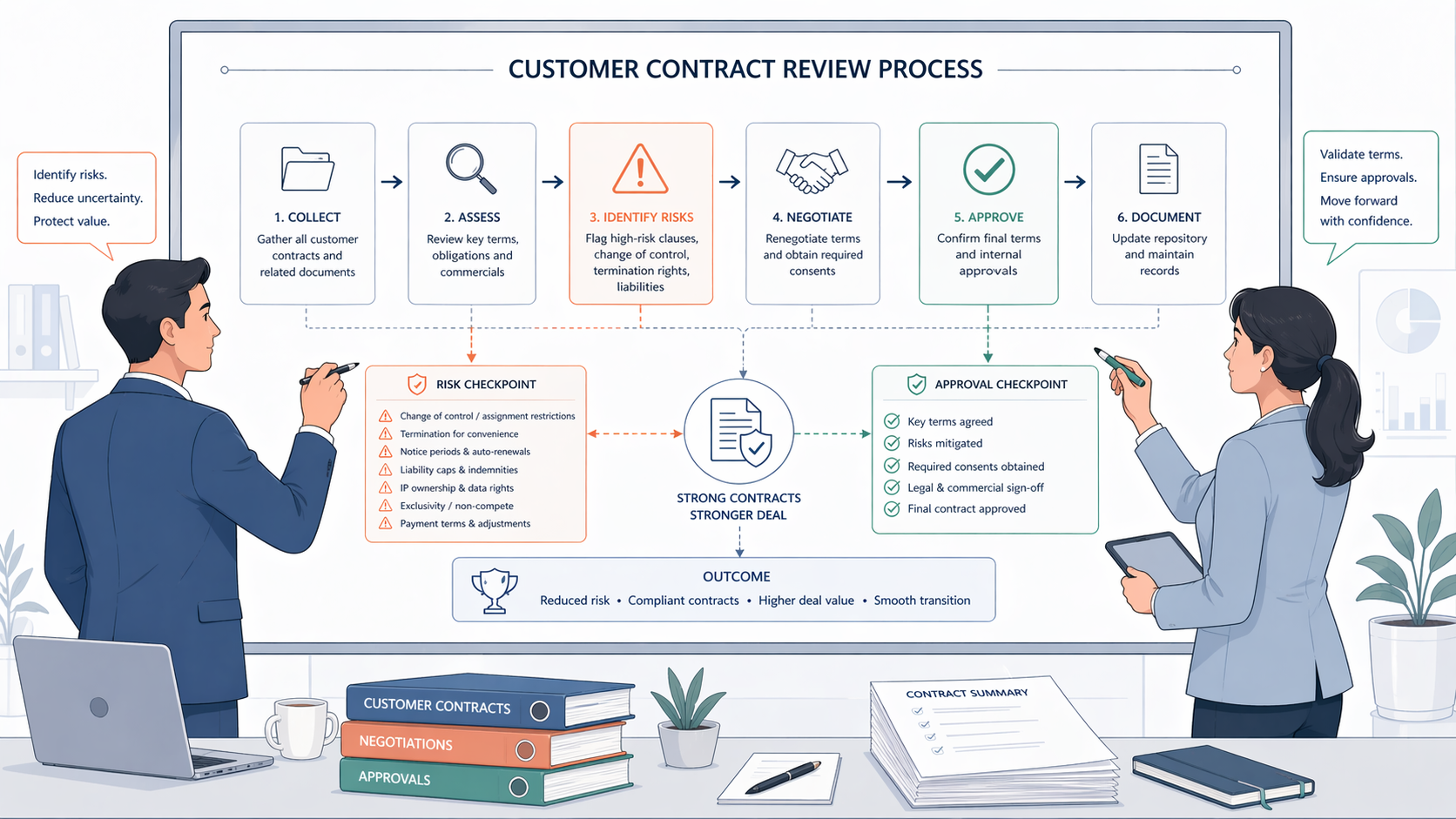
Here’s a step-by-step framework to prepare your contracts. Aim for 4-6 weeks initially, longer for complex portfolios.
- Audit phase (Week 1): Gather all contracts. Use CRM/ERP exports. Classify by customer, value, type.
- Gap analysis (Week 2): Review against a standard template. Flag non-compliant terms: assignment, termination, pricing.
- Standardization (Weeks 3-4): Draft master templates. Renegotiate outliers with key clients, offering incentives for renewals.
- Legal scrub (Week 5): Engage counsel for enforceability opinions. Address disputes.
- Data room prep (Week 6): Anonymize, index, and upload. Create executive summaries: e.g., “95% assignable, avg. 24-month term.”
- Customer comms plan: Draft notices for change-of-control.
Tools: Contract management software like Ironclad or DocuSign for lifecycle tracking. For templates, reference our M&A glossary for terms.
Pro tip: Quantify value—e.g., “Contracts secure $X recurring revenue.” Download our seller readiness checklist for aligned prep.
When should sellers start preparing
Begin 12-18 months pre-market. Contracts tie into broader readiness; early fixes allow natural renewals. Read our 12-month preparation checklist.
If deal timeline accelerates, prioritize top-revenue contracts. In hot markets like current M&A upticks, speed matters—but quality first.
How this connects to the overall business sale journey
Contracts are one pillar of seller readiness, interlocking with financials, legal, and ops. Clean them alongside legal preparation and financial statements.
They inform valuation: Strong contracts justify premiums. In the journey—prep, market, diligence, close—they shine in diligence. Post-sale, they ensure smooth transitions.
Explore more at our M&A blog. To kick off, start your M&A journey.
Ready to assess your contracts? Download our seller checklist.
Need expert eyes? Book a confidential call with our advisors.