Preparing Internal Data Before M&A: Key Steps for Business Sellers

The hidden pitfalls of unprepared data that can derail your business sale
As a business owner eyeing an M&A exit, you’ve built your company from the ground up, pouring in years of effort, innovation, and grit. But when it comes time to sell, one overlooked area can slash your valuation by 20-30% or kill the deal outright: your internal data. Buyers don’t just want your story—they demand verifiable proof through clean, organized financials, operational metrics, customer records, and compliance documents. Without this, due diligence turns into a nightmare, trust erodes, and offers evaporate.
I’ve seen it time and again in Vietnam’s bustling M&A market: founders with thriving operations who stumble because their data is scattered across old spreadsheets, siloed departments, or worse, nonexistent. Preparing internal data isn’t a last-minute checkbox; it’s the foundation that unlocks maximum value. This guide breaks it down practically, from a seller’s viewpoint, so you can sidestep common traps and present a bulletproof case to buyers.
Think of your internal data as the blueprint of your business. Buyers use it to validate revenue streams, assess scalability, and spot risks. Get it right, and you command premium multiples; get it wrong, and you’re negotiating from weakness. Let’s dive into why this matters and how to master it.
Table of Contents
- Why business owners need to understand preparing internal data before selling
- Preparing internal data from a seller’s perspective
- How investors view this issue
- Common seller mistakes
- Practical checklist for business owners
- When should sellers start preparing
- How this connects to the overall business sale journey
Why business owners need to understand preparing internal data before selling
Understanding how to prepare your internal data isn’t optional—it’s a strategic imperative that directly impacts your exit multiple. In M&A, buyers base 70-80% of their valuation on data-driven insights. Sloppy or incomplete data signals hidden risks, prompting discounts or walkaways. For instance, if your revenue figures can’t be reconciled across systems, buyers question the entire P&L.
From market trends, we’ve observed that deals with well-prepared data rooms close 40% faster and at higher prices. Business owners who grasp this early avoid rushed scrambles that expose weaknesses. It also builds buyer confidence, turning skeptics into committed partners. Moreover, in competitive auctions, pristine data differentiates you, attracting strategic buyers willing to pay premiums for low-risk targets.
Neglecting this prep often stems from underestimating due diligence depth. Buyers won’t take your word; they drill into every metric. By mastering data preparation, you not only safeguard value but also accelerate the process, freeing you to focus on life post-sale.
Preparing internal data from a seller’s perspective
For sellers, internal data preparation means compiling a comprehensive, audit-ready package that tells your business’s story with precision. Start with financials: P&L statements, balance sheets, and cash flow reports for the last 3-5 years, normalized for one-time expenses. Ensure they’re GAAP-compliant or adjusted to industry standards.
Operational data is equally critical. Gather KPIs like customer acquisition costs, churn rates, inventory turnover, and supply chain metrics. Customer data—segmented by revenue contribution, retention, and geography—reveals scalability. For Vietnam-based firms, include export/import records and local compliance filings.
HR and IP data rounds it out: employee contracts, org charts, patents, trademarks, and software licenses. Digitize everything into a secure virtual data room (VDR) early. Tools like DealRoom or Intralinks simplify this, but the key is consistency—standardize formats, resolve discrepancies, and document assumptions.
Sellers often overlook ‘soft’ data like vendor contracts and litigation history. Scrutinize leases, supplier agreements, and any disputes. This holistic approach positions your business as turnkey, minimizing buyer friction.

How investors view this issue
Buyers—whether private equity, strategics, or family offices—approach internal data with forensic intensity. They seek confirmation of your growth story: Is EBITDA sustainable? Are margins defensible? Data gaps trigger ‘yellow flags,’ leading to deeper audits or lower bids.
PE firms prioritize normalized financials to model future cash flows, often haircutting add-backs without ironclad proof. Strategics focus on synergies, dissecting customer and operational data for integration fit. In Vietnam’s market, foreign buyers emphasize compliance data to navigate regulatory hurdles.
High-quality data reduces perceived risk, justifying 1-2x higher multiples. Buyers also gauge management depth through HR data; founder-heavy teams raise red flags without transition plans. Ultimately, investors view prepared data as a proxy for operational excellence—your ticket to competitive offers.
Common seller mistakes
Sellers frequently trip over these pitfalls, eroding value:
- Incomplete historicals: Providing only 1-2 years of data; buyers need 3-5 for trends.
- Unreconciled figures: Mismatches between tax returns, management accounts, and bank statements breed doubt.
- Outdated ops data: Stale KPIs that don’t reflect current reality mislead on performance.
- Poor organization: Dumping files into folders without indexing slows due diligence.
- Ignoring non-financials: Skipping IP audits or customer contracts invites post-LOI surprises.
Another blunder: delaying until LOI. This compresses timelines, amplifying errors. As detailed in our post on preparing financial statements before selling a business, early alignment prevents these issues. Avoid them to keep momentum.
Practical checklist or framework for business owners
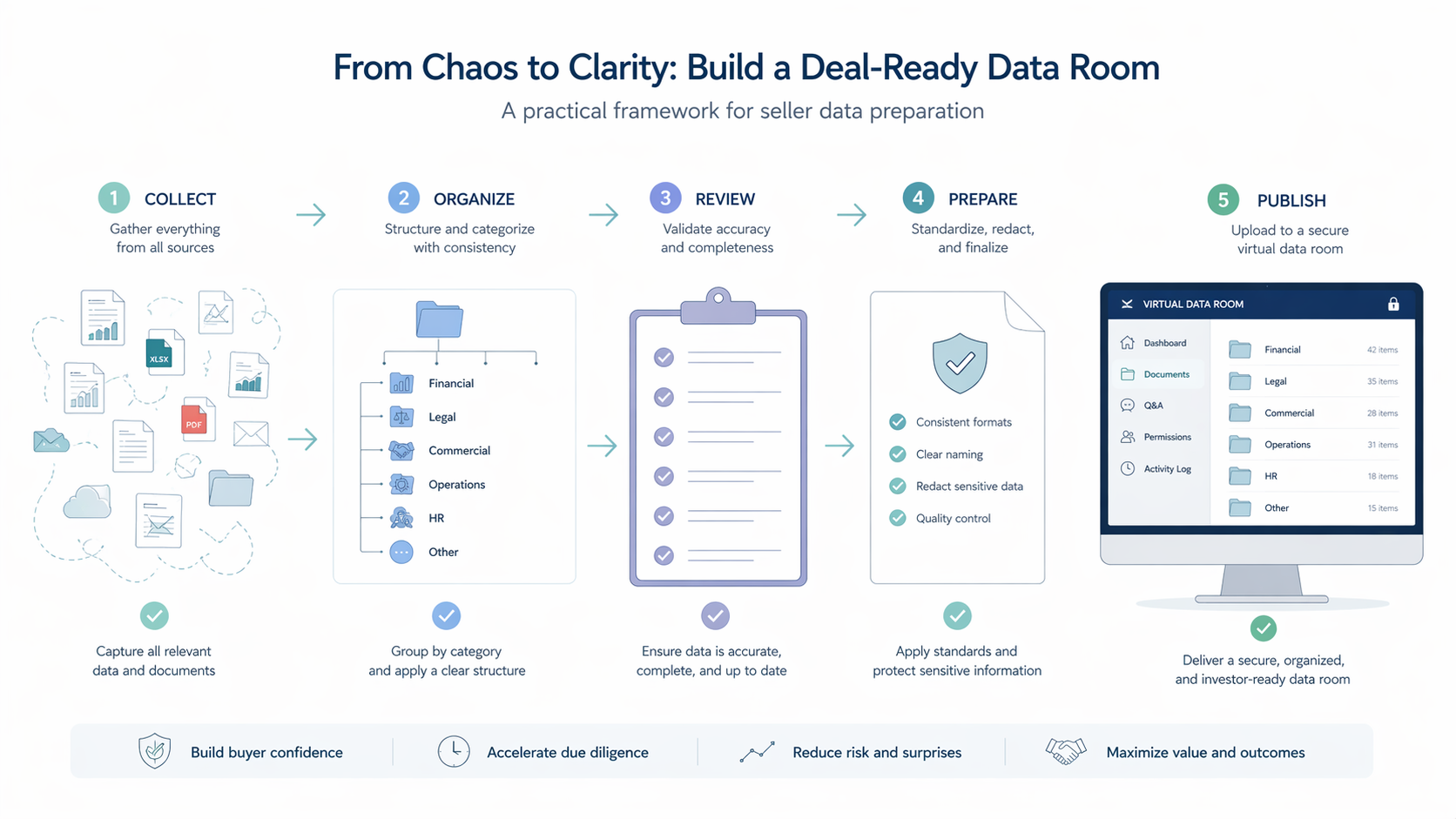
Here’s a step-by-step framework to prepare your internal data systematically:
- Assemble a cross-functional team: Involve finance, ops, HR, and legal leads. Assign ownership for data streams.
- Audit financials: Reconcile accounts, normalize EBITDA, forecast 12-24 months ahead with scenarios.
- Compile operational metrics: Track 10-15 core KPIs monthly for 3 years. Visualize in dashboards.
- Gather customer/supplier data: Anonymize sensitive info; highlight top 20% contributors.
- Review legal/compliance: Collate contracts, licenses, and disputes. Flag expirations.
- Build the data room: Use a VDR with permissions. Index folders: Financials, Ops, Legal, HR/IP.
- Third-party validation: Engage auditors for clean opinions on key statements.
- Test for Q&A: Simulate buyer queries; refine based on gaps.
For a full roadmap, check our 12-month preparation checklist. This framework ensures completeness.
When should sellers start preparing
Begin 9-12 months before marketing your business. This timeline allows for audits, cleanups, and iterations without pressure. If you’re exploring options, start a ‘data hygiene’ phase now—ongoing maintenance prevents buildup.
Align with market cycles: In Vietnam, prep ahead of Q4 peaks when buyers deploy capital. Early starters close deals faster, as buyers appreciate readiness. Link this to broader readiness via our seller readiness checklist.
How this connects to the overall business sale journey
Data preparation threads through every M&A stage. Pre-marketing, it sharpens your teaser and CIM for buyer interest. During due diligence, it sustains momentum. Post-close, clean records ease transitions.
It dovetails with financial normalization, legal prep, and founder transition—core to avoiding pitfalls like those in founder dependency risks. For a holistic view, explore our M&A blog.
Mastering internal data elevates your entire exit, maximizing returns and minimizing stress.
Ready to get started? Start your M&A journey with an initial assessment today.
Need a structured plan? Download our seller checklist for proven steps.
Questions on your data? Book a confidential call with our advisors.


