Business Valuation in M&A: How Investors Value Companies

Introduction: Why Business Valuation Feels So Frustrating for Sellers
For most business owners, valuation is the most emotional part of selling a company.
You may hear numbers that feel:
- Too low compared to the effort you invested
- Too theoretical compared to real cash you generated
- Too complex compared to how you actually run the business
Many sellers ask:
- Why do buyers value my company this way?
- Why don’t they care about my past growth as much as I do?
- Why does valuation change after due diligence?
The core problem is this:
Founders and investors look at valuation through completely different lenses.
Founders value businesses based on:
- History
- Effort
- Sacrifice
- Emotional attachment
Investors value businesses based on:
- Risk
- Future cash flows
- Transferability
- Downside protection
This article explains how business valuation in M&A actually works, why investor logic often surprises sellers, and how business owners can prepare to protect value—long before negotiations begin.

Table of Contents
- Why business owners need to understand business valuation before selling
- Business valuation from a seller’s perspective
- How investors value companies in M&A
- Common valuation mistakes made by sellers
- A practical valuation framework for business owners
- When should sellers start preparing for valuation?
- How valuation fits into the overall business sale journey
Why Business Owners Need to Understand Business Valuation Before Selling
Valuation is not something that happens after you decide to sell.
It is something that is being shaped every day by how your business operates.
Without understanding business valuation in M&A, sellers often:
- Anchor to unrealistic price expectations
- Focus on the wrong performance metrics
- Negotiate emotionally instead of strategically
- Lose leverage during due diligence
- Accept deal structures that reduce real value
Understanding valuation early allows business owners to:
- See their company through investor eyes
- Identify value drivers and value killers
- Prepare evidence before buyers ask for it
- Separate price from deal structure
- Avoid surprises late in the process
In M&A, valuation is not a reward for past success.
It is a price for future risk-adjusted returns.
Business Valuation From a Seller’s Perspective
From a seller’s point of view, valuation often feels subjective and inconsistent.
One buyer offers 5x EBITDA.
Another suggests 7x.
A third structures the deal with earn-outs that change the real outcome entirely.
This leads many sellers to believe valuation is arbitrary.
It is not.
How Sellers Commonly Think About Value
Business owners tend to value their companies based on:
- Revenue size
- Year-over-year growth
- Market potential
- Brand reputation
- Personal effort and time invested
While these factors matter, they are inputs, not valuation drivers by themselves.
What Sellers Are Actually Being Valued On
In M&A, sellers are not selling:
- Their story
- Their struggle
- Their ambition
They are selling:
- A stream of future cash flows
- With a certain level of risk
- That must survive without them
Valuation reflects how confident a buyer is that:
- Cash flows will continue
- Risks are manageable
- Growth assumptions are realistic
- Ownership can be transferred smoothly
Once sellers understand this shift in perspective, valuation becomes less emotional and more manageable.

How Investors Value Companies in M&A
Investors use structured frameworks to value companies.
While models differ, the logic is consistent.
Core Principle: Risk vs. Return
At its core, business valuation in M&A answers one question:
How much should we pay today to receive future cash flows, given the risks involved?
Everything else flows from this.
1. Earnings Quality Comes First
Before applying any multiple, investors assess earnings quality:
- Are profits recurring?
- Are margins stable?
- Are earnings dependent on one client, product, or person?
Low-quality earnings reduce valuation—even if headline numbers look strong.
2. Common Valuation Methods in M&A
a. EBITDA Multiples (Most Common)
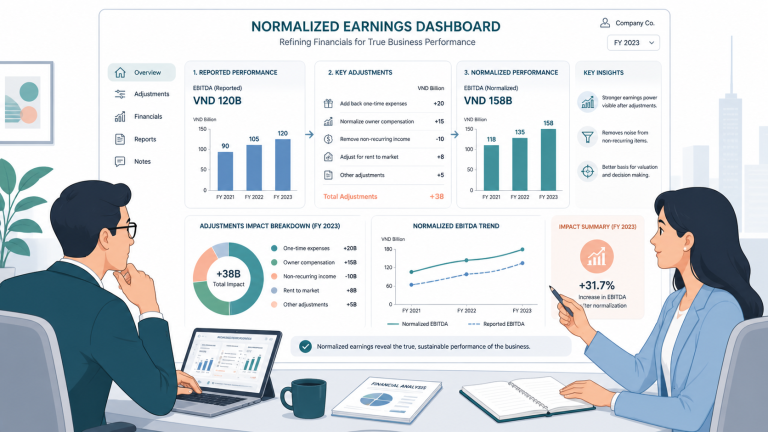
Buyers apply a multiple to normalized EBITDA.
However, the multiple depends on:
- Business stability
- Industry risk
- Scalability
- Management depth
- Customer concentration
Two companies with the same EBITDA can receive very different valuations.
b. Discounted Cash Flow (DCF)
Used to:
- Validate assumptions
- Stress-test projections
- Understand downside scenarios
DCF emphasizes:
- Predictability
- Growth credibility
- Capital requirements
Unrealistic forecasts weaken seller credibility.
c. Comparable Transactions
Investors compare your business to:
- Recent deals
- Similar industries
- Similar risk profiles
Sellers often cite high-profile deals—but buyers focus on relevant, comparable ones.
3. Risk Adjustments Drive Price
Investors discount valuation for risks such as:
- Founder dependency
- Customer concentration
- Lack of management depth
- Weak systems
- Regulatory uncertainty
Importantly, risk does not always reduce headline price—it often changes deal structure (earn-outs, holdbacks, rollovers).
4. Growth Is Valued Only If It Is Transferable
Investors value growth when it is:
- System-driven
- Supported by data
- Independent of founder relationships
Growth tied solely to the owner is often discounted heavily.

Common Valuation Mistakes Made by Sellers
1. Anchoring to the “Highest Multiple”
Sellers often fixate on:
- Industry rumors
- Exceptional outlier deals
- Media headlines
Valuation is context-specific.
Ignoring risk factors leads to disappointment.
2. Overestimating Synergy Value
Sellers sometimes assume buyers will pay for:
- Strategic fit
- Synergies
- Future expansion
In reality, buyers prefer to capture upside themselves, not pay for it upfront.
3. Ignoring Deal Structure
A “high valuation” with:
- Earn-outs
- Performance conditions
- Deferred payments
may result in less cash and more risk than a lower, cleaner deal.
4. Treating Valuation as a One-Time Event
Valuation is shaped by:
- Preparation
- Positioning
- Process management
Poor preparation leads to valuation erosion during due diligence.
A Practical Business Valuation Framework for Sellers
Use this framework to understand and improve your valuation readiness.
1. Financial Clarity
- Normalize EBITDA
- Remove personal expenses
- Explain adjustments clearly
- Prepare multi-year financials
2. Risk Reduction
- Reduce customer concentration
- Document processes
- Strengthen management
- Address legal and compliance gaps
Lower risk often increases valuation more than growth.
3. Growth Credibility
- Support projections with data
- Show repeatable growth drivers
- Avoid overly aggressive assumptions
Credible growth beats optimistic growth.
4. Transferability
- Reduce founder dependency
- Delegate key relationships
- Build systems that survive transition
A transferable business is a valuable business.
5. Deal Awareness
- Understand earn-outs and rollovers
- Know acceptable trade-offs
- Separate emotional value from financial value
Prepared sellers negotiate better outcomes.
When Should Sellers Start Preparing for Valuation?
Valuation preparation should start years before a sale, not months.
Recommended Timeline
- 3–5 years before exit: Ideal
- 1–2 years before exit: Still effective
- <1 year: Mostly reactive
Early preparation allows sellers to:
- Improve earnings quality
- Reduce risk factors
- Build valuation resilience
- Increase buyer competition
Importantly, preparing for valuation does not force you to sell—it gives you options.
How Valuation Connects to the Overall Business Sale Journey
Valuation is not an isolated step—it connects every phase of the seller journey.
- Seller Readiness determines valuation credibility
- Positioning shapes valuation expectations
- Buyer Selection affects valuation ranges
- Negotiation converts valuation into real outcomes
- Due Diligence confirms or erodes valuation
Sellers who understand valuation early experience:
- Fewer surprises
- Stronger leverage
- Better deal structures
- Higher certainty of closing
Ultimately, valuation is not about winning an argument—it is about aligning expectations with reality.
If you are thinking about selling in the future:
These resources help you prepare for valuation—and the entire sale process—step by step, without pressure.