Payment Structures in M&A Deals: A Guide for Sellers

Navigating payment terms that maximize your deal value
In the high-stakes world of M&A, the moment you’ve built your business for years comes down to the payment structure. It’s not just about the headline price; it’s how that value flows to you as the seller. Get this wrong, and you could leave millions on the table—or worse, face disputes that drag on for years. Many owners focus solely on valuation multiples, overlooking how payments are structured: upfront cash, deferred installments, earn-outs tied to future performance, or even stock in the buyer’s company.
Consider a typical scenario: a mid-sized tech firm sells for $50 million, but only 40% is paid at closing, with the rest contingent on milestones. If those aren’t met due to integration hiccups, the seller’s payout shrinks dramatically. Trends in Asian M&A deals underscore this complexity, where structures are evolving to balance risk between parties. As a seller, understanding these mechanics empowers you to negotiate terms that protect your interests, ensure liquidity, and align with your post-sale plans.
This isn’t abstract theory. Payment structures directly impact your net proceeds, tax liabilities, and even your lifestyle after exit. Owners who dive deep into these details often secure better outcomes, avoiding common traps like over-reliance on buyer stock or poorly defined earn-outs. Whether you’re eyeing a strategic buyer or private equity, grasping these elements turns a good deal into a great one.
Table of Contents
- Why business owners need to understand payment structures in M&A deals before selling
- Payment structures in M&A deals from a seller’s perspective
- How investors view payment structures
- Common seller mistakes with payment structures
- Practical checklist for negotiating payment structures
- When should sellers start preparing payment structure discussions
- How payment structures connect to the overall business sale journey
Why business owners need to understand payment structures in M&A deals before selling
Payment structures define not just how much you receive, but when and under what conditions. For business owners, this knowledge is critical because it bridges the gap between agreed valuation and actual cash in hand. Without it, you risk accepting a deal that sounds impressive on paper but delivers far less in reality.
Take cash deals versus deferred payments. Full cash at closing provides immediate liquidity, ideal if you plan to retire or reinvest quickly. But buyers often push for structures that tie payments to future events, shifting risk onto you. In competitive markets, understanding these lets you counter with hybrid models that safeguard your payout.
Moreover, tax implications vary wildly. Cash might trigger immediate capital gains taxes, while stock swaps could defer them, preserving more value long-term. Ignorance here leads to post-deal regrets, as owners scramble with accountants after term sheets are signed.
From a strategic standpoint, payment terms signal buyer confidence. A heavy upfront payment shows commitment; earn-outs suggest skepticism about your projections. Sellers who grasp this can use it to negotiate protections, like minimum guarantees or acceleration clauses.
Ultimately, this understanding prevents valuation erosion. What starts as a $100 million enterprise value can dwindle if 60% is at risk. Proactive owners treat payment structures as a core negotiation pillar, not an afterthought.
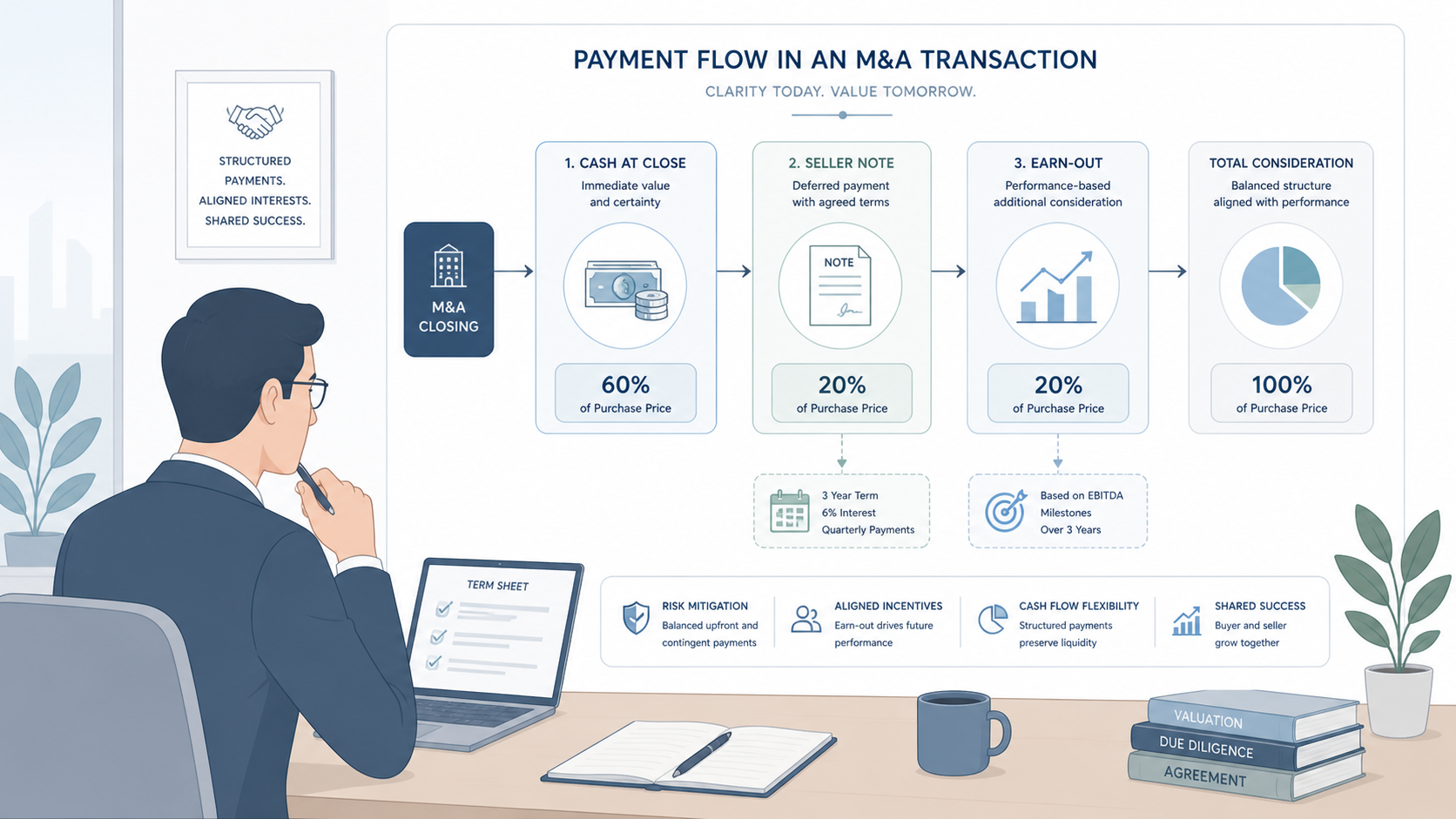
Payment structures in M&A deals from a seller’s perspective
- Cash payments: The gold standard for liquidity. Full cash upfront minimizes risk but may come at a discount to headline value, as buyers conserve capital.
- Deferred payments (seller notes): Buyer pays over time, often 1-5 years, with interest. This lets you capture full value but exposes you to buyer default risk—mitigate with security like liens on assets.
- Earn-outs: Performance-based payouts tied to revenue, EBITDA, or milestones post-close. Great for bridging valuation gaps, but definitions must be ironclad to avoid disputes.
- Stock or equity swaps: You get buyer shares, aligning interests but introducing volatility. Liquidity events depend on the buyer’s success.
- Hybrids: Mix of above, e.g., 70% cash, 20% note, 10% earn-out. Most common in practice, offering balance.
From your view, prioritize structures matching your goals. Need cash now for relocation? Push for 80%+ upfront. Betting on growth? Earn-outs can boost total value. Always model scenarios: What if EBITDA drops 20%? Does your payout hold?
Negotiation tip: Anchor on your valuation multiples, then layer in protections. Caps on earn-out clawbacks or independent auditors prevent manipulation.
How investors view payment structures
Buyers—strategics or private equity—see payment structures as risk mitigators. They favor deferred or contingent pay to hedge against overpayment, integration failures, or market shifts. For instance, PE firms often structure 50-70% upfront, rest in earn-outs, ensuring skin in the game.
Strategics might offer stock to conserve cash and foster synergy. But they scrutinize your financials via EBITDA adjustments, tying payments to normalized figures.
Investors push earn-outs when projections seem aggressive, viewing them as “truth serum.” They model downside: If synergies falter, why pay full freight? This perspective clashes with sellers’, creating tension—bridge it by proposing mutual KPIs.
In Asian contexts, trends show increasing use of escrows for reps and warranties, holding 10-15% of payments. Buyers demand this for indemnity, so sellers must budget for potential leaks.
Common seller mistakes with payment structures
Sellers often stumble here, eroding deal value:
- Overvaluing headline price: Chasing $X million ignores structure. A $100M deal with 30% at risk nets less than $90M cash upfront.
- Vague earn-out terms: “Revenue growth” without baselines leads to fights. Define metrics precisely, e.g., “trailing 12-month revenue audited by Big Four.”
- Ignoring tax drag: Cash hits harder than installments. Consult advisors early.
- No downside protection: Accept notes without collateral? Risk total loss if buyer folds.
- Stock without liquidity rights: Buyer shares could lock you in for years—demand tag-along rights.
Avoid these by simulating outcomes. Many owners skip this, regretting when payments trickle.

Practical checklist for negotiating payment structures
- Assess your needs: Liquidity horizon? Tax situation? Use this to rank structures.
- Model scenarios: Build spreadsheets for base, upside, downside cases.
- Propose hybrids: Start with 60-70% cash, balance contingent.
- Define earn-outs tightly: Metrics, measurement date, dispute resolution (arbitration).
- Secure notes: Collateral, covenants, prepayment rights.
- Negotiate escrows: Cap duration (12-18 months), amount (5-10%).
- Tax optimize: Structure for deferral where possible.
- Include accelerations: Change of control triggers full payment.
Download our seller readiness checklist for more prep tools. Reference our M&A glossary for terms like “holdback.”
When should sellers start preparing payment structure discussions
Begin 12-18 months pre-sale. Align with financial clean-up: Normalize EBITDA to support higher upfronts. By LOI stage, have models ready.
Early prep reveals preferences—e.g., if earn-outs loom, accelerate growth now. Engage advisors for term sheet reviews. In fast markets, this timing secures better terms.
How payment structures connect to the overall business sale journey
Payment terms thread through every phase: Valuation sets the pot; due diligence tests it; closing disburses it. Link to data room prep by including financial models.
Post-close, they impact earn-outs via transition. View as exit ecosystem: Strong prep here boosts success odds. Explore our M&A blog for more.
Ready to optimize your payout? Download our seller checklist.
Start your M&A journey today. Get an initial assessment or book a confidential call.