What Is an NDA in M&A? Essential Guide for Business Sellers

The first line of defense in confidential deal talks
As a business owner eyeing an exit, you’ve likely spent years building your company into a valuable asset. But when prospective buyers start knocking, sharing sensitive details like financials, customer lists, or proprietary processes can feel like walking a tightrope. Enter the NDA—or Non-Disclosure Agreement—a critical tool that protects your interests before any real discussions begin.
Without a solid NDA in place, you risk exposing trade secrets to competitors disguised as buyers, derailing your deal or worse, handing over competitive edges for free. I’ve seen owners lose millions in potential value because they rushed into data rooms without this safeguard. An NDA isn’t just paperwork; it’s your gatekeeper, ensuring only serious players get a peek behind the curtain while you maintain control.
In M&A, NDAs set the tone for trust and professionalism. They outline what information is shared, how it’s used, and the consequences of breaches—giving you peace of mind as negotiations heat up. Understanding NDAs empowers you to vet buyers effectively, avoid pitfalls, and position your business for maximum value. Let’s break it down step by step.
Table of Contents
- Why business owners need to understand NDAs before selling
- NDAs from a seller’s perspective
- How buyers view NDAs
- Common seller mistakes with NDAs
- Practical checklist for handling NDAs
- When should sellers start preparing NDAs
- How NDAs connect to the overall business sale journey
Why business owners need to understand NDAs before selling
Knowledge of NDAs isn’t optional for sellers—it’s essential for safeguarding your business’s crown jewels. In the early stages of an M&A process, you’ll field inquiries from strategics, private equity firms, and even industry peers. Each one wants data to assess fit and value, but not all have your best interests at heart.
Consider this: sharing revenue breakdowns or IP details without protections can lead to ‘window shopping’ where buyers extract insights without committing. A well-drafted NDA mitigates this by legally binding recipients to confidentiality, non-use, and non-circumvention clauses. It also signals to buyers that you’re a serious seller, weeding out tire-kickers early.
From my experience advising on dozens of transactions, owners who skip or mishandle NDAs often face prolonged processes or forced discounts. Understanding the mechanics—duration, scope, remedies for breach—lets you negotiate terms that align with your timeline and risk tolerance. Ultimately, it’s about control: you decide what, when, and to whom information flows.
NDAs also tie into valuation. Buyers need due diligence to justify offers, but premature leaks erode negotiating power. Mastering this step ensures your business remains attractive without vulnerability.

NDAs from a seller’s perspective
For sellers, the NDA is your first proactive move in the deal. It starts with identifying what constitutes confidential information: financial statements, contracts, employee data, strategies—the works. A strong seller-drafted NDA typically includes broad definitions to cover future disclosures, preventing loopholes.
Key elements from your viewpoint include a perpetual confidentiality period for trade secrets, even post-termination. Non-circumvention clauses stop buyers from poaching your customers or employees directly. And return/destruction provisions ensure data vanishes if talks collapse.
One nuance sellers often overlook: exceptions for information already public or independently developed. Negotiate these carefully to avoid diluting protections. Also, specify governing law—often your home jurisdiction for familiarity—and dispute resolution, like arbitration for speed.
As the seller, you hold leverage here. Buyers expect to sign; refusing raises red flags. Use mutual NDAs sparingly unless reciprocity is vital, as one-way protections suffice early on. This approach keeps momentum while minimizing your exposure.
How buyers view NDAs
Buyers see NDAs as standard operating procedure, but their lens differs. For them, it’s about balancing diligence needs with commitments. Private equity buyers push for narrow scopes—limiting to specific data rooms—to reduce liability, while strategics may seek broader access for synergies.
They scrutinize duration: 1-2 years post-termination is common, but they resist perpetual terms. Remedies clauses are battlegrounds—buyers prefer caps on damages, while sellers want full indemnity. From their side, NDAs facilitate clean exits if the deal sours, with rights to retain summaries for regulatory compliance.
Experienced buyers use NDAs to gauge seller sophistication. A sloppy one suggests disorganization, potentially tanking value. They also watch for overreach, like unreasonable penalties, which can stall processes. In essence, buyers want efficiency: sign quickly, access data, move to LOI.
Understanding this helps sellers anticipate pushback and craft balanced documents that close faster.
Common seller mistakes with NDAs
Sellers trip up on NDAs more than you’d think, often at great cost. First, using generic templates from the internet—lacking jurisdiction-specific clauses or enforceability. Always tailor to your business and local laws.
Second, signing buyer-drafted NDAs without review. These favor the buyer with short durations and weak remedies. Counter with your version.
Third, over-sharing pre-NDA. Teaser documents are fine (anonymized overviews), but never specifics like customer names.
Fourth, ignoring breach tracking. No mechanism to monitor compliance means silent leaks. Include reporting requirements.
Fifth, poor execution: verbal agreements or unsigned emails don’t count. Insist on wet signatures or e-sign with audit trails.
I’ve witnessed deals unwind because sellers allowed ‘informal’ previews, leading to IP theft claims. Avoid these by treating NDAs as non-negotiable gateways.
Practical checklist for handling NDAs
Here’s a step-by-step framework to manage NDAs effectively:
- Prepare your NDA template: Work with legal counsel for a seller-friendly base. Include definitions, obligations, term (2 years + perpetual for secrets), exclusions, remedies (injunctions, damages), and no-reverse-engineering clauses. Link to our M&A glossary for key terms.
- Vet the buyer: Request background via LinkedIn, references, or advisors. Serious players sign readily.
- Negotiate key terms: Prioritize scope, duration, and governing law. Compromise on caps if it speeds the process.
- Execute properly: Use DocuSign for tracking. Get C-suite sign-off from buyer side.
- Set up data controls: Use secure virtual data rooms (VDRs) with access logs, watermarks, and expiration.
- Monitor and enforce: Track access; follow up on anomalies. Have breach response plan ready.
- Review post-LOI: Update or expand for deeper diligence.
This checklist minimizes risks and projects professionalism. For broader prep, check our business sale process guide.
When should sellers start preparing NDAs
Begin yesterday—or at least 3-6 months pre-market. Draft your template during exit planning, aligning with financial clean-up and teaser creation. This timing lets you test it with advisors for refinements.
If unsolicited inquiries arise, have it ready to respond swiftly, maintaining momentum. Don’t wait for a broker; proactive sellers control the narrative.
In phased processes, initial NDAs cover teasers; expand later. Early prep avoids rushed errors under pressure.
How NDAs connect to the overall business sale journey
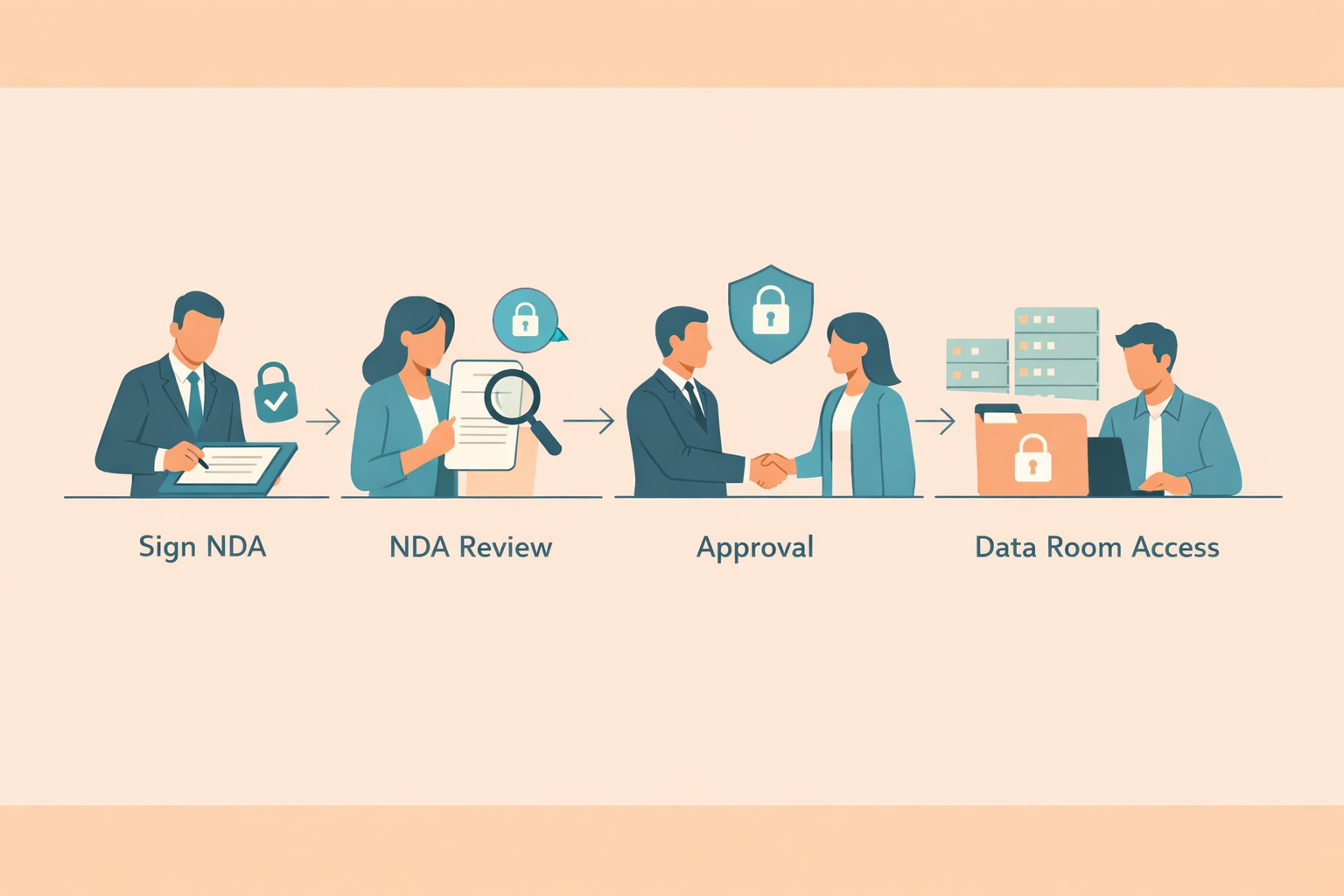
NDAs are the second act after marketing but before LOIs. They bridge teasers (high-level pitches) to diligence, enabling substantive talks. Post-NDA, buyers access initial data rooms, informing indications of interest.
A strong NDA builds trust, accelerating to exclusivity agreements. It integrates with the full timeline: prep (12 months out), market (sign NDAs), negotiate, close. See our 12-month preparation checklist for context.
Ultimately, it’s foundational—flawed NDAs cascade failures downstream.
Ready to prepare? Download our seller checklist.
Take the first step today. Start your M&A journey.