Introduction: Why the Real M&A Process Often Surprises Business Owners
Many business owners imagine selling their company as a relatively straightforward event.
An interested buyer appears.
A price is negotiated.
Documents are signed.
Money is transferred.
In reality, M&A rarely works this way.
Most transactions unfold over many months and involve multiple stages, each with its own challenges, negotiations, and uncertainties. Sellers often discover that the real process includes far more than simply agreeing on valuation.
Deals may evolve through:
- Several rounds of negotiation
- Financial and operational scrutiny
- Unexpected questions about the business
- Structural adjustments to manage risk
For first-time sellers, this complexity can feel overwhelming.
Yet once you understand how M&A works in real life, the process becomes much easier to navigate. Instead of reacting to each stage with uncertainty, business owners can approach the sale with clarity and confidence.
This article walks through the practical, real-world M&A process, helping sellers understand what to expect and how to prepare for each step.
Table of Contents
- Why business owners need to understand how M&A works before selling
- The M&A process from a seller’s perspective
- How investors approach the real acquisition process
- Common seller mistakes during the M&A process
- A practical step-by-step framework of the real M&A process
- When should sellers start preparing for the M&A process?
- How this process connects to the overall business sale journey
Why Business Owners Need to Understand How M&A Works Before Selling
Many founders spend years building a successful company, but very little time understanding how businesses are actually sold.
As a result, when the sale process begins, they often feel unprepared for:
- The time required to close a deal
- The amount of information buyers request
- The number of people involved in the transaction
- The negotiation complexity beyond price
Without understanding the real M&A process, sellers may:
- Misinterpret buyer questions as distrust
- Feel frustrated by delays
- Lose leverage during negotiations
- Agree to unfavorable deal structures simply to move forward
Learning how M&A works in practice allows business owners to:
- Anticipate each stage of the transaction
- Prepare information in advance
- Manage expectations with buyers
- Maintain confidence during negotiations
Perhaps most importantly, understanding the process helps sellers avoid the most common mistake: believing that signing a letter of intent means the deal is already done.
In reality, the most important work often begins after that point.
The M&A Process From a Seller’s Perspective
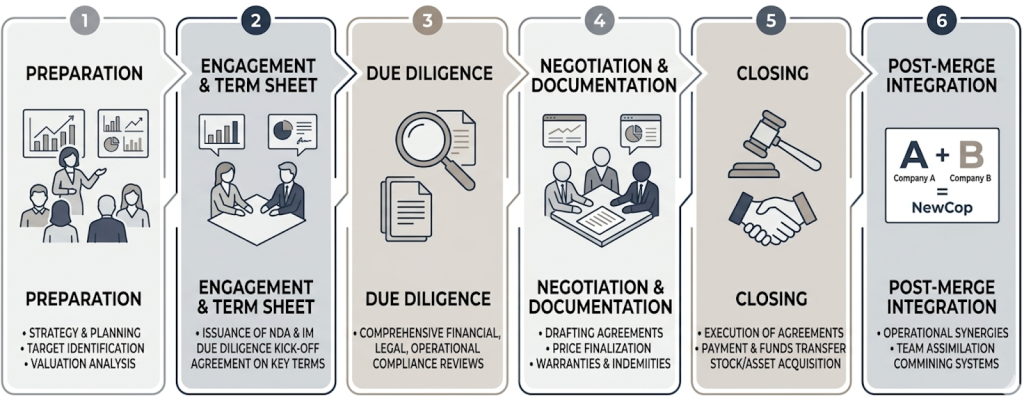
From the seller’s point of view, M&A is not a single transaction but a multi-stage journey.
Each stage gradually reduces uncertainty for the buyer while increasing confidence that the deal can close successfully.
While every transaction differs slightly, most deals follow a similar progression.
Stage 1: Early Buyer Interest
A potential buyer expresses interest in the business. This may happen through:
- Industry relationships
- Advisors or intermediaries
- Direct outreach from investors
- Strategic partnerships that evolve into acquisition discussions
At this stage, conversations are usually informal and exploratory.
Buyers want to understand:
- The basic business model
- Market position
- Revenue scale
- Growth potential
Sellers should be cautious about sharing sensitive information before confidentiality agreements are in place.
Stage 2: Initial Discussions and Information Sharing
Once confidentiality agreements are signed, more structured conversations begin.
Buyers typically request high-level information such as:
- Revenue history
- Profitability
- Market positioning
- Key products or services
This stage helps buyers determine whether the opportunity fits their acquisition strategy.
If the business appears attractive, discussions move toward valuation expectations.
Stage 3: Letter of Intent (LOI)
When both sides see potential alignment, buyers often submit a Letter of Intent (LOI).
The LOI outlines:
- Proposed valuation
- Deal structure
- Payment terms
- Timeline for due diligence
Although the LOI is usually non-binding, it establishes the framework for the transaction.
For sellers, this stage can feel like the deal is nearly complete. In reality, the most detailed examination of the business has not yet begun.
How Investors View the Real Acquisition Process
Investors approach acquisitions with a structured mindset focused on risk reduction and validation.
From the buyer’s perspective, the early stages of M&A are about forming a hypothesis:
“This business appears valuable, and we believe it may be worth acquiring.”
The rest of the process is designed to test that hypothesis.
Why Buyers Move Step by Step
Each stage allows investors to confirm different aspects of the business:
Initial discussions test strategic fit.
Financial review tests profitability and scalability.
Due diligence tests accuracy and risk exposure.
Negotiation defines how risk will be shared between buyer and seller.
Because buyers must deploy significant capital, they aim to reduce uncertainty gradually rather than committing immediately.
Why Deals Sometimes Change Midway
Sellers are often surprised when buyers revise terms during the process.
This usually happens because:
- New information emerges during due diligence
- Financial adjustments are required
- Operational risks become clearer
From the buyer’s perspective, these changes are not necessarily negative—they are part of refining the deal based on better information.
Understanding this dynamic helps sellers remain calm and constructive during negotiations.
Common Seller Mistakes During the M&A Process
Many deals become more difficult than necessary because sellers misunderstand how the process works.
Mistake 1: Assuming the Process Will Be Fast
While some transactions close quickly, most deals take six to twelve months from first conversation to final closing.
Sellers who expect a quick outcome may feel frustrated or pressured.
Mistake 2: Sharing Information Too Late
Some sellers delay preparing financial statements, operational documentation, or contracts until buyers request them.
This slows the process and can create doubts about transparency.
Mistake 3: Becoming Emotionally Reactive
Negotiations can involve detailed questions about decisions made years earlier.
When sellers interpret these questions personally, communication can become tense.
Successful transactions require calm and professional dialogue.
Mistake 4: Focusing Only on Price
Valuation is important, but the structure of the deal often determines the seller’s real outcome.
Payment timing, earn-outs, and post-sale roles can significantly affect the final result.

A Practical Framework of the Real M&A Process
Although every transaction is unique, most successful business sales follow a clear sequence.
Step 1 — Preparation
Before engaging buyers, sellers should prepare:
- Clean financial statements
- Key operational documentation
- Strategic narrative explaining the business
Preparation improves both valuation and transaction efficiency.
Step 2 — Buyer Identification
Potential buyers are identified and approached carefully.
These may include:
- Strategic industry players
- Private equity firms
- Entrepreneurial buyers
The goal is to find buyers whose strategy aligns with the business.
Step 3 — Initial Discussions
High-level discussions allow buyers to evaluate whether the opportunity fits their investment criteria.
If interest continues, more information is exchanged.
Step 4 — Letter of Intent
The buyer proposes a preliminary deal structure and valuation.
The seller reviews whether the terms align with expectations.
Step 5 — Due Diligence
Buyers conduct detailed analysis of the business.
This stage typically includes:
- Financial review
- Operational analysis
- Legal documentation checks
- Market evaluation
Step 6 — Final Negotiation
Based on due diligence findings, final adjustments to the deal may occur.
Both sides negotiate final terms.
Step 7 — Closing
Legal documents are finalized and ownership is transferred.
The buyer pays the agreed purchase price according to the deal structure.
When Should Sellers Start Preparing for the M&A Process?
Many successful exits begin years before the transaction actually occurs.
Ideally, business owners should begin preparing at least two to three years before a potential sale.
This allows time to:
- Improve financial reporting
- Strengthen management teams
- Reduce operational risks
- Demonstrate consistent growth
Early preparation also allows sellers to approach buyers from a position of strength rather than urgency.
How This Process Connects to the Overall Business Sale Journey
Understanding how M&A works in real life helps business owners see how each stage connects.
The process typically unfolds across several major phases:
First, sellers develop readiness, ensuring the business can operate independently.
Next, they focus on valuation and positioning, presenting the company clearly to potential buyers.
Then comes buyer engagement and negotiation, where interest turns into formal proposals.
Finally, due diligence and closing confirm the transaction and transfer ownership.
Each step builds on the previous one.
Sellers who understand this journey early are able to move through it with greater control and fewer surprises.
If you are thinking about selling your company in the future:
Download the Seller Readiness Checklist
or explore
These resources provide practical guidance to help business owners prepare for each stage of the M&A process.