What Sellers Should Do When Buyers Request Customer Meetings

Customer Meetings Can Protect a Deal or Quietly Damage It
When a buyer asks to meet your customers during an M&A process, the request can feel both reasonable and alarming. Reasonable, because customer relationships are often one of the most important assets being acquired. Alarming, because those same relationships may be sensitive, personal, and commercially delicate. A poorly timed customer conversation can create uncertainty, trigger competitive concerns, or cause customers to question whether the company is stable.
For sellers, the key question is not whether customer meetings should ever happen. In many transactions, they eventually do. The real question is when, with whom, under what safeguards, and for what purpose. A buyer who wants customer access too early may be asking for comfort before they have earned it. A seller who refuses all customer interaction may create the impression that revenue is fragile or difficult to verify.
The right approach is balanced. Sellers need to protect confidentiality while helping serious buyers validate customer quality, revenue durability, and growth potential. That requires planning before the request arrives, not improvisation in the middle of negotiations.
This guide explains how sellers should think about customer meetings in M&A, how buyers interpret them, what mistakes to avoid, and how to build a practical framework that protects both the deal and the business.
Table of Contents
- Why business owners need to understand customer meetings before selling
- Customer meetings from a seller’s perspective
- How investors view this issue
- Common seller mistakes
- Practical checklist for business owners
- When should sellers start preparing?
- How this connects to the overall business sale journey
Why Business Owners Need to Understand Customer Meetings Before Selling
Customer meetings are rarely just casual reference calls. In an M&A process, they sit at the intersection of commercial due diligence, confidentiality management, valuation protection, and negotiation leverage. If handled well, they can confirm the strength of the business and reduce buyer uncertainty. If handled poorly, they can weaken the seller’s position or introduce unnecessary risk into the company’s day-to-day operations.
Most owners understand that buyers will review financial statements, contracts, tax records, and operational data. Fewer owners are prepared for the moment when a buyer says: We would like to speak directly with your top customers. That request can arrive after initial due diligence, before signing, during confirmatory diligence, or even as a condition before closing. The timing matters because customer access becomes more sensitive the earlier it occurs.
From the buyer’s perspective, customer meetings help answer questions that documents alone cannot fully resolve. Are customers satisfied? Do they depend on the owner personally? Are there hidden service issues? Would customers remain after a change in ownership? Is future revenue as reliable as the seller’s forecast suggests?
From the seller’s perspective, those questions are legitimate, but the method must be controlled. Customers do not always understand the nuance of an M&A process. A customer may hear that the company is exploring a sale and assume instability. A competitor may learn indirectly that the company is in play. An employee may hear rumours through customer channels. Even a loyal customer may use the situation to renegotiate pricing or payment terms.
This is why customer meetings should not be treated as a routine diligence item. They are a strategic milestone in the sale process. Before allowing access, sellers should be clear on three points:
- Purpose: What exactly is the buyer trying to confirm?
- Timing: Has the buyer shown enough seriousness to justify customer exposure?
- Protection: What safeguards exist to prevent commercial disruption?
A seller who answers these questions in advance is far less likely to be pressured into a risky concession. If you are still preparing your overall sale process, a seller readiness checklist can help identify which diligence areas should be organized before buyers start asking for sensitive access.
Customer meetings also influence valuation indirectly. Buyers assign higher confidence to businesses with predictable revenue, diversified customer relationships, strong retention, and limited owner dependency. When customer feedback supports those qualities, it can reinforce the valuation case. When feedback is inconsistent, unprepared, or poorly managed, buyers may reduce their offer, demand stronger warranties, request an earn-out, or slow the transaction.
The goal is not to hide weaknesses. Serious buyers will uncover material issues eventually. The goal is to avoid avoidable damage: premature disclosure, uncontrolled messaging, or conversations that confuse rather than clarify.

Customer Meetings from a Seller’s Perspective
For a seller, the first instinct may be defensive: Why should I let a potential buyer speak to my customers before the deal is done? That instinct is understandable. Customer relationships are hard-won. In many founder-led businesses, they have been built over years of trust, responsiveness, and personal credibility. Giving a buyer access too early can feel like giving away the keys to the company’s commercial engine.
However, a blanket refusal can create its own problems. If a buyer is making a meaningful acquisition, especially where customer concentration or recurring revenue is important, they will need some level of commercial validation. If the seller refuses any customer contact at any stage, the buyer may assume there is something to hide. The issue is not whether to cooperate, but how to sequence cooperation intelligently.
Sellers should view customer meetings as part of a staged disclosure process. Early in the transaction, the buyer may receive anonymized customer data, revenue by segment, contract summaries, churn analysis, and customer concentration tables. As the buyer becomes more serious, signs stronger confidentiality commitments, completes key diligence work, and agrees on principal deal terms, more specific customer information may be released. Direct customer meetings usually belong near the later stages, not at the first expression of interest.
A sensible seller should ask the buyer several questions before agreeing:
- Which customers do you want to meet, and why? The buyer should have a clear diligence rationale, not a vague desire to “get comfortable.”
- What questions do you plan to ask? Sellers should understand the discussion agenda before any meeting occurs.
- Who from your side will attend? The presence of senior decision-makers signals seriousness; junior diligence teams alone may not justify sensitive access.
- How will confidentiality be maintained? The buyer should commit to controlled communication and no commercial solicitation.
- What stage of the transaction are we in? Customer meetings are more appropriate after substantial agreement on valuation, structure, and exclusivity.
The seller should also consider which customers are appropriate for meetings. Not every important customer is a good candidate. Some customers may be too commercially sensitive. Some may be in active contract negotiations. Some may have procurement policies that complicate discussions. Some may be loyal but unpredictable in how they communicate. The best customer references are usually those with stable relationships, credible decision-makers, positive but balanced views, and limited risk of misinterpreting the conversation.
It is also important to distinguish between customer reference calls and customer consent discussions. A reference call helps a buyer understand satisfaction, service quality, and relationship durability. A consent discussion may be necessary where contracts include change-of-control provisions or assignment restrictions. These are different conversations and should be managed differently. Mixing them together can create confusion.
In some cases, the seller can propose alternatives before direct customer meetings. These may include anonymized customer satisfaction surveys, management-led customer relationship summaries, contract renewal history, pipeline analysis, or third-party commercial due diligence reports. These alternatives may not replace customer access entirely, but they can delay it until the buyer has demonstrated commitment.
For owner-managed companies, the biggest issue is often personal dependency. If customers buy because of the founder, the buyer will want to understand whether those relationships can survive ownership transition. Sellers should not wait until a buyer asks. They should proactively show how customer relationships have been institutionalized through account managers, service teams, formal contracts, documented processes, and repeatable customer success practices.
If you are preparing for buyer diligence more broadly, it may be useful to review how investors assess seller information in what investors look for during due diligence. Customer access is only one part of a wider pattern: buyers are trying to convert uncertainty into evidence.
How Investors View This Issue
Buyers and investors do not request customer meetings because they enjoy making sellers uncomfortable. They request them because customer quality is central to the investment case. A business may show attractive revenue and profit, but if customers are dissatisfied, concentrated, short-term, dependent on discounts, or attached only to the owner, the buyer’s risk profile changes significantly.
Investors typically use customer meetings to test several assumptions.
Revenue Durability
Historical revenue is useful, but buyers care about future revenue. Customer conversations help them understand whether customers intend to continue buying, whether budgets are stable, and whether the company remains relevant to their needs. A buyer may ask how long the customer has worked with the company, what alternatives they considered, and what might cause them to switch.
Customer Satisfaction
Financial reports rarely show the emotional quality of a customer relationship. A customer may be renewing contracts while quietly frustrated. Another may be highly satisfied but constrained by budget cycles. Meetings allow buyers to hear tone, confidence, hesitation, and enthusiasm. These qualitative signals can strongly influence buyer comfort.
Pricing Power
Buyers want to know whether customers see the company as a strategic partner or a replaceable vendor. If customers value quality, reliability, technical capability, or speed, the business may have stronger pricing power. If customers focus mainly on price, buyers may worry about margin pressure after closing.
Owner Dependency
This is one of the most important issues for sellers. If customers repeatedly say they work with the company because of the founder personally, the buyer may worry that revenue could leave when the founder exits. This does not automatically kill a deal, but it may affect structure. The buyer may ask for a longer transition period, deferred consideration, retention commitments, or stronger non-compete and non-solicitation protections where legally appropriate.
Competitive Position
Customers can often explain market position better than the seller can. They may compare the company with competitors, describe why they choose it, and identify areas for improvement. Buyers listen carefully because these comments help validate the company’s strategic narrative.
From an investor’s perspective, customer meetings are not only about confirming good news. They are about identifying the difference between a business that looks strong on paper and a business that will remain strong after acquisition. This distinction is central to valuation. A company with durable, transferable customer relationships usually commands more confidence than one where revenue feels fragile or relationship-dependent.
Sellers should remember that buyers evaluate not only what customers say, but also how the seller manages the process. A thoughtful, structured approach can signal maturity. A chaotic approach can raise concerns. If the seller cannot coordinate customer access professionally, the buyer may question broader management discipline.
At the same time, serious investors understand that sellers must protect confidentiality. A reasonable buyer should not expect unrestricted access to all customers at the beginning of a process. If a buyer insists on broad customer access before valuation alignment, exclusivity, or proper confidentiality protections, the seller should be cautious. That may indicate inexperience, poor process discipline, or, in some cases, strategic motives beyond the transaction itself.
Strategic buyers deserve particular care. If the buyer operates in the same or adjacent market, customer access carries higher risk. Even under a confidentiality agreement, sensitive information can be difficult to unlearn. Sellers should be especially selective about what customer names, contact details, pricing terms, and commercial strategy they disclose to strategic buyers before binding commitments are in place.
Common Seller Mistakes
Customer meetings can be constructive, but sellers often make avoidable mistakes under pressure. These mistakes usually happen because the seller wants to keep momentum, avoid seeming uncooperative, or satisfy a buyer’s diligence request quickly. In M&A, speed matters, but uncontrolled speed can be expensive.
Allowing Customer Access Too Early
The most common mistake is granting customer meetings before the buyer has shown sufficient seriousness. Early-stage buyers may not have secured financing, completed internal approvals, or committed to a valuation range. If such buyers receive customer access and later disappear, the seller has taken real commercial risk without receiving meaningful progress in return.
Before direct customer access, sellers should usually expect a signed confidentiality agreement, clear buyer identity, evidence of seriousness, a defined transaction perimeter, meaningful diligence progress, and ideally a letter of intent or exclusivity arrangement. The exact sequence depends on the deal, but customer meetings should not be treated as an initial screening tool.
Letting the Buyer Control the Conversation
Another mistake is allowing buyers to contact customers directly without structure. This can lead to inconsistent messaging, inappropriate questions, and avoidable anxiety. Customer meetings should have an agreed agenda. The seller or advisor should know who will attend, what topics will be covered, and how the transaction will be described.
In many cases, the meeting should be framed around service quality, relationship history, and future needs, not around the sale itself. The wording matters. Customers do not need to hear speculative details or incomplete transaction terms. They need a calm, accurate explanation that protects confidence in the company.
Selecting the Wrong Customers
Some sellers assume the largest customers should automatically be included. Not always. A large but difficult customer may create more risk than value. A customer in the middle of a pricing dispute may not be suitable. A customer with confidentiality sensitivities may not be available. A customer that depends heavily on the owner may need careful preparation before any conversation.
The best customers for meetings are not necessarily the biggest. They are the ones that can provide credible, balanced, and commercially stable feedback.
Over-Coaching Customers
Preparation is important. Manipulation is dangerous. Sellers should never script customers to give artificial answers. Sophisticated buyers can detect over-coached responses, and it can damage trust. Instead, sellers should prepare customers by explaining the context, confirming they are comfortable participating, and ensuring they understand the confidentiality of the discussion.
A credible customer does not need to say everything is perfect. In fact, balanced feedback can be more reassuring than exaggerated praise. Buyers know every business has improvement areas. What matters is whether those issues are manageable and whether the relationship is fundamentally sound.
Ignoring Contractual Restrictions
Some customer contracts contain confidentiality clauses, change-of-control provisions, consent requirements, or restrictions on assignment. Before involving customers, sellers should review the relevant contracts carefully. A casual conversation can create legal or commercial complications if it conflicts with contractual obligations.
This is especially important when customer concentration is high. If one customer represents a material portion of revenue and has consent rights or termination flexibility, the buyer will pay close attention. Sellers should understand these issues before the buyer does.
Failing to Prepare Internal Teams
Customer meetings may involve sales leaders, account managers, operations heads, or finance teams. If internal team members are not aligned, they may send inconsistent messages. Worse, they may become anxious about the transaction and unintentionally spread uncertainty.
Sellers should decide who inside the company needs to know, what they need to know, and how information will be controlled. Too much secrecy can make coordination difficult. Too much disclosure can create leaks. The balance depends on the company’s size, culture, and management depth.
Treating Customer Feedback as a Surprise
Owners sometimes discover during diligence that customers have concerns they did not fully understand. This is a preventable problem. Before launching a sale process, sellers should already have a clear view of customer satisfaction, renewal risk, pricing pressure, and service issues. If the first honest customer feedback comes during buyer diligence, the seller is already late.
Customer feedback should be part of pre-sale preparation. Sellers should speak with key customers, monitor account health, review complaints, analyze churn, and understand renewal dynamics well before buyer meetings begin.
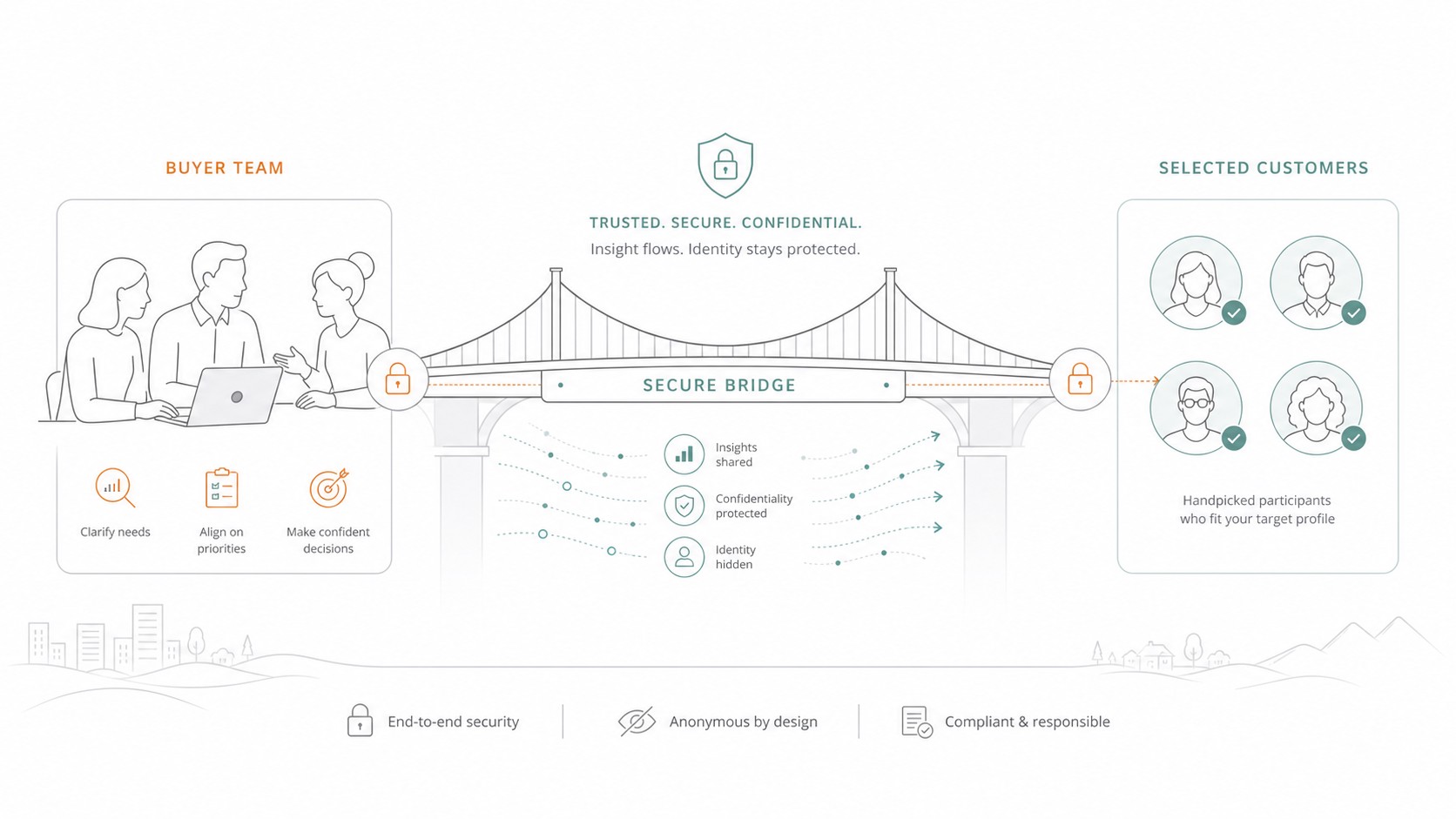
Practical Checklist or Framework for Business Owners
A practical framework helps sellers respond calmly when a buyer requests customer meetings. Instead of accepting or rejecting the request emotionally, the seller can evaluate it through a structured process.
Step 1: Confirm the Buyer’s Seriousness
Before any customer meeting, ask whether the buyer has earned that level of access. Indicators of seriousness include a clear acquisition rationale, signed confidentiality agreement, demonstrated financial capacity, defined deal structure, meaningful diligence progress, and alignment on headline valuation. If these elements are missing, customer meetings may be premature.
A useful response is: We understand why customer validation matters. Given the sensitivity, we typically reserve direct customer discussions for the later stage of confirmatory diligence, once key commercial terms are aligned. This is not a refusal. It is a professional boundary.
Step 2: Define the Objective
Ask the buyer what they need to validate. Is the concern customer concentration? Renewal probability? Product satisfaction? Competitive positioning? Owner dependency? Pricing stability? The clearer the objective, the easier it is to design a lower-risk process.
For example, if the buyer’s concern is customer concentration, a meeting with one major customer may be appropriate later in the process. If the concern is overall satisfaction, an anonymized customer survey or retention analysis may be enough at an earlier stage.
Step 3: Offer Phased Alternatives
Direct customer access does not need to be the first solution. Sellers can offer a phased approach:
- Phase one: Provide anonymized customer revenue data, contract summaries, retention history, and concentration analysis.
- Phase two: Share selected customer case studies, renewal patterns, and account management structure.
- Phase three: Arrange management-led discussions about customer relationships and pipeline.
- Phase four: Conduct controlled customer reference calls with selected customers after key deal terms are agreed.
This approach shows cooperation while preserving confidentiality.
Step 4: Select Customers Carefully
Build a shortlist of possible customer references before buyers ask. For each customer, assess relationship quality, commercial importance, contract status, confidentiality sensitivity, decision-maker availability, and likely communication style. Avoid selecting customers solely because they are large.
For each potential customer, sellers should know:
- How long the relationship has existed
- Who owns the relationship internally
- Whether the customer has recently renewed or expanded
- Whether there are unresolved service issues
- Whether the customer is aware of any strategic transition discussions
- Whether the contract includes consent, assignment, or confidentiality limitations
Step 5: Control the Agenda
Customer meetings should have a defined agenda. Typical topics may include relationship history, service experience, decision criteria, product quality, responsiveness, future needs, and overall satisfaction. Topics to avoid or tightly control include purchase price, transaction structure, employee matters, unresolved negotiations, detailed margin information, and speculative post-closing changes.
The seller or advisor should agree the question list in advance. Buyers may still ask natural follow-up questions, but the discussion should not become an open-ended interrogation.
Step 6: Decide Who Attends
Attendance depends on sensitivity. In some cases, the seller joins the call. In others, the buyer speaks with the customer alone, but only after strict boundaries are agreed. Sometimes an advisor moderates the call. For highly sensitive customers, a staged approach may begin with a management presentation and only later involve the customer directly.
If the seller attends, customers may be less candid. If the seller does not attend, messaging risk increases. There is no universal rule. The right structure depends on trust, customer sophistication, and transaction stage.
Step 7: Prepare the Customer Without Over-Scripting
When inviting a customer to participate, sellers should be calm and concise. The message should explain that the company is exploring a strategic transaction or partnership, that the discussion is confidential, and that the buyer wants to understand the customer experience. Avoid dramatic language. Avoid creating the impression that the company is distressed or uncertain.
A good preparation conversation may cover:
- Why the customer is being asked to participate
- Who will be on the call
- What topics may be discussed
- What information should remain confidential
- How the company will continue serving the customer without disruption
The customer should feel respected, not used as a diligence tool.
Step 8: Document the Process
Keep records of who was contacted, when, for what purpose, and under what confidentiality terms. This helps prevent confusion and supports disciplined process management. It also helps the seller respond if questions arise later about what was disclosed.
Step 9: Debrief Immediately
After each customer meeting, the seller and advisor should debrief quickly. What did the customer say? Did any issue arise? Did the buyer interpret something negatively? Is follow-up needed? A prompt debrief allows the seller to correct misunderstandings before they grow into deal issues.
If a customer raises a legitimate concern, do not dismiss it. Address it directly. Buyers are often more comfortable with a seller who acknowledges and manages issues than with one who insists everything is perfect.
Step 10: Link Customer Meetings to the Data Room
Customer meetings should not exist in isolation. They should connect to the broader diligence materials in the data room: contracts, revenue analysis, customer concentration schedules, renewal history, pipeline, churn data, and account management structure. If your data room is not organized, customer discussions can create more questions than answers. Sellers may find it helpful to review guidance on how to structure an M&A data room before moving into customer-level diligence.
When Should Sellers Start Preparing?
Sellers should prepare for customer meeting requests long before buyers ask. Ideally, preparation begins 12 to 18 months before a planned sale, although even a shorter preparation window can create value. The reason is simple: customer risk cannot be fixed overnight.
If a business depends heavily on a few customers, the seller may need time to diversify revenue. If customers depend on the founder, the company may need time to transition relationship ownership to senior managers. If contracts are informal or outdated, they may need to be renewed or clarified. If service issues exist, they need to be addressed before buyer diligence turns them into valuation issues.
Early preparation should focus on five areas.
Customer Concentration
Buyers pay close attention when a small number of customers represents a large share of revenue or profit. Concentration is not always a problem. Some companies naturally serve a small number of enterprise customers. However, sellers should understand the risk profile clearly. Are these relationships contracted? Are they long-term? Are they growing? Are they profitable? Are they transferable?
If concentration is high, sellers should prepare a clear explanation of why the relationships are stable and how the business manages dependency risk.
Relationship Ownership
Before selling, owners should reduce excessive founder dependency. This does not mean disappearing from customer relationships. It means ensuring customers also trust the broader team. Account managers, commercial directors, technical leads, and operations managers should have meaningful relationships with key customers.
A buyer is more comfortable when customer trust is embedded in the organization, not concentrated in one person.
Contract Quality
Customer contracts should be reviewed for term, renewal rights, termination provisions, pricing mechanisms, change-of-control clauses, assignment restrictions, exclusivity, service levels, and confidentiality obligations. Weak or unclear contracts can reduce buyer confidence even if the commercial relationship is strong.
Legal review is especially important before any customer contact. Sellers should understand what they can disclose and whether customer consent may be required at any stage.
Customer Satisfaction Evidence
Buyers prefer evidence over claims. Sellers should gather customer satisfaction indicators such as renewal rates, repeat purchases, complaint resolution history, service performance metrics, testimonials where appropriate, and account expansion records. These materials can reduce the need for broad customer access early in the process.
Messaging Discipline
Owners should prepare a calm narrative around the transaction. Why is the sale being considered? What does it mean for customers? What will remain stable? What may improve? If the seller cannot explain the transaction confidently, customers may fill the gap with their own assumptions.
Good messaging does not overpromise. It reassures customers that service continuity, quality, and relationship management remain priorities.
Sellers who prepare early are not simply making diligence easier. They are improving the business itself. Stronger contracts, better account management, lower customer dependency, and clearer satisfaction data all make the company more resilient, whether or not a sale happens.
How This Connects to the Overall Business Sale Journey
Customer meetings are one part of a larger sale journey. They should align with the overall transaction strategy, not sit outside it. A well-run M&A process gradually moves from broad market interest to serious buyer engagement, then to detailed diligence, negotiation, signing, and completion. Customer access should be matched to that progression.
Early in the process, the seller’s priority is to generate qualified interest while protecting confidentiality. At this stage, customer names may be anonymized. Buyers can understand revenue mix, customer concentration, industry exposure, and contract profile without direct access.
Once a serious buyer emerges, the seller may provide more detailed information under stricter confidentiality. The buyer can review contracts, financial performance by customer, retention history, and pipeline. If concerns remain, the parties can discuss whether customer meetings are necessary.
After key terms are agreed, customer meetings may become appropriate as confirmatory diligence. At this stage, the buyer has invested time and resources, the seller has greater confidence in seriousness, and both sides have a shared interest in completing the transaction.
In some deals, customer meetings happen only after signing and before closing, particularly where customer consent is required. In other deals, they happen after closing as part of transition planning. The correct timing depends on contract terms, buyer type, customer sensitivity, and negotiation leverage.
Customer meetings also connect directly to deal structure. If buyers are not fully comfortable with customer retention, they may propose deferred consideration, earn-outs, holdbacks, or seller transition obligations. Sellers who can demonstrate strong customer stability are better positioned to resist unnecessary risk-sharing mechanisms. Sellers who cannot demonstrate stability may need to accept more conditional structures.
This is why customer preparation should begin before the sale process, not during final negotiations. By the time a buyer requests customer meetings, the seller should already know which customers are safe to approach, what they are likely to say, what contractual issues exist, and how the discussion should be framed.
There is also a human dimension. Customers are not assets on a spreadsheet. They are commercial partners with their own priorities, concerns, and internal politics. Treating them respectfully during a sale process can protect long-term value. Mishandling them can damage trust, even if the transaction completes.
For sellers, the best mindset is measured transparency. Do not hide material issues. Do not expose sensitive relationships unnecessarily. Do not let buyers dictate the process without boundaries. Instead, build a disciplined framework that gives serious buyers the confidence they need while protecting the company you have built.
If you are at the beginning of your exit planning, you can start your M&A journey with an initial assessment of readiness, valuation drivers, and potential diligence risks. If you are already in discussions with buyers and customer access has become a live issue, it may be appropriate to speak with an M&A advisor before responding.
Prepare before buyers ask. Download our seller checklist.
Planning a sale or already speaking with buyers? Start here.


