Discounted Cash Flow (DCF) Explained: Guide for Business Sellers

Unlocking the valuation mystery that could make or break your business sale
As a business owner eyeing an exit, you’ve likely heard the term discounted cash flow (DCF) thrown around in M&A conversations. Buyers and advisors reference it casually, but what does it really mean for you? At its core, DCF is the gold standard for valuing companies based on future earnings potential, not just historical profits. Misunderstanding it can lead to undervalued offers, prolonged negotiations, or deals falling apart entirely.
Imagine pouring years into building your company, only to accept a price that ignores its true growth trajectory because you couldn’t articulate its cash flow story. Sellers who grasp DCF enter discussions with confidence, spotting inflated discount rates or overly conservative projections that erode value. This isn’t abstract theory—it’s a practical tool that empowers you to challenge buyer assumptions and maximize your payout.
In Vietnam’s dynamic M&A market, where strategic buyers from Asia and beyond seek high-growth targets, DCF calculations often determine if your business fetches a premium multiple or settles for average. Owners who prepare financials aligned with DCF principles avoid surprises during due diligence, ensuring smoother transactions. Whether you’re in manufacturing, tech, or services, mastering this concept bridges the gap between your internal view and investor expectations.
This guide breaks down DCF step by step from a seller’s viewpoint, highlighting pitfalls and preparation strategies. By the end, you’ll know how to make your business DCF-ready, turning a complex formula into your competitive edge.
Table of Contents
- Why business owners need to understand DCF before selling?
- DCF from a seller’s perspective
- How investors view this issue?
- Common seller mistakes
- Practical checklist or framework for business owners
- When should sellers start preparing?
- How this connects to the overall business sale journey
Why business owners need to understand DCF before selling?
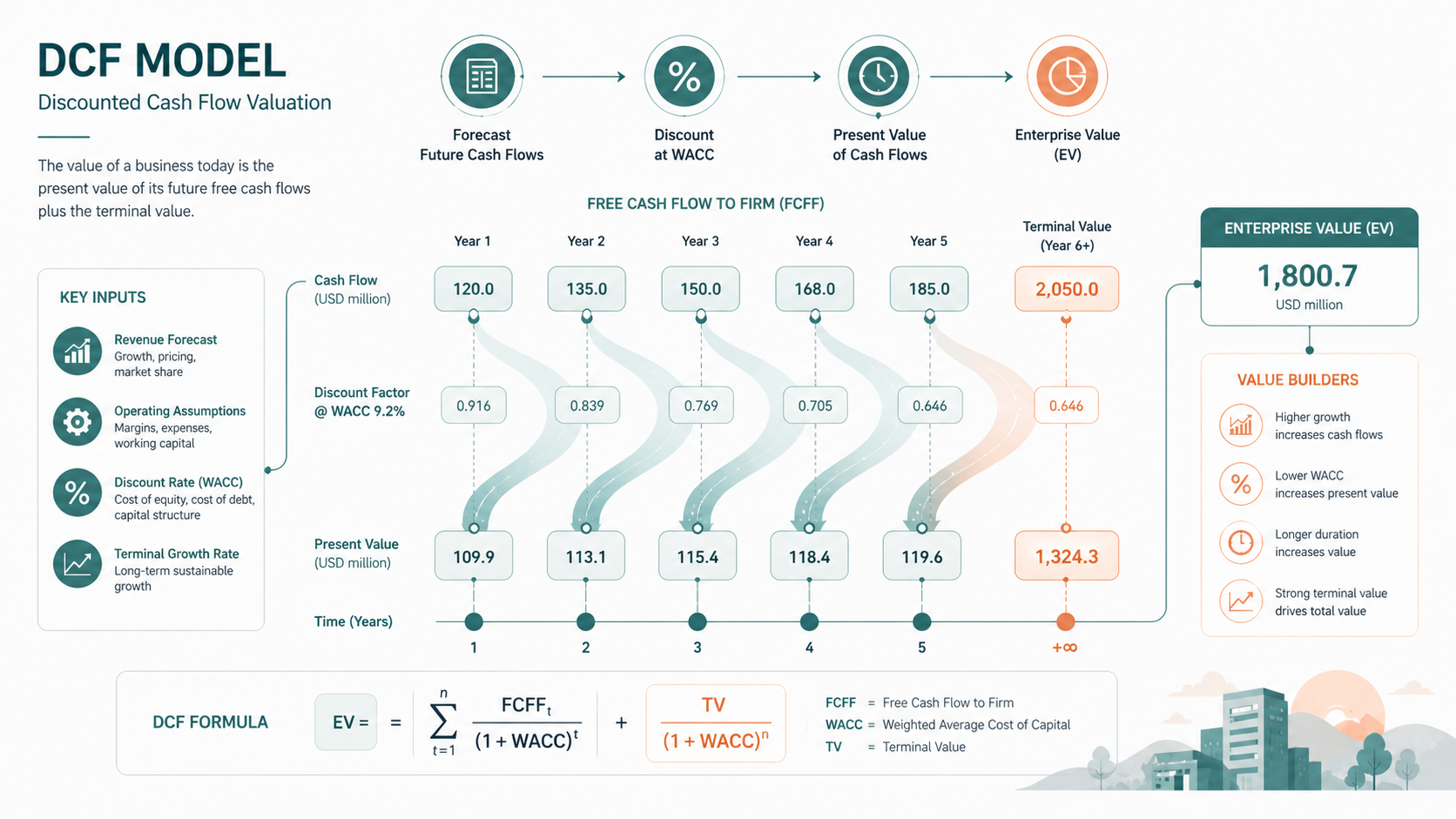
Business sales hinge on valuation, and DCF dominates because it forecasts value from future cash generation—the ultimate measure of a company’s worth. Unlike simpler methods like earnings multiples, DCF accounts for time value of money, growth rates, and risks specific to your operations.
For sellers, ignorance of DCF means ceding control. Buyers use it to justify lower bids, applying aggressive assumptions that undervalue predictable revenues or synergies. Understanding the mechanics lets you counter with data-backed projections, potentially adding millions to your exit price.
Consider a mid-sized Vietnamese exporter: without DCF insight, the owner accepted a 4x EBITDA multiple. Armed with a proper model showing 15% annual growth, a revised offer hit 7x. This isn’t luck—it’s preparation. DCF reveals hidden levers like working capital efficiency or capex needs, which buyers scrutinize.
Moreover, in competitive auctions, multiple bidders compare DCF outputs. Sellers who provide clean, auditable inputs stand out, accelerating bids and reducing discounts for uncertainty. It’s not just about the number; it’s about demonstrating foresight in an uncertain market.
Finally, tax implications tie back to DCF. Accurate valuation minimizes disputes with authorities, ensuring you retain more proceeds post-sale. Owners who skip this prep risk audits or renegotiations years later.
DCF from a seller’s perspective
From where you sit, DCF translates your vision into numbers. Start with free cash flow (FCF): operating cash minus capex and working capital changes. Project this over 5-10 years, applying a growth rate grounded in historical trends and market data.
Sellers often overlook terminal value—the bulk of DCF worth post-explicit forecast. Use the Gordon Growth Model: final FCF times (1 + perpetual growth) divided by (discount rate minus perpetual growth). Conservative assumptions here slash value dramatically.
Discount rate, typically WACC (weighted average cost of capital), reflects risk. For Vietnamese firms, factor in local beta, debt costs around 8-10%, and equity premiums adjusted for emerging market risks. Sellers can influence this by highlighting stable contracts or diversification.
Key seller tip: Normalize earnings first. Strip out one-offs like owner perks or non-recurring expenses. This upfront work aligns your books with buyer models, avoiding diligence red flags.
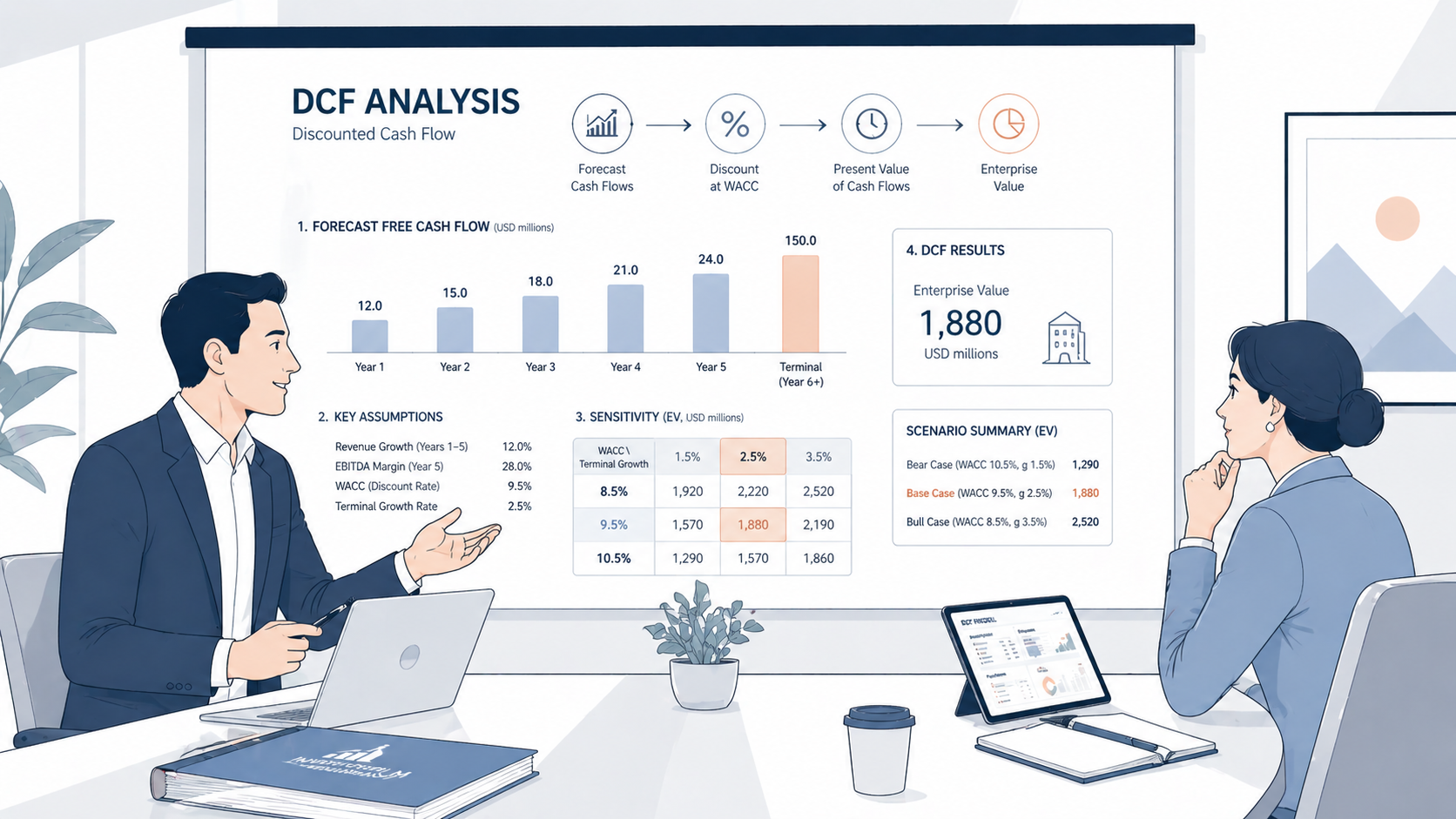
Run scenarios—base, optimistic, pessimistic—to show resilience. Buyers appreciate this; it builds trust and justifies higher valuations. Tools like Excel suffice, but professional audits add credibility.
In practice, a tech services firm used seller-led DCF to highlight recurring revenue, shifting buyer focus from cyclical risks to SaaS-like stability, boosting value by 25%.
How investors view this issue?
Buyers treat DCF as a reality check against gut feel. They stress-test your projections, often haircutting growth by 2-5% and hiking discount rates for execution risks. Strategic acquirers layer in synergies, but independents stick to standalone value.
Private equity favors DCF for IRR calculations—ensuring 20-30% returns. They probe capex sustainability and margin expansion, discounting firms with high owner dependency.
In Vietnam, foreign investors adjust for currency volatility and regulatory shifts, pushing discount rates to 12-15%. They demand audited financials to validate FCF, viewing discrepancies as red flags.
Corporates seek bolt-on fits, using DCF to quantify accretion. If your model shows EPS boost, expect premium offers. However, they discount heavily for integration risks.
Overall, investors see DCF as a negotiation anchor. Weak inputs invite lowballs; robust ones spark bidding wars.
Common seller mistakes
Sellers frequently botch DCF by projecting unrealistic growth—chasing 30% without market backing. Stick to 1-3 year historical compounds, tapering to GDP levels.
Ignoring working capital swings is another trap. Buyers model net working capital as % of sales; spikes erode FCF. Review cycles quarterly.
Overlooking taxes in FCF calculations distorts outputs. Use effective rates post-diligence adjustments.
Mismatching discount rates plagues many. Generic 10% ignores industry beta or leverage. Benchmark against peers.
Terminal value errors abound: perpetual growth above 4% screams overoptimism. Tie to long-term inflation.
Finally, not sensitizing models leaves you vulnerable. Always present ranges.
Avoid these, and you’ll neutralize buyer pushback. For deeper financial prep, see our guide on preparing financial statements before selling a business.
Practical checklist or framework for business owners
Here’s a step-by-step framework to DCF-proof your business:
- Gather historicals: 3-5 years P&L, balance sheets, cash flows. Normalize for anomalies.
- Forecast revenue: Segment by customer/product, apply conservative drivers.
- Build expenses: Variable % sales, fixed with inflation. Stress margins.
- Calculate FCF: EBIT(1-tax) + depreciation – capex – ΔNWC.
- Estimate WACC: Cost of debt, equity (CAPM), target capital structure.
- Project explicit period: 5 years, then terminal value.
- Discount and sum: NPV of FCFs + terminal.
- Sensitize: ±1-2% growth, ±2% WACC.
- Validate: Cross-check with multiples, precedent transactions.
- Document assumptions: Create a data room section.
Preparing a data room early supports this. Download our seller readiness checklist for templates.
When should sellers start preparing?
Begin 12-18 months pre-market. Align financials with 12-month preparation checklist timelines.
Quarterly reviews keep projections fresh. Engage advisors 6-9 months out for model builds.
If founder-dependent, address now—buyers haircut DCF heavily. Build management depth per our insights on building a management team before selling.
Market timing matters: Prep during upcycles for stronger baselines.
How this connects to the overall business sale journey
DCF threads through every stage. Pre-marketing: Builds your asking price. Teaser/IM: Highlights FCF strength. Due diligence: Validates inputs. Negotiation: Counters lowballs.
It links to legal prep, ensuring clean contracts for projections. Ties to attractiveness—how to make your business attractive to buyers starts with solid financials.
Post-LOI, DCF confirms adjustments. Ultimately, it positions you for optimal outcomes in Vietnam’s M&A landscape. Visit our M&A blog for more.
Ready to strengthen your valuation? Download our seller checklist.
Take the first step today. Start your M&A journey or book a confidential call with an advisor.