Building a Management Team Before Selling Your Business

Why founder dependency can derail your business sale
In the world of mergers and acquisitions, few issues can sink a deal faster than heavy reliance on the founder. Imagine pouring years into building your company, only to watch potential buyers hesitate because they can’t envision it thriving without you at the helm. This “key person risk” is a silent valuation killer, often slashing offers by 20-30% or more. Business owners who recognize this early can transform their exit prospects by strategically building a capable management team.
Buyers—whether strategic acquirers or private equity firms—prioritize businesses that run smoothly on their own. A strong management bench signals stability, scalability, and reduced integration risks. Without it, you’re selling a job, not a business. Recent insights underscore this: assessing company readiness for M&A in 2025 emphasizes management depth, while succession planning emerges as critical for effective capital allocation. Even in specialized sectors like fintech, checklists for successful deals highlight leadership continuity.
This guide breaks down why building your management team matters, how to do it right, and the pitfalls to avoid. Whether you’re eyeing an exit in the next year or three, starting now positions you for maximum value.
Table of Contents
- Why business owners need to understand building a management team before selling
- Building a management team from a seller’s perspective
- How investors view this issue
- Common seller mistakes
- Practical checklist for business owners
- When should sellers start preparing
- How this connects to the overall business sale journey
Why business owners need to understand building a management team before selling
Most mid-sized businesses start as founder-led operations. You wear multiple hats—CEO, salesperson, operations lead—driving growth through personal networks and vision. This works brilliantly in the early stages but becomes a liability as you approach a sale.
Buyers scrutinize leadership depth during due diligence. Without a proven team, they worry about post-sale disruptions: customer churn, operational hiccups, or stalled innovation. Data from countless deals shows that founder-dependent companies trade at lower multiples. A robust management team mitigates this, proving your business has institutional momentum.
Understanding this dynamic empowers you to act proactively. It’s not just about hiring; it’s about creating systems where decisions don’t bottleneck at the top. This preparation elevates your company from “promising but risky” to “plug-and-play attractive.” In 2025’s competitive M&A landscape, readiness checklists increasingly spotlight management as a core pillar. Neglect it, and you’re handing buyers leverage to negotiate down your price.
From valuation to deal speed, a strong team influences every stage. Owners who grasp this shift their focus from daily firefighting to strategic handover, unlocking higher offers and smoother closes.

Building a management team from a seller’s perspective
As a seller, your goal is to make the business self-sustaining. Start by mapping your role: identify tasks only you handle and delegate them systematically. This isn’t dilution—it’s amplification.
Begin with key hires or promotions. Prioritize roles like COO for operations, CFO for finance, and heads for sales and product. Look internally first; promoting high-performers builds loyalty and continuity. External talent brings fresh perspectives but requires longer onboarding.
Document processes meticulously. Create playbooks for core functions—sales pipelines, inventory management, customer onboarding. Tools like shared drives or software (e.g., Asana, Notion) ensure knowledge transfer. Train deputies to lead without your input, then test by stepping back for weeks.
Culture matters too. Instill values that outlast you. Regular team meetings, clear KPIs, and merit-based advancement foster ownership. Track metrics like employee retention and decision-making speed to quantify progress.
Sellers often overlook soft skills. Build a team with complementary strengths—your visionary style paired with executors. This balance reassures buyers of long-term viability. Over time, you’ll spend less time in the weeds, freeing you to focus on growth and exit strategy.
How investors view this issue
Investors—PE firms, strategics, family offices—approach management through a risk lens. They ask: Can this business survive a leadership vacuum? Depth is non-negotiable.
Private equity buyers favor “owner-independent” targets. They model scenarios where the founder exits day one, valuing teams with 3-5 years’ tenure in C-suite roles. Succession planning ranks high; without named successors and development plans, deals falter.
Strategics seek synergies but dread integration chaos. A cohesive team accelerates that, often justifying premium multiples. In fintech, for instance, effective M&A checklists stress leadership alignment to capture deal value.
They probe via references, org charts, and trial periods. Metrics like management span of control (teams per leader) and bench strength (backups per role) inform their bids. Weak spots trigger earn-outs or escrows, deferring your payout.
Investors reward foresight. Companies with formal succession plans close 40% faster at 15-25% higher valuations. Present your team as a competitive edge, backed by performance data.
Common seller mistakes
Sellers trip up in predictable ways when building teams pre-sale.
- Hasty hires: Rushing CV screening without cultural fit leads to mismatches. Buyers spot this in due diligence.
- No documentation: Verbal knowledge transfer fails. Always formalize processes.
- Overlooking backups: One strong No. 2 isn’t enough; build depth across levels.
- Founder micromanaging: Lingering control undermines credibility. Delegate fully and visibly.
- Ignoring compensation: Underpaying executives risks poaching post-sale. Benchmark market rates.
Many delay until marketing the deal, but buyers demand proof of 12+ months’ stability. First-time sellers, in particular, underestimate this—check out our post on common mistakes first-time sellers make. Another pitfall: neglecting diversity. Homogeneous teams signal stagnation to modern buyers.
Avoid these by treating team-building as a core exit milestone, not an afterthought.
Practical checklist or framework for business owners
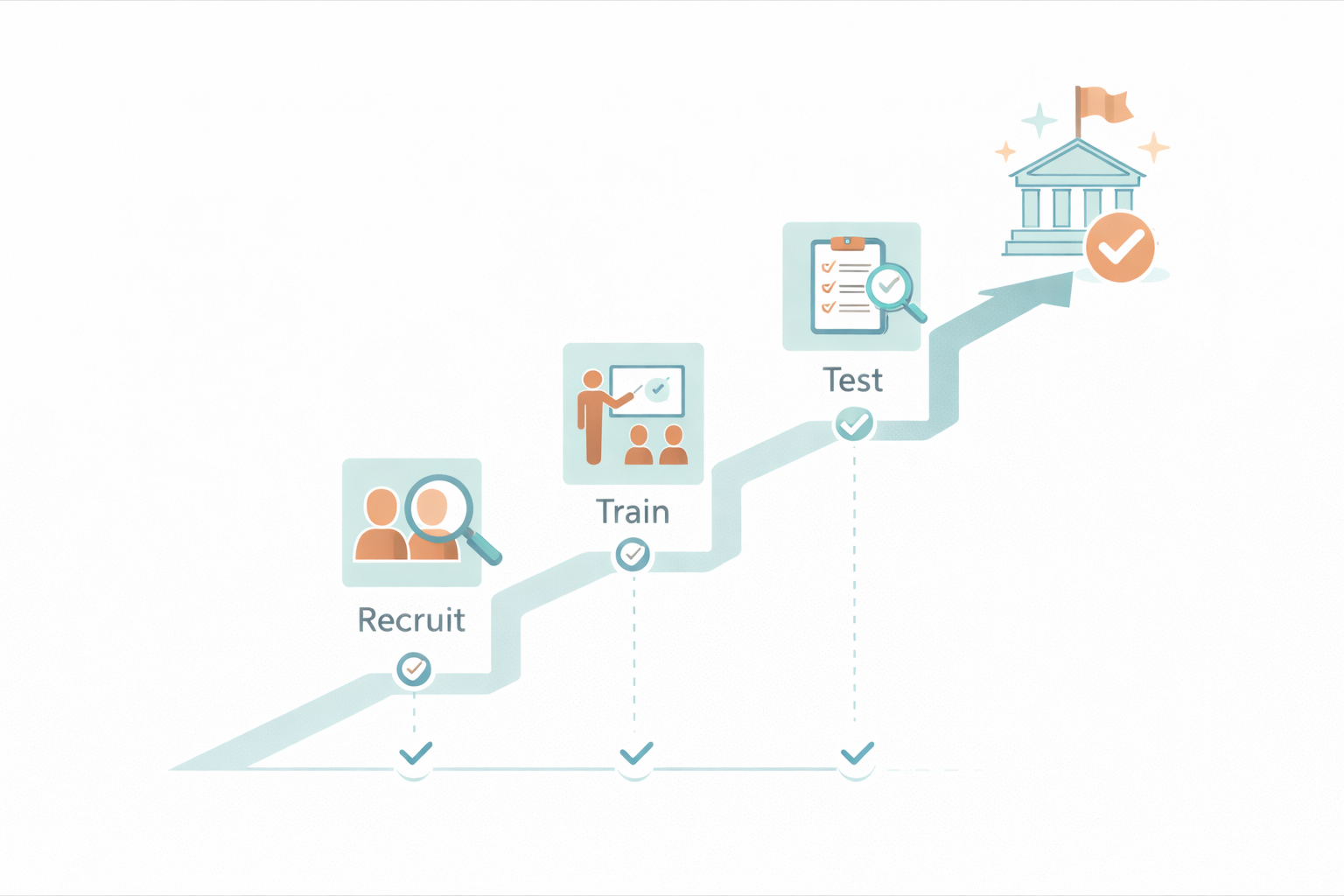
Here’s a step-by-step framework to build your management team effectively. Adapt to your size and timeline.
Phase 1: Assess (Months 1-3)
- Conduct a dependency audit: List all decisions/tasks tied to you.
- Map current org chart: Identify gaps in key functions.
- Benchmark against peers: Use industry data for role definitions.
Phase 2: Recruit & Develop (Months 4-12)
- Hire strategically: Target 2-3 C-level roles. Use recruiters for quality.
- Invest in training: Leadership programs, mentorship.
- Implement KPIs: Tie comp to results for accountability.
Phase 3: Test & Embed (Months 13-18)
- Run simulations: Founder “vacations” to test autonomy.
- Document everything: Playbooks, SOPs, succession matrix.
- Gather feedback: 360 reviews to refine.
Phase 4: Showcase (Ongoing)
- Update investor decks with team bios and achievements.
- Prep for DD: Reference letters, performance histories.
This mirrors readiness checklists for 2025 M&A, ensuring holistic preparation. For a broader view, see our 12-month preparation checklist.
When should sellers start preparing
Ideal timeline: 18-24 months pre-sale. This allows organic integration, avoiding red flags of rushed changes.
If closer, prioritize high-impact roles like operations and finance. Early starters align with cyclical markets—position for 2025 upticks.
Triggers: Approaching peak valuation, personal burnout, or buyer inquiries. Succession planning is critical here, preventing disruptive capital allocation issues.
Don’t wait for perfection; 80% readiness beats delay. Track via milestones: team in place, processes live, proven results.
How this connects to the overall business sale journey
Team-building interlocks with financial prep, legal cleanup, and marketing. Strong management enhances financials (better reporting) and speeds due diligence.
It ties to the full process: from how M&A works in real life to closing. Link it to preparing financial statements—a solid team ensures clean books.
For deeper insights, visit our M&A blog or explore the M&A glossary.
Ready to assess your readiness? Download our seller checklist.
Take the first step today. Start your M&A journey.
Need personalized advice? Book a confidential call with our team.