Founder Dependency Risk in M&A: What Sellers Must Know

Is your business secretly too dependent on you?
As a business owner eyeing an exit, you’ve built something remarkable. But what happens when buyers dig into your operations and realize the company rises and falls with your daily involvement? Founder dependency risk is one of the most overlooked threats in M&A deals, quietly eroding valuations and scuttling transactions before they even reach the finish line.
Imagine this: A prospective buyer reviews your financials, loves the growth trajectory, and starts envisioning synergies. Then, they uncover that key client relationships, strategic decisions, and even day-to-day operations hinge on you—the founder. Suddenly, the deal’s momentum stalls. Investors see heightened risk, demand discounts, or walk away entirely. In today’s discerning market, where venture capital and private equity investments in Vietnam dropped 35% to $2.3 billion in 2024, buyers are pickier than ever, scrutinizing every potential vulnerability.
This isn’t just theory. Companies like VinFast have captured attention with surging EV deliveries and models like the VF 8 Eco, yet even high-flyers face valuation pressures if scalability beyond the founder is unclear. Globally, M&A trends point to a 2026 outlook favoring structured, resilient businesses, as outlined in industry analyses. For mid-market sellers, structuring transactions demands addressing these risks head-on.
Understanding founder dependency isn’t about diminishing your achievements—it’s about fortifying your business for maximum value. In this guide, we’ll break it down practically, from investor perspectives to actionable checklists, helping you mitigate risks and position your company as a turnkey opportunity.
Table of Contents
- Why business owners need to understand founder dependency risk before selling
- Founder dependency risk from a seller’s perspective
- How investors view this issue
- Common seller mistakes
- Practical checklist or framework for business owners
- When should sellers start preparing
- How this connects to the overall business sale journey
Why business owners need to understand founder dependency risk before selling
Founder dependency manifests when a business’s success is disproportionately tied to the founder’s personal attributes—relationships, expertise, or decision-making—rather than scalable systems. Before listing your company, grasp this risk because it directly impacts deal viability and pricing.
In competitive M&A landscapes, especially with guides emerging for foreign investors targeting Vietnam through 2026, buyers prioritize businesses that can thrive post-sale without disruption. A dependent company signals operational fragility, prompting buyers to factor in transition costs, retention risks, or outright failure probabilities.
Quantitatively, this erodes value. Buyers apply higher discount rates or haircut multiples—often 20-50% off comparable valuations like those scrutinized for PepsiCo amid softer share returns. Your EBITDA multiple shrinks because the business isn’t “founder-proof.”
Qualitatively, it prolongs due diligence. Investors probe deeper into org charts, client contracts, and IP ownership, delaying closes and increasing costs. Proactive sellers who address this early command premiums, turning a liability into a selling point: “Our team runs the show seamlessly.”
Neglect it, and you risk deal collapse. Many owners assume their indispensability boosts value—it’s the opposite. Buyers want plug-and-play assets, especially in mid-market deals where structuring insights emphasize team depth over individual heroics.

Founder dependency risk from a seller’s perspective
From where you sit, building the business solo or with a tight team feels like a strength. You’ve nurtured every client win, innovated through crises, and embodied the vision. But this intimacy creates blind spots.
Key signs include: you signing off on major deals, holding unique industry knowledge, or being the sole rainmaker for top revenue. Employees defer to you excessively, processes lack documentation, and growth plateaus without your direct input.
For sellers, the pain is real. It caps exit multiples and forces earn-outs, where you stay on longer than desired, tying wealth to future performance. In Vietnam’s evolving market, with strategic guides for 2026 highlighting foreign investor caution, unaddressed dependency amplifies scrutiny.
Yet, it’s fixable. Transitioning from operator to overseer builds enterprise value. Document your playbook, delegate authority, and cultivate successors. Sellers who do this report smoother negotiations and higher closes—transforming “my baby” into a professional machine.
Consider the emotional side: Letting go feels vulnerable, but it’s liberating. Your legacy endures through a self-sustaining entity, not perpetual involvement.
How investors view this issue
Buyers—strategics, private equity, or family offices—approach founder dependency as a red flag cluster. They model scenarios: What if the founder leaves Day 1? Revenue drops? Key talent follows?
In valuation exercises, like those reassessing VinFast after delivery surges, investors stress-test scalability. Dependency inflates risk premiums, lowering IRR projections. PwC’s global M&A 2026 outlook underscores this: Resilient, team-led firms dominate deal flow.
PE firms, facing a 35% investment dip to $2.3 billion in Vietnam’s VC/PE space in 2024, demand evidence of independence. They seek audited succession plans, diversified leadership, and metrics proving performance sans founder.
Strategics worry about cultural clashes or integration hiccups if the founder’s style doesn’t mesh. Mid-market transaction structuring, per practical insights, prioritizes warranties against key-person risks.
Ultimately, investors buy cash flows, not charisma. Prove continuity, and you’ll unlock better terms.
Common seller mistakes
Sellers often stumble here, amplifying risks unintentionally.
- Ignoring early warning signs: Dismissing feedback like “too founder-centric” during informal chats.
- Overstating team strength: Claiming “great bench” without proof, exposed in diligence.
- Resisting delegation: Micromanaging pre-sale, reinforcing perceptions.
- Poor documentation: No manuals, SOPs, or cross-training records.
- Neglecting client diversification: Top accounts linked to personal ties.
- Timeline compression: Waiting until LOI to address, when fixes are rushed and unconvincing.
Avoid these by self-auditing rigorously. Many first-timers fall prey, as detailed in resources on common mistakes first-time sellers make.
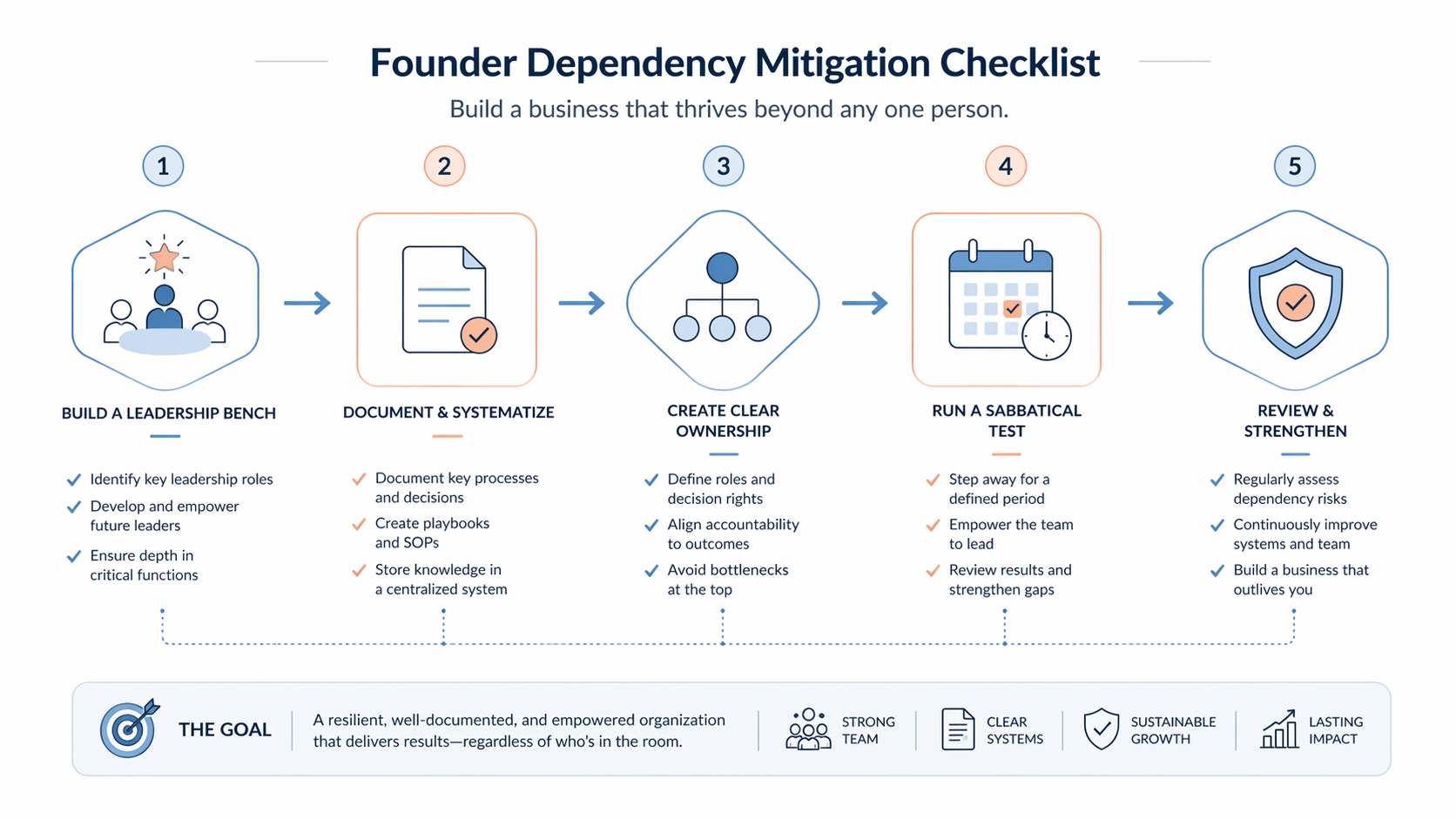
Practical checklist or framework for business owners
Here’s a step-by-step framework to diagnose and mitigate founder dependency. Implement over 6-12 months for credibility.
- Assess dependency depth: Map your involvement across functions (sales, ops, strategy). Score 1-10; target under 3 everywhere.
- Build the leadership bench: Identify/promote No. 2s. Give them P&L skin in the game.
- Document institutional knowledge: Create playbooks for processes, client histories, vendor relations.
- Test run independence: Take a 4-week sabbatical. Monitor KPIs—fix drops.
- Diversify relationships: Transition clients to team members; formalize non-competes.
- IP and systems audit: Ensure company owns all assets, not you personally.
- Third-party validation: Get advisor sign-off on readiness.
- Communicate progress: Weave into teaser memos: “Proven management continuity.”
This mirrors prep in 12-month preparation checklists. For financial tie-ins, review preparing financial statements.
When should sellers start preparing
Start yesterday—but realistically, 12-24 months pre-market. Early action yields organic fixes; last-minute scrambles ring hollow.
Triggers: Approaching peak valuation (e.g., post-growth spurt like VinFast’s), personal life shifts, or market windows per 2026 outlooks.
Align with holistic prep, including legal preparation. Download our seller readiness checklist for a full roadmap.
How this connects to the overall business sale journey
Founder dependency threads through every M&A stage. Pre-marketing: Self-assess to set realistic expectations. Teaser phase: Highlight mitigations. Diligence: Provide evidence packs. Negotiation: Resist dependency-based discounts.
It dovetails with timing decisions (when to sell), capital alternatives, and motivations (why owners sell).
Visit our M&A blog for more, or start your M&A journey.
Ready to assess your readiness? Download our seller checklist.
Take the next step confidentially. Book a confidential call with our team.