How to Control Information Flow During Due Diligence

Information Flow Can Protect or Damage a Deal
Due diligence is often described as a buyer’s investigation. For sellers, that definition is incomplete. In practice, due diligence is also a controlled information process: what you disclose, when you disclose it, who receives it, how it is explained, and how quickly questions are answered can influence valuation, trust, negotiation leverage, and the probability of closing.
Many business owners assume that being transparent means releasing everything as soon as a buyer asks. That is not the right standard. A well-run process is transparent, but not chaotic. It gives serious buyers enough information to make informed decisions while protecting sensitive commercial, employee, customer, technology, pricing, and personal data. This balance matters even more as cybersecurity, data protection, and AI-assisted due diligence become more prominent in transactions.
For owners preparing to sell, information flow is not an administrative detail. It is a strategic discipline. Poorly controlled disclosure can create unnecessary anxiety, trigger internal rumors, weaken commercial relationships, or give a buyer too much leverage before key deal terms are agreed. Properly managed disclosure, by contrast, helps buyers build confidence without giving away the company’s negotiating position.
This is why sellers should think about information flow before the data room opens, not after the first buyer question arrives.
Table of Contents
- Why business owners need to understand information flow before selling?
- Information flow from a seller’s perspective
- How investors view this issue?
- Common seller mistakes
- Practical checklist or framework for business owners
- When should sellers start preparing?
- How this connects to the overall business sale journey
Why Business Owners Need to Understand Information Flow Before Selling?
Business owners usually focus on valuation, buyer interest, and legal documents when thinking about a sale. Those areas are important, but they depend heavily on something less visible: the credibility of the information provided to buyers. A buyer can only price, negotiate, and approve a transaction based on what it understands. If the information is incomplete, inconsistent, delayed, or poorly explained, the buyer’s natural response is to increase caution.
That caution can appear in several ways. The buyer may ask for a lower valuation, request stronger indemnities, delay signing, widen the scope of due diligence, or ask for more aggressive conditions precedent. In some cases, the buyer may lose confidence altogether, even if the underlying business is attractive.
Information flow matters because due diligence is not only about facts. It is also about interpretation. Two companies can provide the same financial statements, contracts, and operational reports, yet create very different impressions. One seller provides context, reconciliations, clear folder structures, controlled access, and timely responses. Another uploads scattered documents, gives contradictory explanations, and allows multiple team members to answer buyer questions without coordination. The second seller may appear less organized, even if the business itself is fundamentally strong.
For owners considering a sale, the key point is simple: buyers do not only evaluate the company; they evaluate the seller’s control over the company. A disciplined information process signals that management understands its numbers, contracts, risks, and operations. A disorganized process suggests hidden problems, even where none exist.
This is particularly relevant in markets where cross-border investors are active and business practices may differ across jurisdictions. Buyers may be encouraged by a resilient M&A environment, but they will still expect professional information handling. A strong market does not excuse weak preparation. If anything, it raises the standard because quality buyers compare opportunities across sectors and countries.
Information control also protects confidentiality. During a sale process, sellers may disclose sensitive data that would be damaging if mishandled: customer concentration, supplier terms, margin by product line, employee compensation, pending disputes, proprietary technology, tax positions, and strategic plans. Even under a non-disclosure agreement, sellers should not treat every buyer as equally entitled to every document at every stage.
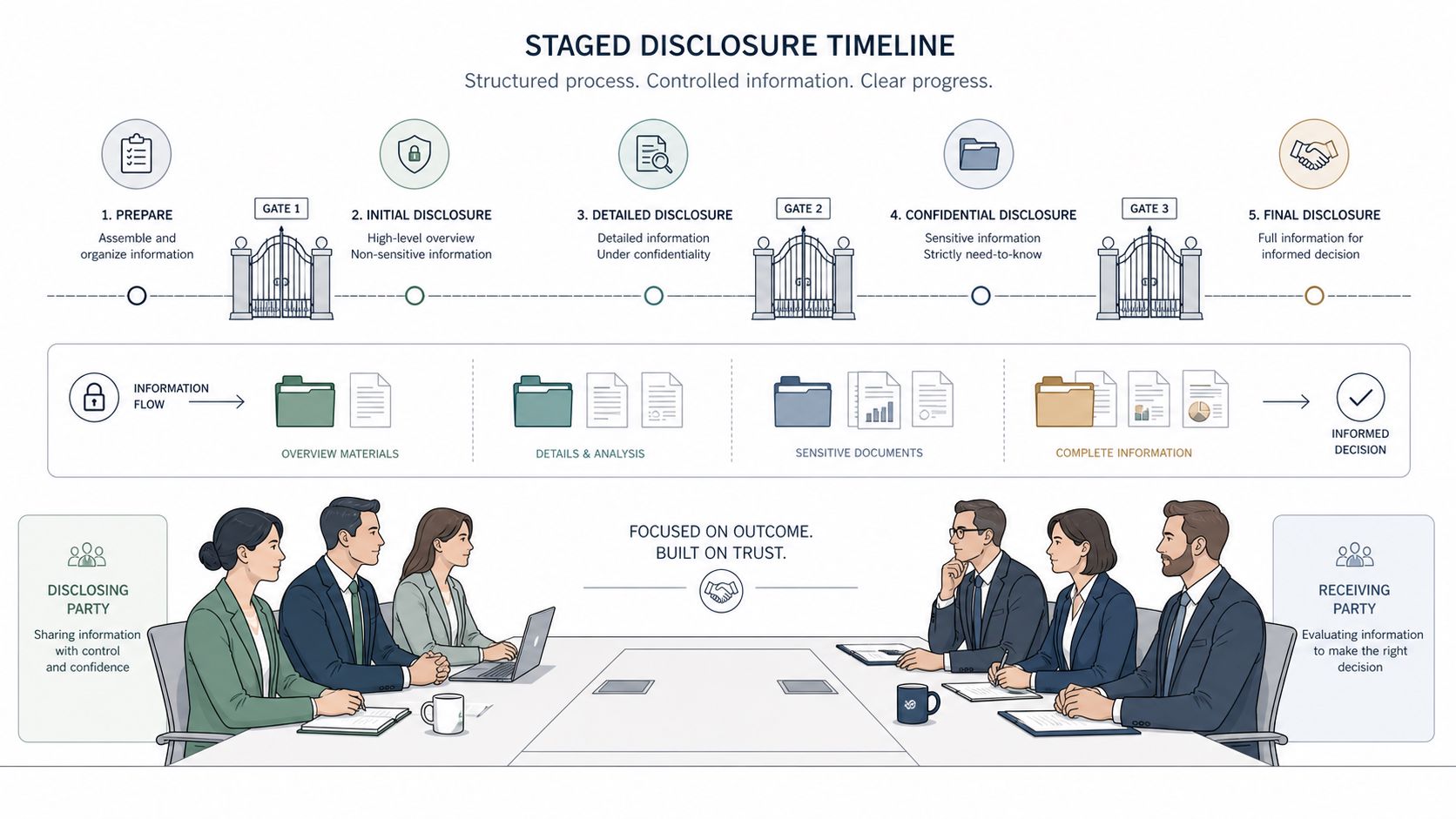
The principle is not secrecy. The principle is sequencing. Early-stage buyers need enough information to assess whether the opportunity fits their mandate. Shortlisted buyers need deeper financial, legal, commercial, tax, operational, and technology materials. A preferred bidder may need highly sensitive information before signing definitive documents. Each stage should have a purpose, a disclosure boundary, and a decision gate.
Modern data protection and cybersecurity expectations make this even more important. Businesses handling personal data, customer records, employee information, or digital systems should be careful about what is uploaded, who can access it, and whether documents contain information that should be redacted. Information flow is therefore both a transaction issue and a compliance issue.
Owners who are new to M&A often underestimate this point. They may think the buyer’s checklist is the process. It is not. The seller needs its own process. A buyer checklist tells you what the buyer wants. A seller information protocol determines what should be shared, when, in what format, under whose authority, and with what safeguards.
Information Flow from a Seller’s Perspective
From the seller’s perspective, due diligence should be designed around three objectives: build confidence, preserve leverage, and protect the business. These objectives are connected, but they are not identical.
Building confidence means giving buyers a reliable understanding of the company. This requires accurate financial information, organized supporting documents, clear explanations of key trends, and openness about material issues. A seller who tries to hide obvious problems usually damages credibility. Sophisticated buyers expect issues; they mainly want to know whether management understands them and whether the risks can be priced, mitigated, or contractually allocated.
Preserving leverage means avoiding unnecessary disclosure before the buyer has demonstrated seriousness. If a buyer has not signed an appropriate confidentiality agreement, has not submitted a credible indication of interest, or is still one of many early-stage parties, the seller should not release the most sensitive materials. Information has value. Once disclosed, it cannot be undisclosed.
Protecting the business means ensuring that the sale process does not disrupt employees, customers, suppliers, lenders, or competitors. In many private company transactions, the biggest risk is not only that a deal fails. The bigger risk is that the failed process leaves behind commercial damage. Employees hear rumors. Customers become uncertain. Suppliers ask questions. Competitors sense vulnerability. Information control helps prevent the sale process from becoming a business risk in itself.
A seller should therefore think in terms of information layers. The first layer may include a teaser, high-level financial summary, anonymized business overview, and selected non-sensitive operating metrics. The second layer may include a confidential information memorandum, management presentation, historical financial statements, customer segmentation without full customer names if appropriate, and summary legal information. The third layer may include a structured data room with detailed financial, legal, tax, HR, commercial, operational, and technology documents. The final layer may include highly sensitive documents such as customer contracts, employee-level data, source code information, pricing schedules, or pending dispute files, often released only to a preferred bidder or under enhanced restrictions.
This layered approach allows the seller to match disclosure depth with buyer commitment. It also creates a cleaner negotiation path. Before a letter of intent, the buyer receives enough to make a serious valuation proposal. After a letter of intent, the buyer receives deeper information to confirm the assumptions behind that proposal. If the buyer attempts to renegotiate later, the seller can assess whether the concern is based on genuinely new findings or simply deal tactics.
Good information flow also requires internal discipline. Not everyone in the company should communicate directly with the buyer. The seller should identify a small transaction team, usually involving the owner, CFO or finance lead, legal counsel, tax advisor, and M&A advisor. Questions should be centralized. Answers should be reviewed. Materials should be version-controlled. If management gives different answers in different meetings, the buyer will notice.
For business owners who are still early in preparation, it is useful to review what buyers typically examine during diligence. A practical starting point is this guide on what investors look for during due diligence, because information flow is easier to control when you understand the buyer’s likely areas of focus.
Another seller-side concern is narrative. Documents alone rarely tell the full story. A decline in gross margin may reflect a deliberate shift toward larger customers. A working capital spike may reflect seasonality. A customer concentration issue may be mitigated by long-term renewal history. A tax adjustment may be historical and non-recurring. If sellers provide documents without explanation, buyers may assume the worst. If sellers provide explanations without documents, buyers may doubt the explanation. The strongest process combines evidence with context.
This is especially relevant as AI tools become more common in due diligence. AI can help investors process large document sets, identify anomalies, summarize contracts, and accelerate review. That does not remove the need for judgment. It increases the importance of clean, well-labeled, consistent information. If the data room contains duplicate files, inconsistent naming, outdated versions, or unexplained gaps, technology may accelerate confusion rather than clarity.
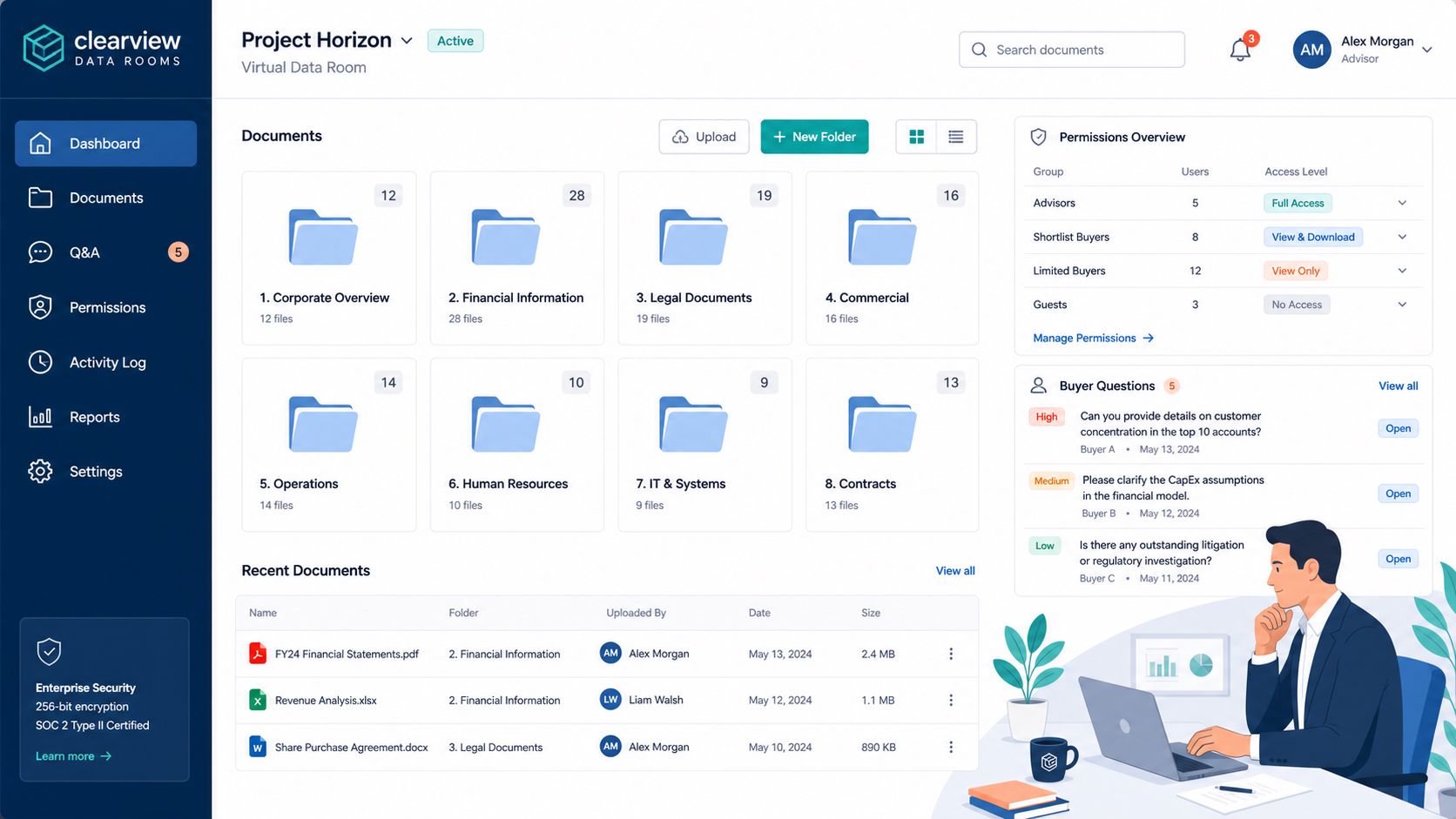
For sellers, the practical lesson is clear: do not wait for the buyer to impose order. Create order first. A well-structured data room and a disciplined Q&A process help ensure that buyer analysis starts from the right information base.
How Investors View This Issue?
Investors view information flow as a proxy for management quality. They rarely say it that directly, but it influences their behavior throughout the transaction. When a seller provides timely, accurate, organized information, investors become more comfortable that the company is professionally managed. When information is late, incomplete, or contradictory, investors begin to question not only the specific issue but the broader reliability of management reporting.
From an investor’s point of view, due diligence is a risk-reduction exercise. The buyer is trying to answer several fundamental questions. Are the earnings real? Are they sustainable? Are the contracts enforceable? Are there hidden liabilities? Are customer relationships stable? Are employees likely to remain? Are systems secure? Are regulatory obligations understood? Can the business continue to perform after closing?
Information flow affects every one of these questions. A buyer may not expect perfection, but it expects traceability. If revenue in the management accounts does not reconcile with tax filings or audited statements, the seller should be ready to explain why. If customer data is provided in summary form, the seller should be able to describe how the summary was prepared. If certain documents are withheld, the seller should explain the confidentiality rationale and define when access may be granted.
Investors also look for response quality. A fast but careless answer can be worse than a slower but accurate one. Sellers sometimes feel pressure to respond immediately to every buyer request. That can lead to mistakes, especially when different advisors or managers are involved. A better approach is to maintain a Q&A log, assign internal owners, review responses before release, and mark sensitive answers for legal or commercial review.
Professional buyers understand that not all information can be released immediately. They are generally more concerned with whether the seller has a clear process. If the seller says, “This document will be available after exclusivity,” or “Customer names will be disclosed to the preferred bidder under enhanced confidentiality,” that can be acceptable if the position is reasonable and consistently applied. What creates concern is arbitrary refusal, unexplained delay, or inconsistent treatment among buyers.
Investors may also interpret information control differently depending on the stage of the process. Before an indication of interest, limited disclosure is normal. After a signed letter of intent, deeper disclosure is expected. Before signing definitive agreements, material legal, financial, tax, operational, and compliance matters must be sufficiently transparent. If a seller continues withholding core information too late in the process, the buyer may assume there is a problem.
This is why sequencing is so important. The seller should not disclose everything at the beginning, but it must be prepared to disclose enough at the right time. Poor sequencing can create two opposite problems. Over-disclosure too early weakens the seller’s position and increases confidentiality risk. Under-disclosure too late damages trust and can delay or derail the deal.
Investors are also increasingly attentive to cybersecurity and data protection. When a company shares personal data, employee records, customer information, or system access materials, buyers will expect the seller to handle those materials responsibly. In a transaction environment where cybersecurity and data protection rules are a practical compliance concern for businesses, careless data room practices can raise avoidable questions. Sellers should consider redaction, access restrictions, watermarking, download controls, and staged disclosure for sensitive data.
AI-assisted diligence adds another layer. If investors use AI to review contracts, financial reports, or operational data, the quality of input becomes critical. Clear file names, consistent document versions, complete folders, and well-prepared indexes are no longer just administrative best practices. They shape how quickly and accurately the buyer can identify issues. A messy data room can produce more follow-up questions, more perceived risk, and more negotiation friction.
In short, investors view information flow as part of the investment case. A seller who controls information professionally helps the buyer say “yes” with confidence. A seller who manages information poorly gives the buyer reasons to hesitate, discount, or walk away.
Common Seller Mistakes
Most information-flow problems do not come from bad faith. They come from lack of preparation. Owners are busy running the company, and many have never been through a full M&A process before. As a result, they respond reactively to buyer requests rather than designing a controlled disclosure process.
1. Opening the data room before it is ready
One common mistake is launching a data room too early. The seller uploads documents gradually, folders are incomplete, file names are inconsistent, and key reports are missing. Buyers then form an early impression that the company is disorganized. Even if the seller later improves the data room, the first impression may remain.
A data room does not need to be perfect on day one, but it should be coherent. At minimum, the seller should have a logical folder structure, current financial information, key corporate documents, major contracts, tax filings, employee summaries, and a document index. For a deeper guide, sellers can refer to this article on how to structure an M&A data room.
2. Treating all buyers the same
Not every buyer should receive the same level of access. A strategic buyer who is also a competitor may require tighter controls than a financial investor. A buyer who has submitted a serious proposal may deserve deeper access than one still exploring the market. A preferred bidder may receive sensitive information that is not released to earlier-stage parties.
Equal process does not mean identical disclosure at every stage. It means applying a fair, consistent, and commercially rational disclosure policy.
3. Sharing sensitive information before deal terms are anchored
Some sellers release customer lists, pricing data, supplier terms, or employee-level compensation information before the buyer has made a credible valuation proposal. This can be risky. The buyer gains valuable intelligence while the seller receives little commitment in return.
A better approach is to release sensitive information only when it supports a specific transaction milestone. For example, detailed customer contracts may be released after a letter of intent, while highly sensitive customer contacts may be withheld until confirmatory diligence or signing preparations.
4. Allowing unmanaged communication
When buyers speak directly with multiple employees, accountants, lawyers, or managers without coordination, the process can quickly become inconsistent. Different people may answer the same question differently. Some may disclose information beyond their remit. Others may unintentionally raise concerns because they do not understand the transaction context.
The seller should define who communicates with the buyer, what topics each person can address, and how responses are approved. This is not about hiding information. It is about accuracy and consistency.
5. Answering questions without context
Buyers often ask narrow questions, but the answer may require explanation. If revenue dropped in one quarter, the buyer needs to know whether it was due to seasonality, customer timing, supply constraints, one-off events, or a structural decline. If a contract has unusual termination rights, the buyer needs to understand whether those rights have ever been used.
Short answers can create long problems. Sellers should provide enough context to prevent misinterpretation, while avoiding unnecessary commentary that creates new questions.
6. Ignoring data protection and confidentiality controls
Uploading unredacted personal data, unrestricted employee files, customer records, or confidential technical materials can create compliance and commercial risk. Sellers should think carefully before sharing personal information or commercially sensitive data. Where possible, they should use summaries, anonymized data, redactions, access controls, and staged disclosure.
7. Failing to track what has been disclosed
During a fast-moving process, sellers may forget which buyer received which document, when it was uploaded, and whether a newer version replaced an older one. This becomes especially dangerous if there are multiple bidders. Poor tracking can lead to inconsistent disclosure, confusion during negotiations, and difficulty responding to legal questions later.
A proper disclosure log is essential. It should record document names, upload dates, versions, access permissions, and major Q&A responses. This record can also support the disclosure process when negotiating representations, warranties, and indemnities.
Practical Checklist or Framework for Business Owners
Business owners do not need to become data room technicians, but they do need a practical framework. The goal is to create a process that is controlled enough to protect the company and clear enough to help buyers move forward.
Step 1: Define the disclosure stages
Before engaging buyers, decide what information will be available at each stage. A simple structure may include:
- Stage 1: Initial screening. Share a teaser, high-level company overview, broad financial indicators, and non-sensitive business highlights.
- Stage 2: Serious buyer review. Share a confidential information memorandum, management presentation, summary financials, key operating metrics, and selected non-sensitive supporting documents.
- Stage 3: Letter of intent and confirmatory diligence. Open a structured data room with detailed financial, legal, tax, HR, commercial, operational, and technology documents.
- Stage 4: Preferred bidder review. Release highly sensitive materials under enhanced confidentiality and access controls where commercially appropriate.
- Stage 5: Signing and closing preparation. Provide final disclosure schedules, bring-down confirmations, and documents needed for conditions precedent.
Step 2: Classify information by sensitivity
Not all documents carry the same risk. Classify materials into practical categories:
- Low sensitivity: general corporate overview, public-facing marketing materials, high-level organization chart, broad sector positioning.
- Moderate sensitivity: management accounts, customer segmentation, supplier summaries, employee headcount by function, operational KPIs.
- High sensitivity: customer names, pricing schedules, supplier contracts, employee compensation, litigation files, tax risk analysis, technology architecture.
- Restricted sensitivity: personal data, source code-related materials, trade secrets, customer contact details, board discussions, unresolved disputes, commercially delicate negotiations.
This classification helps the seller decide access rights, redaction needs, and disclosure timing.
Step 3: Build the data room around buyer logic
A good data room is not simply a document storage folder. It should follow how buyers think. Typical sections include corporate, financial, tax, legal, commercial, customers, suppliers, HR, operations, technology, compliance, real estate, insurance, and litigation. Each section should have clear file names and current versions.
If a document is missing, do not ignore it. Add a placeholder or note explaining its status. Silence creates more concern than a clear explanation.
Step 4: Prepare management explanations
Documents answer “what.” Management explanations answer “why.” Sellers should prepare concise explanations for the main issues buyers are likely to notice, such as:
- Revenue growth or decline by period
- Gross margin changes
- Customer concentration
- Related-party transactions
- Working capital movements
- One-off expenses or income
- Pending legal, tax, or regulatory matters
- Key employee dependency
- Technology, cybersecurity, or data protection issues
These explanations should be accurate, consistent, and supported by documents.
Step 5: Centralize Q&A
A controlled Q&A process is one of the most important tools in diligence. Every buyer question should be logged, assigned to an internal owner, reviewed, and answered through a central channel. The seller should avoid informal side answers unless they are part of an agreed management meeting process.
Good Q&A discipline reduces misunderstandings and helps the seller identify recurring buyer concerns. If several buyers ask about the same issue, it may need a better explanation or additional supporting material.
Step 6: Use access controls intelligently
Data room permissions should reflect sensitivity. Some documents may be view-only. Some may block downloads. Some may be watermarked. Some may be restricted to specific buyer representatives or advisors. Sellers should also consider whether competitor buyers need a clean team arrangement for commercially sensitive data.
Access controls should not be used to frustrate genuine diligence. They should be used to manage risk while allowing the buyer to complete its review.
Step 7: Review data protection implications
Before uploading documents, sellers should check whether they contain personal data or sensitive customer, employee, or system information. Data protection and cybersecurity rules are increasingly important for businesses, and transaction processes should reflect that reality. Practical measures may include redacting personal identifiers, sharing aggregated employee data first, restricting access to sensitive files, and confirming that the data room provider has appropriate security features.
Step 8: Keep a disclosure record
The seller should maintain a record of what was disclosed, when, to whom, and in which version. This is useful for process control and legal negotiations. If a buyer later claims it was not informed of a matter, the disclosure record may help clarify what was provided.
Step 9: Align advisors before buyer engagement
The seller’s advisors should agree on the information protocol before diligence begins. Legal counsel, tax advisors, finance advisors, and M&A advisors should understand disclosure stages, sensitive issues, and approval procedures. Misalignment among advisors can create delays and inconsistent messaging.
Step 10: Prepare the owner emotionally
Due diligence can feel intrusive. Buyers may ask detailed questions about decisions the owner made years ago. They may challenge accounting treatments, margins, contracts, employee arrangements, or customer risk. Owners should expect this. A controlled information process helps reduce frustration because the seller is not improvising under pressure.
Preparing to sell requires more than a valuation discussion. Use this seller readiness checklist to identify the information buyers are likely to request before the process begins.
When Should Sellers Start Preparing?
Sellers should start preparing information flow well before launching a sale process. Ideally, preparation begins six to twelve months before approaching buyers. For more complex companies, especially those with multiple entities, cross-border customers, regulated activities, significant technology assets, or historical tax and legal issues, preparation may need even longer.
The reason is straightforward: information problems are much easier to fix before a buyer is waiting. Once diligence begins, every delay has meaning. If the seller takes three weeks to produce basic financial reconciliations, the buyer may assume the finance function is weak. If contracts are missing, unsigned, or inconsistent, the buyer may question revenue quality. If employee data is incomplete, the buyer may worry about HR controls.
Early preparation allows the seller to identify and address gaps privately. This may include cleaning up corporate records, organizing contracts, reconciling management accounts, documenting related-party transactions, reviewing tax filings, preparing customer and supplier summaries, updating HR records, and assessing data protection practices.
It also allows the seller to decide how sensitive issues should be handled. Every company has issues. The question is whether they are understood, quantified, and explainable. For example, if there is customer concentration, the seller can prepare retention history, contract terms, renewal patterns, and relationship context. If there is founder dependency, the seller can show second-layer management responsibilities and transition planning. If there are unusual accounting adjustments, the seller can prepare reconciliations and supporting schedules.
Preparation should also include a dry run of buyer questions. The seller’s advisors can review the company as a buyer would, identify likely red flags, and help prepare responses. This is often uncomfortable, but it is much better to discover issues before the buyer does.
Timing also matters because AI-assisted due diligence may compress review periods. Buyers using technology tools may be able to process documents faster than before. That can be positive for sellers with clean information. It can be challenging for sellers with messy, inconsistent, or poorly labeled documents because issues may surface quickly and in volume. The seller should assume that buyers will become more efficient at finding inconsistencies.
Owners should not wait until they receive a buyer approach. By then, the process may already be moving. If the company is attractive, the owner may feel pressure to respond quickly. Without preparation, this can lead to rushed disclosure, weak controls, and avoidable mistakes.
A useful rule is this: if you would not be comfortable showing a document to a serious buyer tomorrow, you should know why. Maybe the document is outdated. Maybe it contains sensitive information. Maybe it needs explanation. Maybe it reveals a real issue that should be addressed. Whatever the reason, it is better to know early.
Sellers should also prepare internal communication protocols. In many transactions, only a small group inside the company knows about the sale process at first. The owner should decide who needs to know, when they need to know, and what they should say if approached. Confidentiality can be damaged by casual internal conversations as easily as by external leaks.
Customer and supplier communication should also be planned. In most cases, customers and suppliers are not contacted early in the process. Reference calls or consent requests may occur later, usually with careful sequencing. Sellers should not allow buyers to contact key commercial relationships without clear timing, scripts, and boundaries.
Finally, sellers should prepare for the possibility that diligence findings affect negotiation. A controlled process does not eliminate buyer concerns. It helps ensure concerns are based on facts, not confusion. If a genuine issue exists, early preparation gives the seller more options: fix it, explain it, price it, insure it, carve it out, or allocate it through transaction documents.
How This Connects to the Overall Business Sale Journey
Information flow is not a separate administrative task. It sits at the center of the entire business sale journey. It affects buyer selection, valuation, negotiation, legal documentation, closing certainty, and post-closing transition.
At the preparation stage, information flow determines whether the seller understands its own readiness. A company that cannot produce reliable financials, contracts, tax records, customer data, and operational metrics is not yet fully prepared for a serious process. That does not mean the company cannot be sold, but it may face more valuation pressure and execution risk.
At the buyer outreach stage, information flow protects confidentiality. The seller should share enough to attract serious buyers, but not so much that the market learns sensitive details. A well-written teaser and confidential information memorandum can create interest while preserving control.
At the offer stage, information flow helps anchor valuation. Buyers make preliminary offers based on the information available. If the information is clear and credible, the seller has a stronger basis to compare offers. If the information is vague, buyers may submit cautious offers or include broad assumptions that allow later price reductions.
At the diligence stage, information flow becomes a trust-building mechanism. Buyers test the claims made earlier in the process. If the data room supports the management story, confidence increases. If the data room contradicts the story, negotiation leverage shifts to the buyer.
At the legal documentation stage, information flow affects representations, warranties, disclosure schedules, indemnities, escrows, and conditions precedent. A well-documented disclosure process can reduce ambiguity. A poor process can create disputes over what was known, disclosed, or relied upon.
At the closing and transition stage, information flow supports continuity. The buyer needs enough knowledge to take ownership responsibly. The seller needs to provide this information without destabilizing employees, customers, or operations. Good information control before signing often leads to smoother integration after closing.
This is why sellers should view information flow as part of deal strategy. It is closely connected to valuation, risk allocation, and buyer confidence. It is also connected to the seller’s personal objective: completing the transaction without unnecessary disruption to the company they have built.
For owners at the beginning of the process, the most practical next step is to assess readiness. Which documents are available? Which are missing? Which contain sensitive information? Which issues require explanation? Which team members can support diligence discreetly? Which advisors should review the materials before buyers see them?
If you are still defining the broader sale process, you can start your M&A journey with an initial assessment of readiness, valuation considerations, and likely buyer expectations. If your company is already receiving buyer interest and you need to discuss confidentiality or diligence strategy, you may also book a confidential call.
Information flow is not about hiding weaknesses. It is about presenting the company accurately, professionally, and at the right level of detail for each stage. A seller who controls information well gives buyers fewer reasons to doubt, fewer reasons to delay, and fewer opportunities to reprice the deal unnecessarily.
The best sale processes feel calm from the outside because the seller has done the hard work before the buyer arrives. Documents are organized. Sensitive information is protected. Questions are tracked. Explanations are consistent. Advisors are aligned. The owner is prepared.
That level of control does not happen by accident. It is built deliberately, step by step, before due diligence begins.
Before opening your data room, pressure-test your readiness. Download our seller checklist.
If you are considering a sale and want a structured starting point, Start Here – The journey for business sellers.


