How Small Businesses Are Valued: A Guide for Sellers

Discovering the real value of your small business ahead of any sale
As a business owner eyeing an exit, you’ve poured years into building your company. But when it comes time to sell, the question looms large: how much is it really worth? Misjudging that value can derail deals, leave money on the table, or scare off buyers. In Vietnam’s dynamic M&A landscape, where 218 deals closed in just the first 10 months of the year, understanding small business valuation isn’t optional—it’s essential for maximizing your return.
Small businesses often trade hands differently from large corporations. Buyers focus on tangible cash flows, growth potential, and risks unique to smaller operations, like owner dependency or limited financial history. Yet many sellers dive in without a clear grasp, leading to frustration. This guide breaks it down practically, drawing from real market trends like the three drivers set to shape Vietnam’s M&A market in 2026 and infrastructure’s role as a catalyst in logistics deals. We’ll explore why valuation matters, how it’s calculated from your viewpoint, buyer perspectives, pitfalls to avoid, and a step-by-step framework to prepare.
Whether you’re in logistics, tech, or manufacturing, getting valuation right positions you for success amid ASEAN’s shift to more selective M&A activity with declining deal values. Let’s demystify the process so you can approach your sale with confidence.
Table of Contents
- Why business owners need to understand small business valuation before selling
- Small business valuation from a seller’s perspective
- How investors view this issue
- Common seller mistakes
- Practical checklist or framework for business owners
- When should sellers start preparing
- How this connects to the overall business sale journey
Why business owners need to understand small business valuation before selling
Valuation sets the foundation for every M&A transaction. For small business owners, it’s not just a number—it’s your leverage in negotiations. Without it, you risk accepting a lowball offer or pricing too high and killing momentum. In a market seeing robust activity, like Vietnam’s 218 M&A transactions over 10 months, sellers who know their worth close faster and at better multiples.
Consider the stakes: a 20% valuation gap on a $5 million business means $1 million lost. Understanding the process helps you spot red flags early, align expectations, and build a compelling story for buyers. It also informs strategic decisions, such as timing your exit amid trends like the selective phase in ASEAN M&A.
Moreover, valuation reveals hidden issues. If your numbers show volatility, addressing them pre-sale boosts appeal. Owners who grasp this often achieve 15-30% higher exits by preparing proactively. It’s about control—turning an emotional handover into a calculated financial win.
Small business valuation from a seller’s perspective
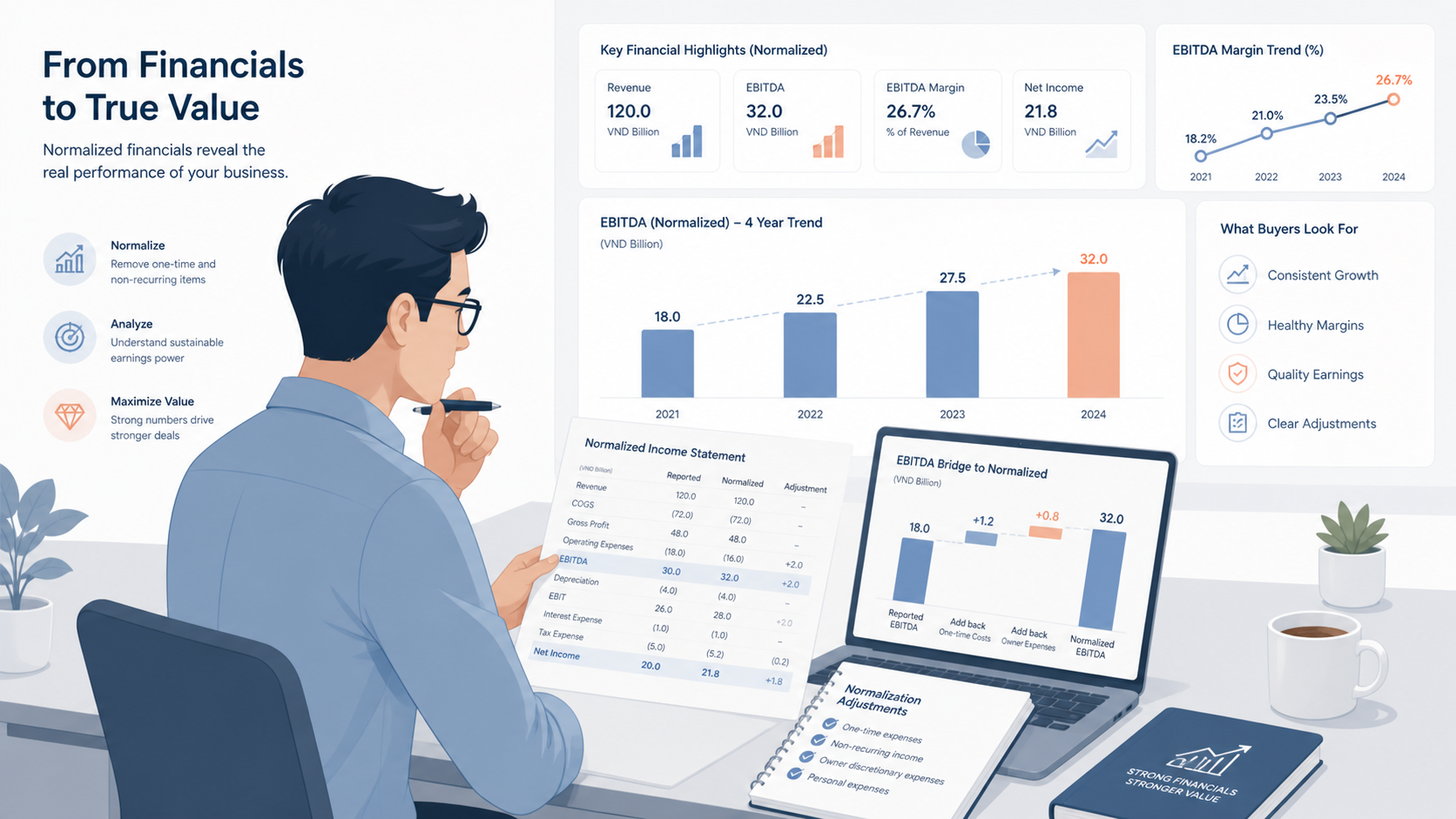
From where you sit, valuation boils down to proving your business generates reliable cash and has upside. Common methods include multiples of EBITDA, which normalize earnings to show true profitability. For small businesses, buyers apply 3-6x EBITDA, depending on sector and growth.
Revenue multiples suit early-stage firms, often 0.5-2x sales, but they’re less reliable without profits. Asset-based approaches value hard assets minus liabilities, ideal for asset-heavy operations like manufacturing. Discounted cash flow (DCF) projects future earnings, but it’s sensitive to assumptions—great for high-growth but tricky for stables.
In Vietnam’s context, where activities like M&A in logistics are catalyzed by infrastructure, buyers adjust for local factors like supply chain efficiencies. Check out our Valuation Multiples Explained for deeper insights, or What Is EBITDA in M&A to master key metrics.
Sellers should start with a professional appraisal, blending methods for a range (e.g., $3-4 million). Adjust for add-backs like owner perks, which can add 10-20% to normalized earnings. Focus on storytelling: highlight recurring revenue, customer concentration risks mitigated, and market positioning.
How investors view this issue
Buyers scrutinize small businesses for post-acquisition performance. They discount for risks like key-person dependency, thin margins, or cyclical sales. Strategic buyers seek synergies, paying premiums for bolt-on fits; financial buyers chase cash-on-cash returns, favoring stable EBITDA.
In ASEAN’s selective M&A phase, with deal values declining, investors prioritize quality. Vietnam’s market anticipates three key drivers in 2026, making scalable models attractive. They model scenarios: base, upside, downside, often haircutting projections by 20-30%.
Expect diligence on financials, customers, and ops. A clean data room accelerates this. Learn more in our Common Business Valuation Methods for Sellers.
Common seller mistakes
Sellers often overlook normalization, inflating earnings with unsustainable perks—buyers strip them out. Ignoring comparables leads to unrealistic asks; benchmark against recent deals.
Another pitfall: emotional pricing, ignoring market realities like Vietnam’s ongoing M&A discussions on status and solutions. Poor records delay diligence, eroding value. Rushing without a teaser or CIM exposes weaknesses early.
Neglecting growth narrative: buyers pay for potential, so quantify it. For deeper dives, see Key Factors Affecting Business Valuation and Why Similar Businesses Sell Differently.
Practical checklist or framework for business owners
Here’s a step-by-step framework to value your small business effectively:
- Gather financials: Compile 3 years of P&L, balance sheets, tax returns. Normalize for add-backs (personal expenses, one-offs).
- Calculate key metrics: EBITDA, revenue growth, customer retention. Use our M&A glossary for terms.
- Apply multiples: Research sector comps (3-5x EBITDA typical). Adjust for size, growth.
- Run scenarios: Low/medium/high cases via DCF or assets.
- Validate externally: Get advisor input or benchmark deals.
- Document story: CIM highlighting strengths, mitigations.
- Stress test: Simulate buyer adjustments.
This yields a defensible range. Tailor to trends like logistics M&A catalysts.

When should sellers start preparing
Begin 12-18 months pre-market. Early fixes like diversifying customers take time. Align with cycles: post-strong year, before economic dips. In Vietnam, with M&A status analyses ongoing, timing captures momentum toward 2026 drivers.
Download our seller readiness checklist to kick off.
How this connects to the overall business sale journey
Valuation threads through every stage: prep, marketing, diligence, close. It informs teasers, negotiates LOIs, and survives SPA adjustments. Integrate with exit planning—see Preparing a Data Room.
Strong valuation boosts buyer confidence, speeds processes. Visit our M&A blog for more.
Ready to assess your business? Start your M&A journey.
Need expert guidance? Book a confidential call with our advisors.