How Manufacturing Businesses Are Valued: A Seller’s Guide

Valuing your manufacturing business: The seller’s roadmap to maximum value
As a manufacturing business owner eyeing an exit, you know your operation inside out—from the hum of production lines to the precision of your supply chain. But when it comes to valuation, the numbers on your balance sheet tell only part of the story. Investors scrutinize everything from asset-heavy machinery to scalable processes, often arriving at figures that surprise even seasoned owners.
In today’s dynamic market, especially with sectors like manufacturing gaining traction amid Vietnam’s economic shifts, understanding how your business is valued can mean the difference between a solid deal and leaving money on the table. Recent trends show disciplined capital reshaping opportunities, with trackers highlighting manufacturing’s steady pulse as of April 2026. Residential deals may lead headlines, but manufacturing’s tangible assets and growth potential draw savvy buyers.
This guide breaks down the valuation process from your perspective as a seller. We’ll explore why it matters, common pitfalls, and actionable steps to position your business for top dollar. Whether you’re dealing with construction materials or broader production, getting valuation right starts with preparation.
Table of Contents
- Why business owners need to understand manufacturing business valuation before selling
- Manufacturing business valuation from a seller’s perspective
- How investors view this issue
- Common seller mistakes
- Practical checklist or framework for business owners
- When should sellers start preparing
- How this connects to the overall business sale journey
Why business owners need to understand manufacturing business valuation before selling
Manufacturing businesses stand out in M&A due to their capital-intensive nature. Unlike service-based firms, your value hinges on physical assets, inventory turnover, and capacity utilization—metrics that buyers dissect rigorously. Without a grasp of these, sellers risk undervaluation or deal collapse.
Consider the stakes: A misaligned valuation expectation can derail negotiations early. Buyers apply sector-specific multiples, often lower for cyclical industries like manufacturing, adjusted for factors like raw material volatility. In Vietnam’s context, where manufacturing trackers note ongoing evolution as of April 2026, owners who ignore this face surprises.
Understanding valuation empowers you to highlight strengths—such as efficient plant operations or export-ready certifications—that command premiums. It also reveals weaknesses, like outdated equipment, before buyers do. Ultimately, this knowledge turns you from a reactive seller into a strategic partner, fostering trust and better terms.
For instance, asset replacement value often forms the floor for manufacturing valuations, protecting against lowball offers. But layering on earnings potential elevates it. Owners who study this pre-sale report higher multiples and smoother closings.
Manufacturing business valuation from a seller’s perspective
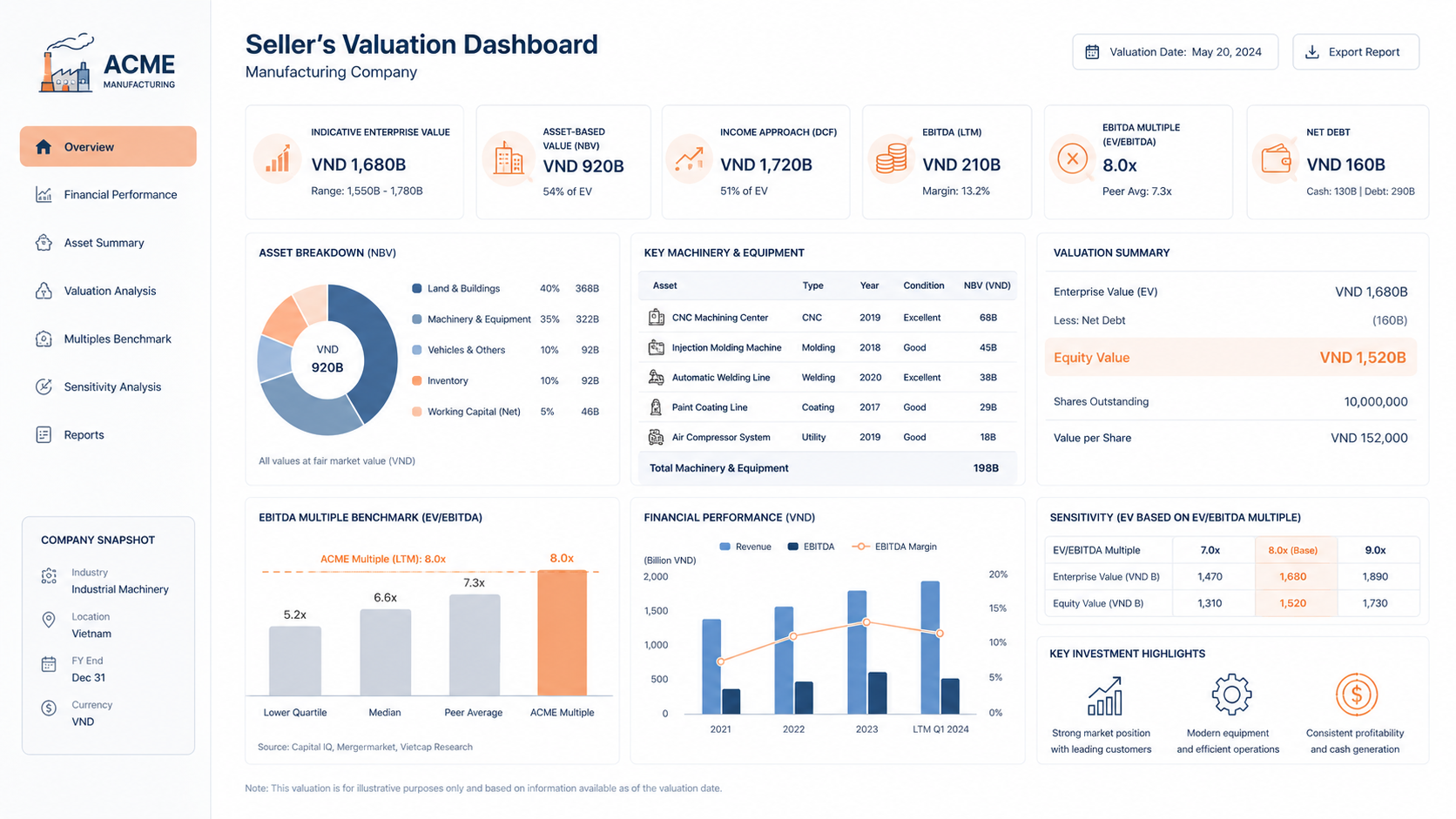
From where you sit, valuation isn’t abstract—it’s about quantifying years of sweat equity. Key methods include asset-based approaches, ideal for manufacturers with heavy machinery and real estate. Here, appraisers calculate fair market value of equipment minus depreciation, plus inventory at cost or net realizable value.
Income approaches like discounted cash flow (DCF) project future free cash flows, discounted at a rate reflecting manufacturing risks—think supply chain disruptions or commodity price swings. Multiples of EBITDA are common too, with manufacturing often trading at 4-8x normalized earnings, depending on subsector stability.
Common business valuation methods emphasize normalizing earnings by adding back owner perks, crucial for family-run plants. Market comparables draw from recent deals; for example, construction materials outlooks signal upward pressure on multiples amid infrastructure booms.
Sellers should focus on ‘add-backs’—non-recurring expenses—and growth stories. A Vietnam-focused lens reveals foreign investors eyeing disciplined plays, per 2025-2026 guides. Your edge? Documenting scalable capacity or tech upgrades that justify premium pricing.
How investors view this issue
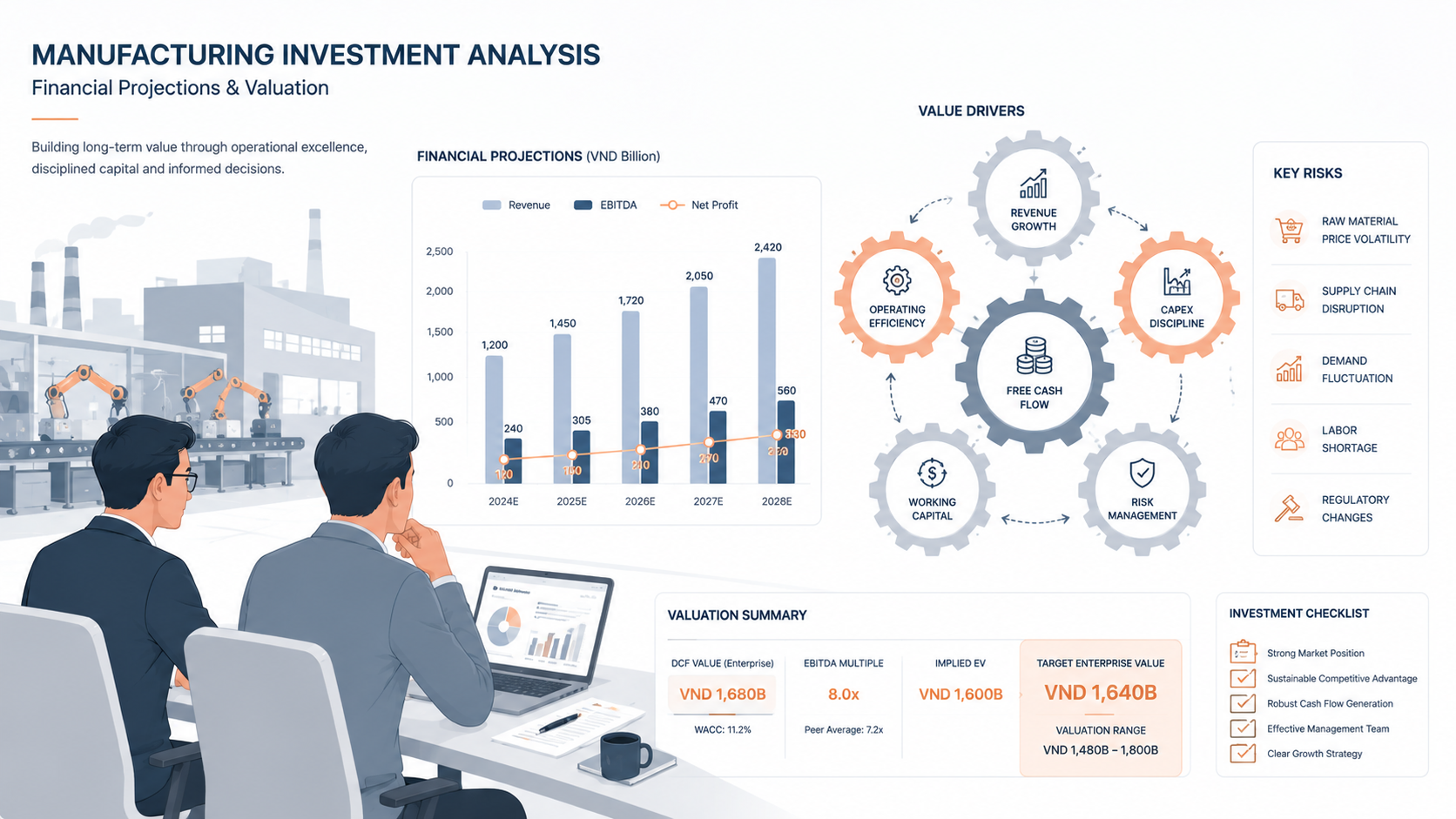
Buyers approach manufacturing valuations with a risk-adjusted lens. Strategic acquirers value synergies—like bolt-on production lines—while financial buyers chase cash-generative assets. They stress-test assumptions: What’s the utilization rate? How resilient is the customer base to economic dips?
In Vietnam, residential sectors lead M&A volume, but manufacturing appeals for its resilience. Investors reference stock market models for listed peers, applying similar EV/EBITDA multiples. Private deals factor control premiums or discounts for illiquidity.
They prioritize due diligence on capex needs—buyers haircut values for pending upgrades—and ESG compliance, increasingly vital for export-oriented firms. A strong order book or diversified suppliers boosts multiples; conversely, founder dependency slashes them.
Foreign players, guided by comprehensive strategies for 2026, seek footholds in high-outlook areas like construction materials. Their view: Pay for proven scalability, not potential alone.
Common seller mistakes
Sellers often trip on overoptimism, projecting peak-cycle earnings without normalization. This inflates expectations, leading to sticker shock when buyers apply conservative multiples.
Neglecting asset audits is another pitfall—undervalued machinery or obsolete inventory erodes the base value. Failing to benchmark against peers, like those in Vietnam’s manufacturing tracker through April 2026, leaves you blind to market realities.
Valuation multiples explained highlight why ignoring subsector comps hurts. Other errors: Poor financial hygiene, like inconsistent capex tracking, or overlooking working capital swings inherent to manufacturing.
Don’t ignore strategic value—buyers pay up for market share gains. And skipping pre-sale valuations invites lowballs. Learn from these to sidestep deal fatigue.
Practical checklist or framework for business owners
Here’s a step-by-step framework to value and enhance your manufacturing business:
- Assemble financials: Compile 3-5 years of P&Ls, balance sheets, and cash flows. Normalize for add-backs.
- Asset inventory: Appraise PP&E, inventory, and real estate independently.
- Forecast realistically: Build DCF with conservative growth (3-7%) and WACC tuned to manufacturing risks (10-15%).
- Benchmark multiples: Research EV/EBITDA for peers—use EBITDA guide for context.
- Stress-test: Model scenarios for input costs, demand drops.
- Enhance value: Optimize inventory turns, reduce capex needs, diversify clients.
- Get external validation: Commission a formal appraisal.
This framework, applied early, aligns your view with buyers’. For deeper dives, check key factors affecting business valuation.
When should sellers start preparing
Begin 12-24 months pre-market. Early audits reveal fixable issues, like equipment overhauls boosting asset values. Align with market cycles—enter when sector outlooks shine, as with Vietnam’s construction materials trajectory.
If exit looms in 6-12 months, prioritize financial clean-up. For opportunistic sales, monitor M&A trends like 2025’s capital discipline. Timing ties to personal goals—retirement or reinvestment.
Pro tip: Track metrics quarterly. This positions you to launch confidently when windows open.
How this connects to the overall business sale journey
Valuation anchors every M&A stage. Pre-loi, it sets teasers; during diligence, it withstands scrutiny. Post-loi, adjustments hinge on findings.
Integrate with increasing business valuation. Link to seller readiness via download our seller checklist. For tailored advice, book a confidential call.
Explore more at our M&A blog or M&A glossary. Start today: get an initial assessment.
Ready to unlock your manufacturing business’s value? Download our seller readiness checklist.
Take the first step in your exit. Start your M&A journey.


