What Is a Letter of Intent in M&A? A Guide for Sellers

Unlocking the gateway to your business sale: The role of the letter of intent
As a business owner eyeing an exit, you’ve likely heard the term “letter of intent” tossed around in M&A conversations. It sounds straightforward—a document signaling serious interest from a buyer. But in reality, it’s far more nuanced. Misunderstanding its purpose and implications can lock you into unfavorable terms, expose your business to risks, or even derail the entire deal before due diligence begins.
Picture this: A promising buyer submits an LOI with attractive headlines—high valuation, quick close—but buried clauses give them outsized control over the process. Sellers who rush to sign without scrutiny often face prolonged exclusivity periods, aggressive price adjustments, or conditions that erode value. On the flip side, a well-negotiated LOI sets clear expectations, protects your interests, and propels negotiations forward efficiently.
In Vietnam’s dynamic M&A market, where deals increasingly involve international buyers, grasping the LOI is non-negotiable. It’s not just paperwork; it’s your first real leverage point. This guide breaks it down practically, from a seller’s viewpoint, helping you avoid pitfalls and maximize outcomes.
Table of Contents
- Why business owners need to understand letters of intent before selling
- Letters of intent from a seller’s perspective
- How buyers view this issue
- Common seller mistakes
- Practical checklist for business owners
- When should sellers start preparing
- How this connects to the overall business sale journey
Why business owners need to understand letters of intent before selling
Before diving into deal documents, savvy sellers treat the LOI as a critical milestone. It’s the bridge between initial interest and binding commitments, often marking the end of the teaser phase and the start of exclusivity. Without a solid grasp, you risk signing away flexibility at a moment when buyer competition is highest.
Consider the stakes: LOIs typically outline price, structure, timeline, and conditions precedent. They signal to other suitors that you’re off-market, potentially costing you better offers. In competitive auctions, multiple LOIs create bidding tension; a weak one from your preferred buyer can still drive improvements elsewhere.
Moreover, LOIs reveal buyer seriousness. A vague term sheet might indicate window-shopping, while a detailed LOI shows due diligence readiness. For sellers, this knowledge empowers you to qualify buyers early, filtering out tire-kickers who inflate expectations but vanish during scrutiny.
In practice, LOIs also shape psychology. Buyers use them to anchor expectations—high initial numbers that “adjust” later based on findings. Sellers who understand this dynamic negotiate drop-dead dates, material adverse change definitions, and break fees to maintain balance.
Ultimately, mastery here prevents valuation leakage. Poorly handled LOIs lead to renegotiations where buyers chip away at enterprise value through earn-outs or working capital true-ups. By prioritizing LOI education, you position yourself as a professional counterpart, attracting quality buyers who respect structured processes.

Letters of intent from a seller’s perspective
Key components include:
- Valuation and structure: Headline price (e.g., 8x EBITDA), payment mix (cash vs. stock), and contingencies like net debt calculations.
- Timeline: Exclusivity (30-90 days typical), due diligence period, and target closing.
- Conditions: Satisfactory DD, no MAC events, regulatory approvals.
- Exclusivity/no-shop: Binding clause preventing other talks; negotiate carve-outs for superior proposals.
Sellers should push for reverse break fees if buyer financing fails, ensuring reciprocity. In Vietnam, where foreign investment approvals add layers, specify timelines tied to State Bank or MPI nods.
A strong seller LOI response counters with specifics: Define EBITDA add-backs, set working capital pegs based on recent averages, and limit buyer reps demands. It’s your script for the deal’s opening act—rehearse it well.
How buyers view this issue
Buyers see the LOI as risk mitigation. After teasers and NDAs, they invest time crafting it to test seller reactions and outline their thesis. Strategic buyers prioritize synergies; financial ones focus on multiples and exit potential.
They favor broad exclusivity to control pace, minimizing leak risks in tight markets. Vague conditions give DD leverage—e.g., undefined “clean” financials allow post-close disputes.
International buyers in Vietnam emphasize compliance: IP ownership, labor contracts, tax audits. They view LOIs as low-commitment ways to gauge seller flexibility on post-closing covenants like non-competes.
Understanding this helps sellers anticipate pushback. Buyers resist fees or short exclusives, seeing them as seller-favoring. Frame your asks as mutual: “This protects the deal’s momentum for both sides.”
Common seller mistakes
First-time sellers often stumble here, treating LOIs as mere formalities. Here’s what to watch:
- Rushing to sign: Excitement blinds to weak terms; always counter.
- Ignoring binding sections: Overlooking no-shop scope leads to lawsuits.
- Undervaluing contingencies: Loose MAC clauses invite buyer walkaways.
- No lawyer review: Commercial logic clashes with legal pitfalls.
- One-size-fits-all: Strategic vs. PE buyers need tailored responses.
Avoid these by involving advisors early. For deeper process insights, explore our take on the business sale process.
Another trap: Accepting low-ball exclusives without auctions. Run parallel discussions pre-LOI to build leverage.
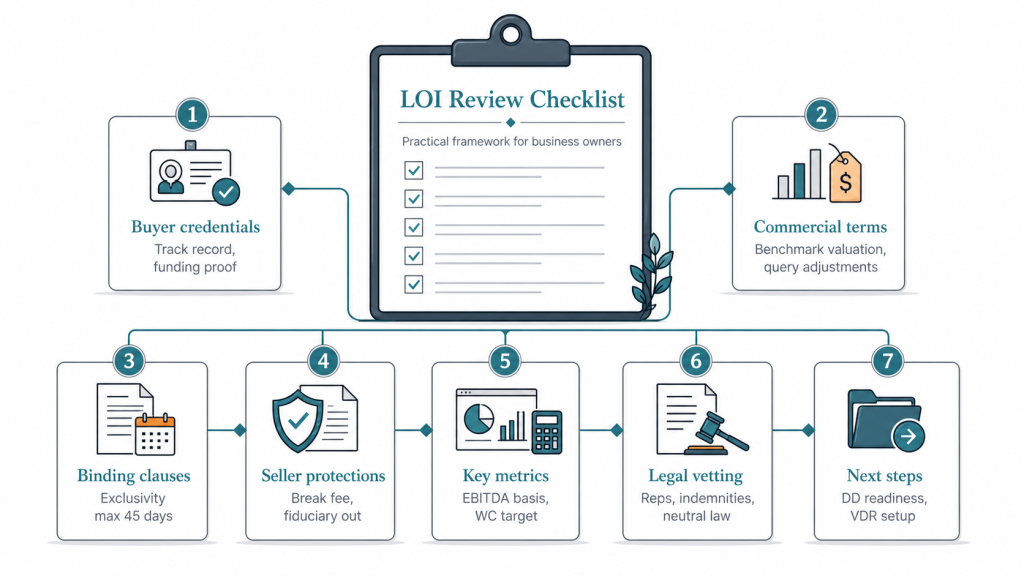
Practical checklist or framework for business owners
Approach LOIs systematically:
- Review buyer credentials: Track record, funding proof.
- Assess commercial terms: Benchmark valuation; query adjustments.
- Scrutinize binding clauses: Limit exclusivity to 45 days max.
- Negotiate protections: Add seller break fee, fiduciary out.
- Define key metrics: EBITDA basis, WC target.
- Legal vetting: Check reps, indemnities, law (Singapore often neutral).
- Plan next steps: DD readiness, VDR setup.
Customize per deal type—shorter for domestics, detailed for cross-border. Reference our M&A glossary for terms like MAC or true-up.
When should sellers start preparing
Ideal timing: 6-12 months pre-sale aligns with financial clean-up. Link this to broader prep via our 12-month checklist.
If unsolicited, pause and prepare—don’t engage without counsel.
How this connects to the overall business sale journey
The LOI slots mid-process: Post-marketing, pre-DD. It follows teasers/IMs, precedes SPA. Success here accelerates to closing; failures reset auctions.
In full cycle—prep, market, LOI, DD, SPA, close—it’s pivotal for momentum. Ties to valuation stability; weak LOIs invite erosion. For Vietnam specifics, see our M&A blog.
Mastering LOIs elevates your entire exit.
Ready to get started? Download our seller checklist.
Take the first step: Start your M&A journey.