The CFO Conversation Can Make or Break Buyer Confidence
By the time a buyer reaches due diligence, they are no longer judging your company only by the headline revenue, EBITDA, or growth story. They are testing whether the business they admired in the teaser and management presentation can withstand detailed financial questioning. Much of that questioning lands on one person: the CFO, finance director, chief accountant, or whoever owns the numbers.
For sellers, this stage can feel uncomfortable. Buyers ask direct questions about revenue quality, margins, working capital, debt, tax, customer concentration, cash conversion, accounting policies, and the gap between reported performance and economic reality. They are not doing this to be difficult. They are trying to understand what they are truly buying, what risks may appear after closing, and whether the valuation still makes sense.
A strong CFO response can increase trust, protect valuation, and keep the process moving. A weak or inconsistent response can create doubt even when the underlying business is healthy. In many transactions, the quality of financial communication matters almost as much as the financial results themselves.
This is why business owners should understand what buyers ask CFOs during due diligence before they go to market. Preparation is not about rehearsing perfect answers. It is about knowing your numbers deeply, explaining them clearly, and addressing risk before the buyer turns it into a price reduction.
Table of Contents
- Why business owners need to understand CFO questions before selling?
- CFO due diligence questions from a seller’s perspective
- How investors view this issue?
- Common seller mistakes
- Practical checklist or framework for business owners
- When should sellers start preparing?
- How this connects to the overall business sale journey
Why Business Owners Need to Understand CFO Questions Before Selling?
Many owners assume due diligence is mainly a buyer exercise: the buyer asks, the seller answers, and advisors coordinate document flow. In practice, due diligence is also a credibility test. Buyers are not only reviewing what the numbers say; they are assessing whether management can explain why the numbers look the way they do.
The CFO is central to that assessment because financial due diligence translates the company’s story into evidence. If the owner says the business has stable growth, the CFO must be able to show how revenue is recognized, how customer cohorts behave, how pricing changes affect margins, and whether growth is driven by repeat customers or one-off projects. If the owner says the company has strong cash flow, the CFO must explain working capital cycles, receivables quality, inventory movement, supplier terms, and capital expenditure requirements.
When a seller is well prepared, buyer questions become an opportunity to reinforce confidence. When the seller is unprepared, the same questions can become negotiation leverage for the buyer.
For example, a buyer may ask why EBITDA increased sharply in the most recent year. A prepared CFO can explain the drivers: higher utilization, improved procurement terms, lower one-off costs, better pricing discipline, or product mix. An unprepared CFO may answer vaguely, promising to “check later.” That delay may seem small, but it can signal weak financial controls, incomplete reporting, or management overstatement.
Owners need to understand these questions because the buyer’s concerns often affect price and structure. If buyers are uncertain about normalized earnings, they may reduce the enterprise value. If they worry about cash conversion, they may push for a higher working capital target. If they doubt revenue sustainability, they may propose an earn-out. If they see unclear tax or debt items, they may request indemnities, escrow, or purchase price adjustments.
In other words, CFO questions are not administrative. They sit directly at the intersection of valuation, risk allocation, and closing certainty.
Owners preparing for a sale should begin with the same mindset they would expect from a sophisticated investor: assume every important financial claim needs support. If your company says margins are improving, prepare the bridge. If you say customers are loyal, prepare retention data. If you say the business is not dependent on you, prepare evidence in reporting, delegation, and governance.
For sellers who are still early in preparation, a structured seller readiness checklist can help identify which financial areas need cleanup before a buyer begins formal due diligence.
CFO Due Diligence Questions from a Seller’s Perspective
From the seller’s side, the CFO’s role is not to “defend” the company at all costs. The role is to explain the business accurately, consistently, and with enough commercial context that the buyer can distinguish real risk from ordinary business variation.
Most buyer questions fall into several practical categories. Understanding these categories helps the owner and CFO prepare without becoming overwhelmed by hundreds of individual requests.
1. Revenue Quality and Sustainability
Buyers typically begin by testing revenue because revenue drives the entire valuation narrative. They want to know whether sales are recurring, repeatable, concentrated, seasonal, contract-backed, or dependent on unusual events.
Common questions include:
- How is revenue recognized, and does it align with contract terms and delivery obligations?
- What percentage of revenue comes from repeat customers versus new customers?
- Are there any one-off projects, unusually large orders, or temporary demand spikes in the historical period?
- How much revenue is contracted, how much is forecast, and how much depends on management assumptions?
- Are there rebates, discounts, returns, warranty claims, or credit notes that affect reported revenue?
- Which customers have grown, declined, or stopped buying, and why?
For sellers, the key is to avoid presenting revenue as a single headline number. Buyers need to understand the texture behind that number. A company with lower growth but high repeat revenue may be more attractive than a company with faster growth driven by unpredictable project work. Similarly, a short-term revenue spike may not support valuation unless the CFO can explain why it is sustainable.
2. EBITDA Normalization
EBITDA is often the center of valuation discussions, but buyers rarely accept reported EBITDA at face value. They want to understand what earnings look like after removing non-recurring, owner-specific, discretionary, or unusual items.
Typical questions include:
- What adjustments have been made to arrive at normalized EBITDA?
- Which costs are genuinely non-recurring, and can they be supported by documentation?
- Are owner salaries, family-related expenses, personal expenses, or related-party charges included in operating costs?
- Were there unusual gains, subsidies, write-backs, or accounting movements that inflated earnings?
- Are there underinvested costs that a buyer will need to add after closing, such as senior finance staff, systems, compliance, or sales leadership?
This is where many sellers lose credibility. Add-backs are legitimate when they are well supported and commercially reasonable. They become dangerous when they look aggressive, poorly documented, or disconnected from how the business will operate under new ownership.
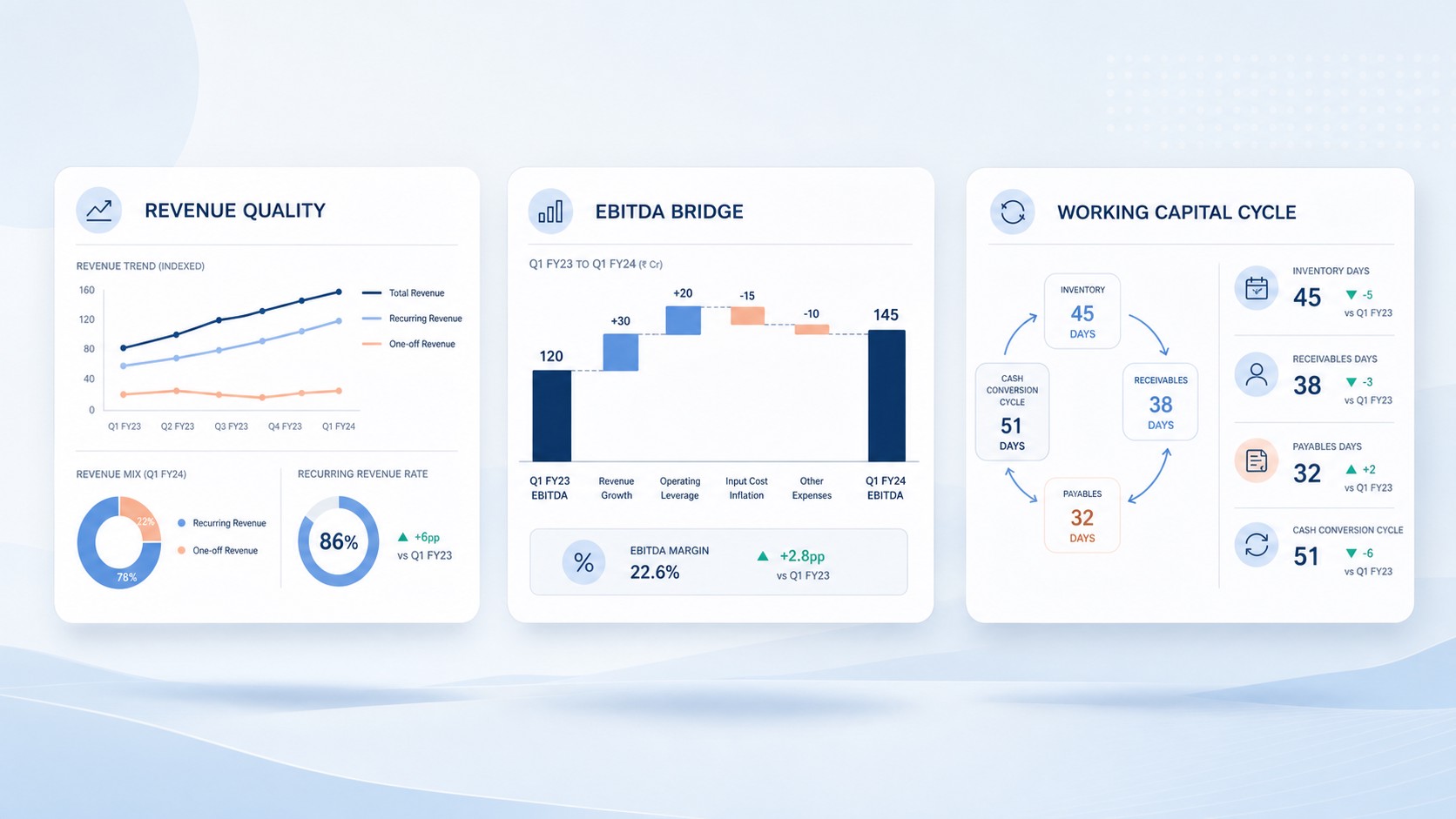
A disciplined CFO should prepare an EBITDA bridge that reconciles reported profit to adjusted EBITDA, with clear explanations and supporting documents for each item. The aim is not to maximize adjustments at any cost. The aim is to present a defensible earnings base that can survive buyer scrutiny.
3. Working Capital and Cash Conversion
Working capital is one of the most misunderstood areas in a sale process. Owners often focus on enterprise value, while buyers focus heavily on how much cash is actually required to run the business after closing.
Buyers may ask:
- What is the normal level of net working capital required to operate the business?
- Are receivables collected on time, or are there overdue balances that should be provisioned?
- Does inventory include slow-moving, obsolete, or overvalued stock?
- Are payables stretched beyond normal commercial terms?
- Are customer deposits, supplier advances, or deferred revenue properly classified?
- How does working capital move across months, quarters, and seasons?
These questions matter because the final purchase price is often adjusted based on closing cash, debt, and working capital. If a seller has not analyzed working capital before negotiations, they may agree to a valuation headline without understanding how much value could be lost through completion adjustments.
The CFO should be ready to explain the cash cycle in practical terms: when customers pay, when suppliers are paid, how inventory is financed, and whether growth requires additional working capital. A profitable business that consumes cash may still be valuable, but the buyer will price that cash need into the deal.
4. Debt, Debt-Like Items, and Off-Balance-Sheet Obligations
In many transactions, the headline valuation is based on a cash-free, debt-free basis. That means buyers will carefully identify all debt and debt-like items that should reduce equity value.
CFOs should expect questions such as:
- What bank loans, overdrafts, shareholder loans, finance leases, or factoring arrangements exist?
- Are there unpaid taxes, social insurance obligations, penalties, or disputed liabilities?
- Are there deferred payments to suppliers, customer claims, legal exposures, or guarantees?
- Are there related-party balances that need to be settled before closing?
- Are lease obligations, equipment financing, or contingent liabilities fully disclosed?
Owners sometimes underestimate this area because they view certain obligations as normal business practice rather than debt. Buyers take a broader view. Anything that economically resembles debt, or creates a future cash outflow related to the pre-closing period, may become a debt-like item in negotiations.
This is why CFO preparation should include a debt-like item review well before buyer due diligence begins. It is better for sellers to identify these items early and address them in valuation discussions than to be surprised late in exclusivity.
5. Forecasts, Budgets, and Management Assumptions
Buyers rarely purchase only the past. They purchase future cash flow. This makes forecasts a major diligence topic.
Common questions include:
- How was the forecast prepared, and who owns the assumptions?
- What revenue is already contracted or highly visible?
- What assumptions support price increases, volume growth, margin expansion, or cost control?
- How accurate were prior budgets compared with actual performance?
- What capital expenditure is required to achieve the forecast?
- What risks could cause the business to miss the plan?
A forecast does not need to be perfectly conservative, but it must be credible. Buyers become concerned when forecasts appear disconnected from historical trends, customer behavior, capacity constraints, or management capability. The CFO should be able to explain not only the numbers but also the operational logic behind them.
6. Accounting Policies and Quality of Reporting
Buyers also assess whether the company’s reporting systems are reliable enough for ownership transition. This is especially important when the buyer is an institutional investor, strategic acquirer, or group company that must consolidate financial results.
Questions may include:
- Are financial statements prepared monthly, quarterly, or only annually?
- How quickly can management accounts be closed after month-end?
- What accounting standards and policies are applied consistently?
- Are there manual adjustments that depend heavily on one individual?
- Are revenue, inventory, depreciation, provisions, and accruals treated consistently over time?
- Has the company been audited, and if so, were there qualifications or recurring audit issues?
High-quality reporting reduces perceived risk. Weak reporting does not automatically kill a deal, especially for smaller founder-led companies, but it can affect valuation, deal structure, and the level of buyer comfort.
How Investors View This Issue?
Investors approach CFO diligence questions through a different lens from business owners. Owners often see the company through years of lived experience: customer relationships, operational instincts, supplier history, and personal knowledge of why certain events occurred. Buyers do not have that history. They rely on evidence.
From an investor’s perspective, the CFO’s answers help answer four larger questions.
Can the Reported Earnings Be Trusted?
The first question is whether reported earnings reflect the true economic performance of the business. Buyers know that accounting profit can differ from cash generation, and that management adjustments can be subjective. They therefore test revenue recognition, margins, accruals, provisions, and add-backs carefully.
If the CFO provides clear reconciliations, consistent explanations, and well-organized support, the buyer gains confidence. If answers shift between meetings, documents contradict management commentary, or basic reconciliations are missing, the buyer may assume the risk is larger than the seller believes.
Is the Business Scalable Under New Ownership?
Buyers also ask CFOs about systems, controls, and reporting because they want to know whether the business can scale. A company may perform well under a hands-on founder, but if finance processes are informal, undocumented, or dependent on a small number of people, integration or growth may become difficult.
This is particularly relevant where the buyer plans to professionalize the business, expand into new markets, add debt financing, or integrate the company into a larger group. The CFO’s ability to produce timely, reliable information becomes part of the investment case.
What Risks Should Be Priced Into the Deal?
Due diligence is not only about confirming facts. It is also about allocating risk. If buyers identify uncertainty, they have several tools: lower price, deferred consideration, earn-out, escrow, indemnity, closing adjustment, or specific conditions before completion.
For example, if revenue visibility is weak, the buyer may push for an earn-out. If working capital is volatile, they may negotiate a tighter target mechanism. If tax exposures are unclear, they may require specific indemnities. If customer concentration is high, they may seek retention conditions or post-closing protections.
Seller preparation can reduce the need for these protections. It cannot eliminate all risk, but it can prevent ordinary business issues from being interpreted as hidden problems.
Does Management Understand the Business at the Right Level?
Finally, buyers use CFO discussions to assess management quality. A CFO who understands the commercial drivers behind the numbers gives the buyer confidence that the business is managed actively rather than reactively. A CFO who can only recite accounting balances may leave buyers uncertain about forecasting, controls, and decision-making.
This does not mean the CFO must have a sophisticated investment banking vocabulary. In fact, overly technical answers can be counterproductive if they obscure the commercial reality. Buyers value clarity: what happened, why it happened, whether it will continue, and how management monitors it.
Owners should see CFO preparation as part of management presentation discipline. The finance function is not a back-office detail in M&A. It is one of the primary ways the buyer decides whether the business is investable.
Common Seller Mistakes
Many diligence problems are avoidable. They happen not because the business is weak, but because the seller enters the process before the numbers are ready to be questioned.
Mistake 1: Waiting Until Due Diligence to Clean the Numbers
Some owners begin financial cleanup only after receiving a letter of intent. By then, the timetable is usually tight, the buyer has exclusivity, and any delay may weaken the seller’s negotiating position.
Financial cleanup should begin before the company goes to market. This includes reconciling accounts, reviewing receivables, documenting add-backs, identifying debt-like items, reviewing tax positions, and preparing monthly management accounts. If these items are handled late, the seller may appear disorganized even when the business fundamentals are strong.
Mistake 2: Overstating Add-Backs
Owners naturally want to present the highest defensible EBITDA. The problem is that some sellers include adjustments that buyers will not accept: recurring costs labeled as one-off, necessary management costs treated as discretionary, or personal expenses without adequate documentation.
Aggressive add-backs can damage trust. Once the buyer believes one adjustment is inflated, they may review every other claim more skeptically. A smaller but well-supported adjusted EBITDA is often more valuable than a larger number that collapses under diligence.
Mistake 3: Ignoring Working Capital Until the SPA Stage
Working capital is often negotiated late, but it should be analyzed early. Sellers who do not understand their normal working capital may be surprised by the buyer’s proposed target. This can lead to frustration because the seller thought the price was agreed, only to discover that completion mechanics may reduce proceeds.
The CFO should prepare a monthly working capital analysis for at least the historical period under review. The analysis should identify seasonality, abnormal balances, overdue receivables, inventory issues, and changes in supplier terms.
Mistake 4: Providing Inconsistent Answers Across the Team
Buyers lose confidence when the owner, CFO, sales director, and operations manager tell different versions of the same story. For example, the owner may say a customer loss was temporary, while the finance team says the customer has not purchased for twelve months. These inconsistencies create unnecessary concern.
Before management meetings and diligence calls, the seller team should align on key messages, factual explanations, and known risk areas. Alignment does not mean scripting artificial answers. It means ensuring everyone understands the same facts.
Mistake 5: Treating the Data Room as a Document Dump
A buyer’s financial questions become harder to answer when the data room is poorly structured. Missing files, unclear naming, duplicate versions, and unsupported schedules all increase friction.
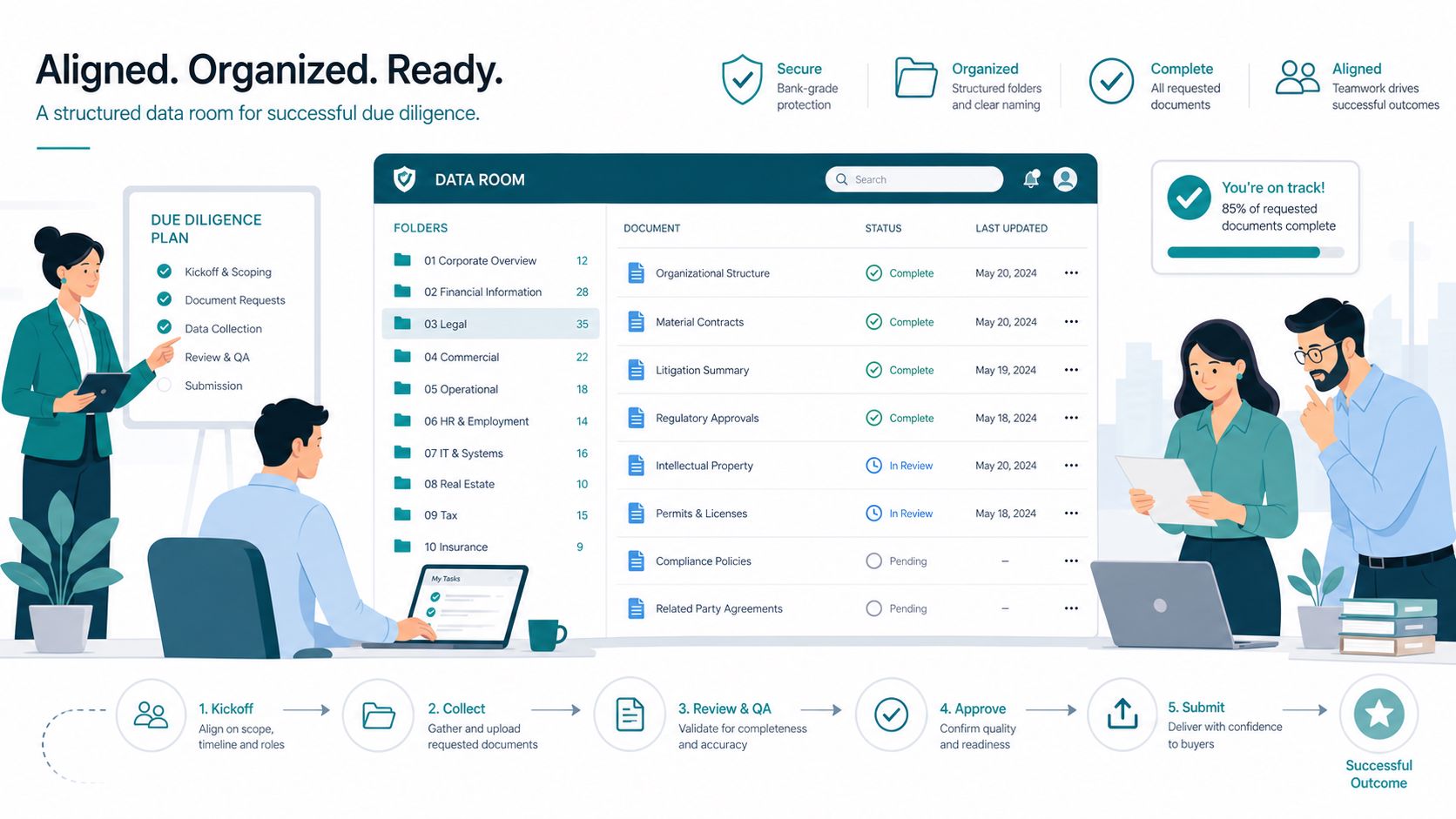
The data room should help the buyer find evidence quickly. It should include clean folders for financial statements, management accounts, tax filings, customer revenue, working capital, debt, payroll, contracts, and forecasts. Sellers who want a more detailed approach can review our guide on how to structure an M&A data room before diligence begins.
Mistake 6: Assuming Verbal Explanations Are Enough
In a founder-led business, many explanations live in the owner’s head. The owner may know why a margin dropped in one quarter, why a supplier balance was high, or why a customer delayed payment. Buyers, however, need documentary support.
Good CFO preparation turns verbal knowledge into evidence: schedules, reconciliations, contracts, invoices, board notes, customer correspondence, and management reports. The goal is to reduce dependence on memory and increase reliance on verifiable information.
Practical Checklist or Framework for Business Owners
Business owners do not need to become finance specialists to prepare for buyer questions. But they do need a practical framework for making sure the CFO, finance team, and advisors are ready.
The following framework can help sellers organize preparation around the questions buyers are most likely to ask.
Step 1: Build a Clean Financial Baseline
- Prepare monthly profit and loss, balance sheet, and cash flow information for the historical period.
- Reconcile management accounts to statutory accounts and tax filings.
- Identify accounting policy changes, reclassifications, and unusual entries.
- Review revenue recognition, cost allocation, inventory valuation, depreciation, accruals, and provisions.
- Ensure the finance team can explain major movements by month and year.
This baseline is the foundation for all later analysis. Without it, every buyer question becomes harder to answer.
Step 2: Prepare the Revenue Story
- Break revenue down by customer, product, channel, geography, and contract type where relevant.
- Separate recurring, repeat, project-based, and one-off revenue.
- Identify customer wins, losses, concentration, churn, and pricing changes.
- Prepare support for large contracts, renewals, pipeline, and backlog.
- Explain seasonality and any unusual revenue spikes or declines.
Revenue analysis should connect numbers to commercial reality. Buyers want to know not only what was sold, but why customers bought and whether they are likely to continue.
Step 3: Create a Defensible EBITDA Bridge
- Start with reported operating profit or EBITDA.
- List each proposed adjustment separately.
- Classify adjustments as non-recurring, owner-related, discretionary, accounting, or transaction-related.
- Prepare evidence for each item, such as invoices, payroll records, contracts, or board approvals.
- Challenge each adjustment from the buyer’s perspective before presenting it.
This step is critical because valuation discussions often depend on adjusted EBITDA. If the bridge is weak, the buyer may challenge both earnings and management credibility.
Step 4: Analyze Working Capital Before Negotiations
- Prepare monthly working capital calculations using a consistent methodology.
- Review receivables aging, bad debt provisions, and collection history.
- Review inventory aging, obsolete stock, and valuation policies.
- Review payables aging and whether supplier terms are normal or stretched.
- Identify deposits, deferred revenue, advances, and other items that may affect the target.
Working capital preparation helps the seller understand what a fair target looks like before the buyer proposes one.
Step 5: Identify Debt-Like Items Early
- List all loans, overdrafts, leases, factoring, shareholder balances, and related-party accounts.
- Review unpaid taxes, social insurance, employee obligations, legal claims, and penalties.
- Identify deferred supplier payments, customer claims, guarantees, and contingent liabilities.
- Agree internally which items should be settled before closing and which may affect price.
Debt-like items can create late-stage tension. Early identification allows the seller to manage expectations and avoid surprises.
Step 6: Make Forecasts Evidence-Based
- Prepare forecasts by revenue driver, cost category, working capital, and capital expenditure.
- Separate contracted revenue from assumed revenue.
- Compare past budgets with actual results to assess forecasting reliability.
- Prepare sensitivity cases for downside scenarios.
- Ensure the CFO, owner, and commercial team agree on the assumptions.
A buyer does not expect certainty, but they do expect logic. A good forecast shows how management thinks, not just what management hopes.
Step 7: Prepare the CFO for Buyer Meetings
- Hold internal preparation sessions before buyer calls.
- Anticipate difficult questions and prepare factual answers.
- Agree who answers which types of questions.
- Keep a diligence Q&A log so responses remain consistent.
- Escalate uncertain answers rather than guessing.
Professional buyers do not expect instant answers to every question. They do expect discipline. If the CFO does not know an answer, it is better to say so and provide a clear timeline than to improvise.
When Should Sellers Start Preparing?
The best time to prepare CFO answers is before the business is marketed, not after a buyer has begun confirmatory due diligence. Ideally, owners should begin preparing at least several months before launching a sale process. For more complex businesses, preparation may need to start twelve months or more in advance.
The reason is simple: some diligence issues cannot be fixed quickly. If monthly reporting is weak, it takes time to improve. If revenue data is not segmented, it takes time to rebuild. If inventory records are unreliable, a buyer may want to see several reporting cycles before gaining confidence. If customer contracts are informal, documentation may need to be strengthened before the process begins.
Early preparation also gives owners more control. When you identify issues before the buyer does, you can decide whether to fix them, disclose them, explain them, or adjust expectations. When the buyer identifies them first, the issue may become a negotiation weapon.
A practical timeline might look like this:
- 12 months before sale: Improve monthly reporting, review accounting policies, clean up related-party balances, and begin tracking KPIs buyers will care about.
- 6 to 9 months before sale: Prepare revenue analysis, EBITDA bridge, working capital review, debt-like item schedule, and forecast assumptions.
- 3 to 6 months before sale: Build the data room, align management explanations, resolve documentation gaps, and conduct sell-side financial review where appropriate.
- During buyer engagement: Keep responses consistent, update financials promptly, manage the Q&A process, and avoid informal disclosures that conflict with formal materials.
Owners who want to assess where they stand can begin the exit process with an initial review of readiness, valuation drivers, and likely diligence issues.
How This Connects to the Overall Business Sale Journey
CFO due diligence questions are not an isolated workstream. They connect to almost every major stage of selling a business.
At the preparation stage, the CFO helps define the financial story. This includes historical performance, normalized earnings, growth drivers, cash flow, and the quality of reporting. These inputs influence valuation expectations and buyer targeting.
At the marketing stage, the CFO’s work supports the information memorandum, financial summaries, and management presentation. Buyers may not see every detail immediately, but the credibility of the materials depends on the quality of the underlying analysis.
At the offer stage, CFO preparation influences how buyers frame valuation. A buyer that trusts the numbers is more likely to submit a cleaner offer. A buyer that sees uncertainty may discount value, add conditions, or request a more protective structure.
At the due diligence stage, the CFO becomes one of the seller’s most important representatives. Clear answers reduce friction. Organized documentation speeds up review. Commercially grounded explanations help buyers understand the business rather than merely audit it.
At the negotiation stage, financial analysis affects enterprise value, equity value, cash-free debt-free adjustments, working capital targets, earn-outs, escrow, indemnities, and closing mechanics. Sellers who understand these concepts are less likely to be surprised by the final economics. If terms such as enterprise value, equity value, debt-like items, or normalized EBITDA are unfamiliar, the M&A glossary can be a useful reference before negotiations become technical.
Finally, at the closing and transition stage, finance readiness supports a smoother handover. Buyers need confidence that financial reporting can continue after completion, that management can operate without constant founder intervention, and that post-closing adjustments can be calculated without dispute.
For owners, the broader lesson is clear: the CFO’s answers do not merely satisfy diligence requests. They shape buyer confidence. And buyer confidence shapes valuation, deal structure, and closing certainty.
A business sale is rarely won by numbers alone. It is won by numbers that are reliable, explainable, and connected to a credible operating story. The earlier the owner and CFO prepare that story, the stronger the seller’s position will be when serious buyers begin asking difficult questions.
Prepare before buyers test the numbers. Download our seller checklist.
Considering a sale in the next 6 to 18 months? Start your M&A journey.