
People Risks Can Change the Economics of a Deal
When owners prepare to sell a company, they often focus first on revenue, EBITDA, customers, contracts, and tax exposure. Those areas matter. But in many transactions, the questions that quietly reshape valuation sit inside the human resources file: who really runs the business, whether key employees will stay, how compensation is structured, whether labor obligations are clean, and whether the culture can survive a change in ownership.
Buyers do not ask HR questions because they are curious about headcount administration. They ask because people risks become financial risks. A company with strong margins can still lose value if its best managers may leave after closing, if undocumented bonuses distort earnings, if employment contracts are inconsistent, or if the founder is still the center of every important decision.
This is especially important in a market where money is no longer cheap. When financing costs are higher, buyers have less room for surprises. They scrutinize assumptions more carefully, move faster when they can, and push harder on diligence areas that could affect post-closing value. HR due diligence is therefore not a soft topic. It is one of the clearest ways a buyer tests whether the business can continue to perform without the seller.
For sellers, the practical lesson is simple: HR preparation should begin well before a buyer enters the data room. If people risk is addressed early, it can support confidence, protect valuation, and reduce the chance that a promising deal slows down at the worst possible moment.
Table of Contents
- Why Business Owners Need to Understand HR Due Diligence Before Selling
- HR Due Diligence from a Seller’s Perspective
- How Investors View This Issue
- Common Seller Mistakes
- Practical Checklist or Framework for Business Owners
- When Should Sellers Start Preparing?
- How This Connects to the Overall Business Sale Journey
Why Business Owners Need to Understand HR Due Diligence Before Selling
Business owners often underestimate HR due diligence because HR records appear administrative. Payroll files, employment contracts, policies, insurance, benefits, and org charts can look like back-office matters. A buyer sees them differently. To a buyer, HR records reveal whether the company is institutionally managed or personally held together by informal relationships.
That distinction matters in a sale. A company may be profitable today because the founder knows every customer, personally approves every salary change, and resolves every employee issue directly. That may work while the founder is active. It becomes a risk when the buyer is acquiring future cash flows. If future performance depends too heavily on one person, the buyer will question the durability of those cash flows.
HR due diligence also helps buyers identify hidden liabilities. These may include unclear employment terms, unpaid obligations, inconsistent treatment of employees, undocumented incentive promises, disputed contractor arrangements, or compliance gaps in labor procedures. Even when each item is individually manageable, together they can create uncertainty. In M&A, uncertainty usually becomes either a price adjustment, a special indemnity, a retention condition, or a delay.
The current deal environment reinforces this point. When capital is more expensive, buyers cannot rely on easy refinancing or aggressive growth assumptions to absorb mistakes. Diligence must go deeper because the margin for error is narrower. At the same time, competitive processes often reward speed. Faster dealmaking can be useful, but it is also a double-edged sword: if sellers have not prepared their HR records in advance, accelerated timelines can expose gaps rather than create momentum.
For owners, understanding HR due diligence before selling is not about becoming an employment lawyer. It is about knowing what buyers will test, preparing evidence before the questions arrive, and reducing preventable friction in the transaction. A clean HR story helps buyers believe that the company is transferable. A messy HR story can make them wonder what else has not been properly controlled.
Owners who are beginning to organize their sale preparation can use a seller readiness checklist to identify the areas that typically require cleanup before a formal process begins.
HR Due Diligence from a Seller’s Perspective
From the seller’s perspective, HR due diligence should be viewed as a credibility exercise. The buyer is not merely asking, “How many employees do you have?” The deeper question is, “Can this workforce continue to generate the earnings we are underwriting after the transaction closes?”
Sellers should expect buyers to examine both documents and behavior. Documents show the formal structure. Behavior shows how the company actually operates. If these two do not match, the buyer will probe further.
What Buyers Typically Ask HR to Prove
Most HR diligence questions fall into a few broad categories. The exact scope depends on the industry, transaction size, buyer type, and jurisdiction, but the logic is consistent.
- Organization and leadership: Who reports to whom, which roles are critical, and where decision-making authority actually sits.
- Employment terms: Whether employment contracts, offer letters, job descriptions, probation terms, and termination provisions are documented and consistent.
- Compensation and benefits: How salaries, bonuses, commissions, allowances, benefits, and informal incentives are calculated and approved.
- Key employee retention: Which employees are essential to customer relationships, technical knowledge, operations, compliance, or revenue continuity.
- Labor compliance: Whether statutory obligations, internal policies, working time practices, leave records, and required registrations are properly maintained.
- Culture and integration: Whether the team can adapt to new ownership, reporting lines, governance standards, and performance expectations.
The seller’s challenge is not only to provide answers, but to provide answers that are internally consistent. A buyer may compare the HR schedule against payroll records, management accounts, employment contracts, and operating KPIs. If headcount in one file does not reconcile with another, the question becomes broader than HR. It becomes a control issue.
That is why sellers should prepare HR materials with the same discipline they apply to financial due diligence. The data room should not be a last-minute collection of files. It should tell a coherent story: the business has the right people, clear obligations, reasonable costs, and a management structure capable of continuing after closing. For practical guidance on organizing diligence information, sellers may find it useful to review how to structure an M&A data room before buyer requests arrive.
The Seller’s Real Objective
The objective is not to make the company look perfect. Buyers do not expect perfection. They expect transparency, control, and a credible plan for issues that remain open. A seller who identifies a compensation inconsistency early, explains the reason, quantifies the exposure, and presents a remediation plan is usually in a stronger position than a seller who lets the buyer discover it first.
This is a core principle in M&A readiness: value is not achieved only by finding a buyer. Value is achieved by preparing the business so that the buyer’s confidence survives diligence, negotiation, and closing. HR preparation is part of that readiness because people are central to execution.
How Investors View This Issue
Investors look at HR through the lens of risk-adjusted value. They ask whether the workforce supports the investment thesis or undermines it. A strategic buyer may focus on integration, culture, overlapping roles, and leadership fit. A financial buyer may focus on management depth, incentive alignment, scalability, and whether the business can grow without heavy founder involvement. Both care about continuity.
Buyers also distinguish between manageable issues and deal-threatening issues. A missing policy can often be fixed. A few inconsistent job descriptions may be a cleanup item. But a management team that is likely to leave, undocumented bonus commitments that materially affect earnings, or unresolved labor claims can change the risk profile of the deal.
Investors typically translate HR findings into transaction consequences. These consequences may include:
- Valuation pressure: If people risk reduces confidence in forecast earnings, the buyer may reduce price or apply a more conservative multiple.
- Working capital or debt-like adjustments: Certain employee obligations may be treated as liabilities if they are unpaid or under-accrued.
- Specific indemnities: Known HR issues may be carved out for special seller protection obligations after closing.
- Closing conditions: The buyer may require key employees to sign retention agreements before completion.
- Integration planning changes: The buyer may revise the post-closing operating model if the current organization is weaker than expected.
These outcomes are not theoretical. They are how investors protect themselves when diligence reveals uncertainty. The stronger the seller’s evidence, the less room there is for negative assumptions.
Speed also affects investor behavior. In a fast-moving process, buyers may use focused diligence questions to identify red flags quickly. That can benefit prepared sellers because clean answers build momentum. But it can hurt unprepared sellers because there is less time to repair incomplete records, align management messaging, or clarify conflicting data. Faster closing is attractive only when the underlying preparation is strong.
International buyers may also view HR diligence as part of broader market entry and operating readiness. Where local employment practices, expatriate staffing, real estate operations, or regulatory processes are relevant, they will want comfort that the business can operate under formal governance after acquisition. For sellers, this means informal practices that once felt commercially efficient may need to be documented, standardized, or explained before a sophisticated buyer reviews them.
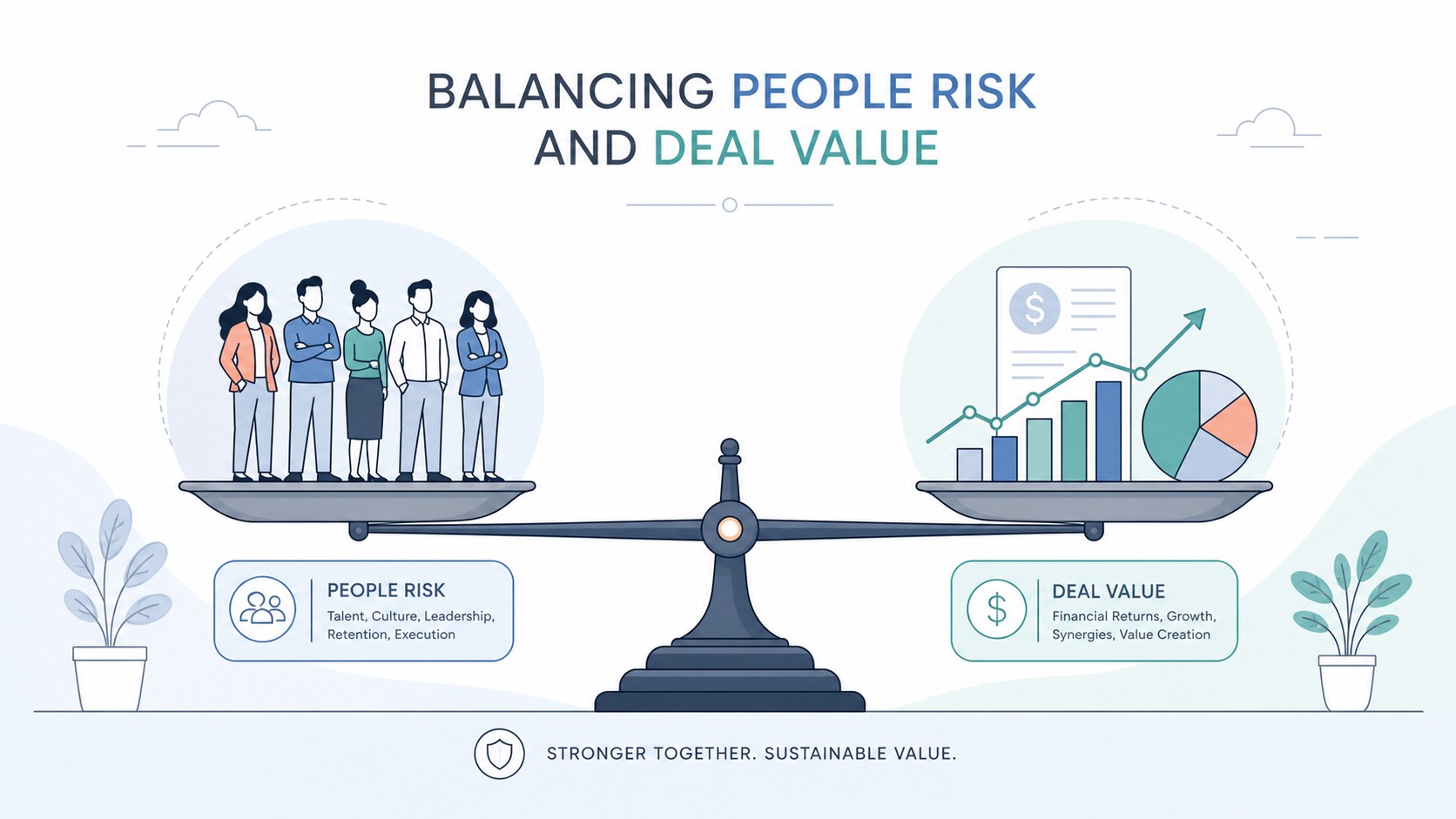
One of the most important investor questions is whether the people system is scalable. A business with a capable second layer of leadership, clear reporting lines, documented processes, and transparent incentives is easier to underwrite. A business where every decision still runs through the owner may still be attractive, but the buyer will price the transition risk.
In simple terms, buyers ask HR questions to answer three investment questions: Will the people stay? Will the cost base behave as expected? Can the company operate under new ownership? If the answer to any of these is uncertain, the deal becomes harder.
Common Seller Mistakes
Most HR diligence problems do not appear overnight. They build gradually as a company grows. Practices that were practical at 20 employees become risky at 200. Promises made informally to retain good people become difficult to verify later. Founder-led decision-making remains efficient until a buyer asks how the company performs without the founder.
Below are the mistakes sellers should address before a formal sale process begins.
1. Treating HR as Administrative Rather Than Strategic
Many owners see HR as payroll, hiring, and employee files. Buyers see HR as continuity of earnings. If the seller does not frame HR in strategic terms, the buyer will do it for them, often more conservatively.
A better approach is to present HR as part of the value story. Show the leadership bench, retention history, training structure, incentive logic, and operational dependency map. This helps the buyer understand why the business is transferable.
2. Waiting Until the Data Room Opens
HR cleanup takes time. Contracts may need to be located, standardized, or updated. Bonus schemes may need to be documented. Employee classifications may need review. Policies may need approval. Key person risks may need succession planning. These are not tasks to begin after a buyer submits a diligence request list.
Late preparation creates avoidable pressure. It also increases the chance that management gives rushed or inconsistent answers. Sellers should prepare HR materials before outreach begins, not after negotiation starts.
3. Underestimating Founder Dependency
Founder dependency is one of the most common people-related valuation risks. If the owner controls customer relationships, pricing, hiring, supplier negotiations, product decisions, and cash discipline, the buyer may question whether the company is really buying a business or buying the owner’s personal operating system.
Reducing founder dependency does not mean the owner becomes irrelevant. It means building a management structure that can function credibly during and after transition. Delegation, documented authority, second-line leadership, and clear KPIs all support buyer confidence.
4. Ignoring Informal Compensation Promises
Informal promises can become serious diligence issues. These may include verbal bonus commitments, discretionary commissions, side agreements, special allowances, retention expectations, or family-related compensation arrangements. If these arrangements affect employee expectations or future costs, buyers will want to understand them.
Sellers should document compensation structures clearly and reconcile them to financial records. If certain payments are discretionary, the basis for discretion should be clear. If they are recurring, they should be reflected properly in the cost base.
5. Presenting an Org Chart That Does Not Reflect Reality
A formal org chart can be misleading if it does not match how decisions are actually made. Buyers will notice when interviews reveal that authority sits somewhere different from the chart. This undermines confidence because it suggests the company may not understand its own operating model.
The org chart should show both reporting lines and practical responsibility. For critical roles, sellers should explain decision rights, backups, and succession options.
6. Failing to Prepare Management for Buyer Interviews
Buyer meetings with management are a key part of diligence. Unprepared managers may answer honestly but inconsistently, creating confusion. Preparation should not involve scripting artificial responses. It should ensure that managers understand the transaction context, the boundaries of confidentiality, and the importance of factual, consistent explanations.
Owners should also avoid over-controlling every management interaction. If the buyer feels that managers cannot speak without the founder present, that may reinforce dependency concerns.
7. Hiding Issues That Should Be Disclosed
Some sellers worry that disclosing HR issues will weaken their negotiating position. In practice, undisclosed issues discovered by the buyer usually cause more damage. They create distrust and may lead the buyer to expand diligence into other areas.
A controlled disclosure with a quantified impact is often better than a surprise. Buyers can usually work with known issues. They are less comfortable with unknown patterns.
Practical Checklist or Framework for Business Owners
A practical HR due diligence framework should help sellers move from scattered files to a buyer-ready people story. The goal is not to create unnecessary bureaucracy. The goal is to make the company easier to understand, easier to underwrite, and easier to transfer.
Step 1: Build a Clean Workforce Snapshot
Start with a current employee schedule. It should be accurate, complete, and reconcilable to payroll and financial accounts.
- Employee name or anonymized identifier for early-stage preparation
- Job title and department
- Location and employment status
- Start date and tenure
- Base salary, allowances, bonus, commission, and benefits
- Contract type and expiry date where applicable
- Notice period and special termination terms
- Criticality of role to operations, revenue, compliance, or customer retention
This schedule becomes the foundation for many buyer questions. If it is inaccurate, the rest of HR diligence becomes harder.
Step 2: Identify Key People and Retention Risk
Not every employee carries the same transaction risk. Sellers should identify key individuals whose departure would affect performance. These may include senior managers, sales leaders, technical specialists, plant managers, finance controllers, regulatory personnel, product leads, or employees who hold important customer knowledge.
For each key person, assess:
- Why the role is critical
- Whether the person has a written contract
- Current compensation and market competitiveness
- Likelihood of staying after a sale
- Whether a backup or successor exists
- Whether a retention plan is needed
The buyer will usually form its own view, but the seller should not wait passively. A thoughtful retention analysis shows maturity and helps prevent the buyer from overstating risk.
Step 3: Reconcile Compensation to Financial Results
Compensation is where HR and finance meet. Buyers will compare payroll, management accounts, tax records, employment contracts, and bonus schedules. If these do not align, they will ask whether earnings are correctly stated.
Sellers should review base pay, variable pay, benefits, allowances, commissions, accrued bonuses, unpaid leave obligations, severance exposure, and any off-cycle payments. The objective is to ensure that recurring employee costs are properly reflected and that unusual payments are explainable.
If sellers are unfamiliar with transaction terminology around adjustments, liabilities, or valuation mechanics, an M&A glossary can help clarify the language buyers and advisors use during negotiations.
Step 4: Review Employment Contracts and Policies
Buyers will want to know whether employment relationships are properly documented. Sellers should review whether contracts exist, whether they are signed, whether terms are current, and whether internal policies are consistent with actual practice.
Important documents may include:
- Employment contracts and amendments
- Offer letters and promotion letters
- Employee handbook or internal labor rules
- Bonus, commission, and incentive plans
- Confidentiality, non-solicitation, and intellectual property provisions
- Disciplinary, grievance, leave, and termination procedures
- Health and safety records where relevant
The review should be practical. If there are gaps, sellers should prioritize issues that affect legal exposure, employee retention, operating continuity, or buyer confidence.
Step 5: Map Founder and Management Dependency
A buyer will test whether the company can operate without the seller. Sellers should therefore map which decisions require the founder today and which can be delegated before the sale process.
Key areas include:
- Customer pricing and major commercial approvals
- Hiring and compensation decisions
- Supplier negotiations
- Cash management and budget approvals
- Product, technical, or operational decisions
- Dispute resolution and employee escalation
Where founder dependency is high, the seller should build a transition plan. This may include stronger delegation, documented authority limits, management dashboards, customer handover plans, and a clear post-closing role for the seller if appropriate.
Step 6: Prepare the Management Narrative
Buyers will often interview senior managers. The seller should prepare a consistent narrative around organization, culture, incentives, retention, and growth capacity. This is not about coaching managers to sell the company artificially. It is about ensuring that management can explain the business clearly and factually.
Useful preparation questions include:
- What are the main strengths of the team?
- Where does the organization need investment?
- Which roles are most critical to performance?
- How are managers measured and rewarded?
- What changes would help the business scale?
- How would the team respond to new ownership?
Strong answers to these questions can support the buyer’s confidence. Weak or inconsistent answers can create doubt even when the financial results look attractive.
Step 7: Link HR Findings to the Deal Strategy
HR diligence should not sit separately from the transaction strategy. If the business is being positioned as a scalable platform, the HR story must show leadership depth and process maturity. If the buyer is likely to be strategic, integration and cultural compatibility matter. If the buyer is financial, management continuity and incentive alignment may carry greater weight.
Sellers should therefore align HR preparation with buyer targeting, valuation expectations, and negotiation planning. For a broader view of how investors assess diligence issues, see what investors look for during due diligence.
When Should Sellers Start Preparing?
The best time to prepare HR for due diligence is 12 to 18 months before a sale process. That may sound early, but HR issues often require time to fix properly. Leadership development, retention planning, contract cleanup, compensation alignment, and founder dependency reduction cannot be solved convincingly in a few weeks.
A staged approach works best.
12 to 18 Months Before Sale
This is the strategic cleanup stage. Sellers should identify key person risk, review the org structure, map founder dependency, assess compensation practices, and begin strengthening the management bench. If there are significant documentation gaps, this is the time to address them calmly.
6 to 12 Months Before Sale
This is the evidence-building stage. Sellers should organize HR records, reconcile employee costs to financial accounts, update policies where needed, and prepare a clean data room structure. Management roles should be clarified and delegation should be visible in daily operations.
3 to 6 Months Before Sale
This is the transaction readiness stage. Sellers should finalize HR schedules, prepare management for diligence discussions, identify likely buyer questions, and develop clear explanations for known issues. Any retention plan should be considered carefully because it can affect economics and negotiation strategy.
During the Sale Process
This is the discipline stage. Sellers should respond to buyer requests consistently, avoid informal side explanations that contradict documents, and keep management aligned. If new issues arise, they should be disclosed with context and, where possible, quantified impact.

Preparing early also helps sellers avoid emotional decision-making. HR topics can be sensitive because they involve loyal employees, family members, long-serving managers, and the owner’s own role. When preparation is rushed, these topics can become reactive. When preparation begins early, they can be handled thoughtfully.
If an owner is unsure where to begin, it may be useful to start your M&A journey with an initial readiness assessment rather than waiting until a buyer is already asking detailed questions.
How This Connects to the Overall Business Sale Journey
HR due diligence is not an isolated workstream. It connects directly to valuation, buyer confidence, negotiation leverage, closing certainty, and post-closing transition. A strong HR position can make the entire sale process more resilient. A weak HR position can create friction at multiple stages.
At the preparation stage, HR diligence helps owners understand whether the business is truly transferable. If the owner is still the main decision-maker, the company may need a transition plan before going to market. If compensation is informal, the financial story may need clarification. If key employees are uncertain about the future, retention planning may be required.
At the marketing stage, HR strength supports the investment narrative. Buyers want to see that the company has more than historical earnings. They want to see an organization capable of sustaining and improving those earnings. Management depth, clear incentives, and low dependency risk can help support that message.
At the diligence stage, HR preparation reduces avoidable disruption. When documents are organized and explanations are consistent, the buyer can move through questions efficiently. This matters because deal speed can be useful, but only when speed is matched by preparedness. Otherwise, faster timelines simply expose weaknesses sooner.
At the negotiation stage, HR findings can affect price, structure, warranties, indemnities, closing conditions, and transition obligations. Sellers who understand their own HR risks can negotiate from a more informed position. They are less likely to be surprised by buyer requests and better able to distinguish reasonable protections from excessive risk-shifting.
At the post-closing stage, HR preparation affects whether the deal actually delivers value. Employees need clarity. Managers need direction. Customers need continuity. The buyer needs confidence that the operating engine remains intact. A well-prepared seller can help make that transition smoother, which may be especially important where part of the consideration depends on future performance.
For many owners, the most important mindset shift is this: HR due diligence is not about defending the past. It is about proving the future. Buyers are acquiring what the company can become under new ownership, and the people system is central to that future.
Before entering a sale process, owners should ask themselves a few direct questions:
- Can the business operate effectively if I step back from daily decisions?
- Do my employment documents match actual practice?
- Can I identify the employees most critical to value preservation?
- Are compensation and benefits fully reflected in the financials?
- Would my management team give consistent answers in buyer meetings?
- Have I prepared a credible plan for retention, transition, and governance?
If the answer to any of these questions is unclear, the issue is worth addressing before buyers begin diligence. The earlier a seller acts, the more options they have. The later they wait, the more likely the issue becomes a negotiation problem.
HR due diligence may not be the first topic owners think about when selling a company. But buyers will ask. They will ask because people carry knowledge, relationships, execution capability, and risk. Sellers who prepare for those questions early can protect value, strengthen credibility, and give buyers a clearer reason to move forward.
Prepare before buyers start asking. Download our seller checklist.
Clarify your next step as a business seller. Start here – the journey for business sellers.


