The Hidden Buyer Concern That Can Quietly Reduce Valuation
A company can be profitable, growing, and well managed, yet still face a difficult M&A conversation if too much revenue depends on too few customers. For business owners preparing for a sale, customer concentration before M&A is not a minor diligence point. It is often one of the first commercial risks investors test, because it affects revenue durability, negotiating leverage, debt capacity, and ultimately valuation.
Many sellers underestimate this issue because the largest customer may feel stable. The relationship may be long-standing, personal, and profitable. The problem is that buyers do not value relationships based only on history. They ask a colder question: What happens to earnings if this customer leaves, reduces orders, renegotiates pricing, or changes procurement policy after completion?
That question has become more important as markets change faster. AI is reshaping how buyers analyze customer data in asset-heavy and service-heavy sectors. Advanced industries are becoming more competitive across borders. Social commerce is changing routes to market. Even small but growing companies are being assessed with more sophisticated commercial lenses. In that environment, sellers who can show a broad, resilient customer base enter negotiations from a stronger position.
This guide explains how owners can reduce customer concentration risk before going to market, how investors view the issue, and what practical steps can protect valuation.
Table of Contents
- Why business owners need to understand customer concentration before selling?
- Customer concentration before M&A from a seller’s perspective
- How investors view this issue?
- Common seller mistakes
- Practical checklist or framework for business owners
- When should sellers start preparing?
- How this connects to the overall business sale journey
Why Business Owners Need to Understand Customer Concentration Before Selling?
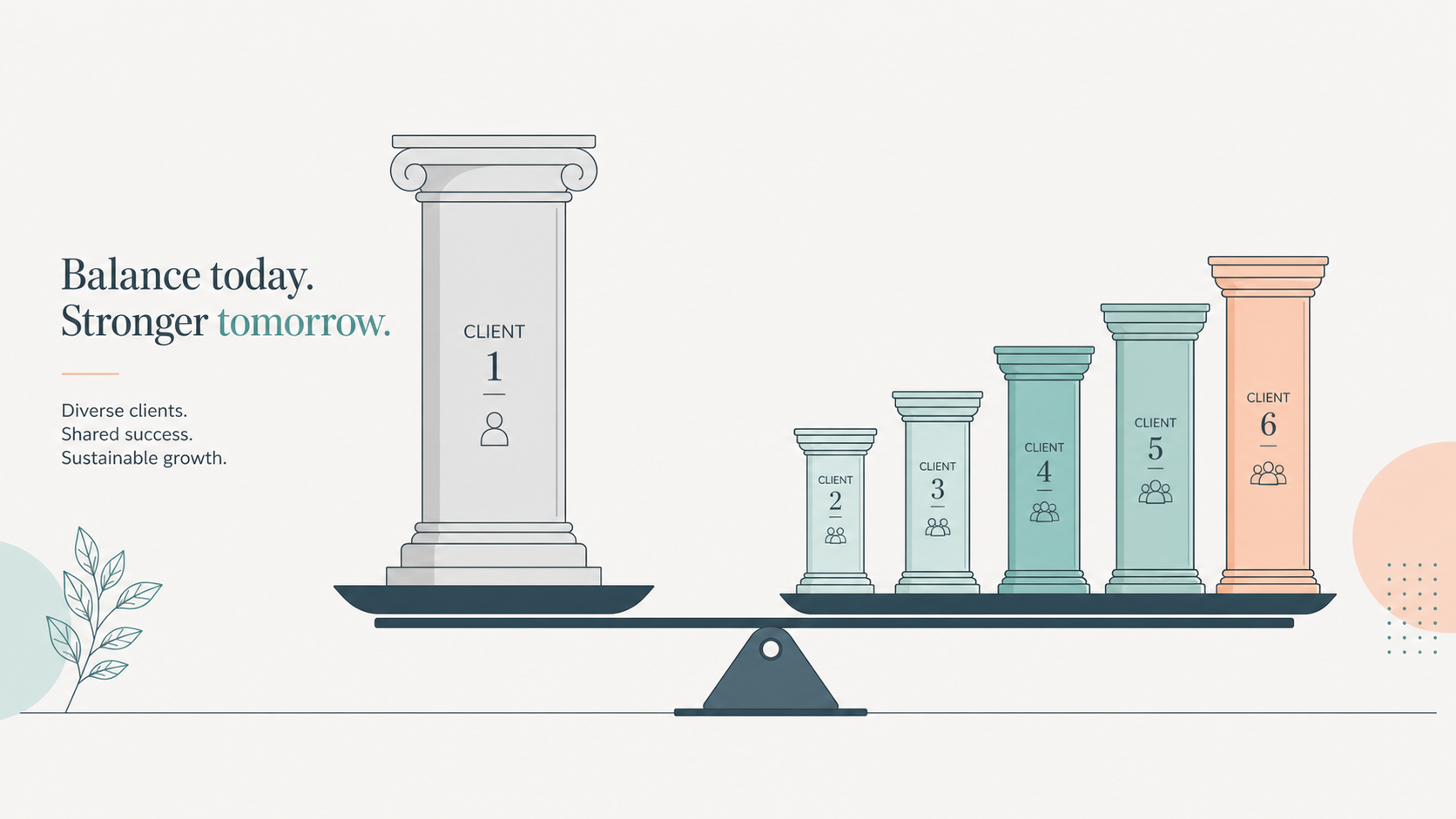
Customer concentration means that a meaningful share of a company’s revenue, gross profit, or EBITDA depends on a limited number of customers. There is no universal threshold that applies to every business, but buyers usually become more cautious when one customer represents a large portion of sales, or when the top five to ten customers dominate revenue.
The issue is not simply mathematical. A large customer can be a sign of strength if it proves the company can serve demanding clients, meet quality standards, and scale operations. But from a buyer’s perspective, concentration creates a single-point failure risk. If that customer is lost, the buyer may not be acquiring the earnings shown in the historical accounts.
This matters because M&A valuation is not only about past profit. It is about the confidence a buyer has in future cash flow. If revenue is diversified, recurring, and supported by contracts or clear switching costs, buyers can underwrite future earnings with greater comfort. If revenue is concentrated, informal, and relationship-dependent, buyers may discount valuation or restructure the deal.
Owners often feel this is unfair. After all, winning a major customer may have taken years of trust, operational discipline, and founder-level effort. But buyers are not judging the achievement. They are pricing the risk of ownership transfer. The more revenue depends on one relationship, one procurement team, or one founder-managed account, the harder it becomes to separate the business value from the seller’s personal role.
Customer concentration also affects financing. Strategic buyers may have their own balance sheets, but financial buyers and leveraged transactions rely heavily on predictable cash flow. Lenders are often uncomfortable funding a transaction where EBITDA could materially decline because one customer changes direction. That can reduce the buyer’s ability to pay, even if the buyer still likes the business.
For sellers, the lesson is practical: reducing customer concentration before going to market is not just a defensive exercise. It is a direct value-protection strategy. It can improve buyer confidence, reduce diligence friction, and support a cleaner negotiation around price, structure, and closing certainty.
Customer Concentration Before M&A from a Seller’s Perspective
From the seller’s side, customer concentration often develops naturally. A large customer grows faster than expected. A multinational client expands orders across regions. A distributor becomes the primary route to market. A platform channel becomes dominant because it delivers efficient growth. None of these developments are automatically negative. In many cases, they are commercially rational.
The challenge is that what makes sense while operating the business may look different during a sale process. A seller may see a loyal key account. A buyer may see revenue fragility. A seller may see strong demand from a leading customer. A buyer may ask whether margins are being squeezed because the customer has bargaining power. A seller may see a personal relationship built over many years. A buyer may wonder whether that relationship survives after the founder exits.
This is why owners should look at concentration through several lenses, not only revenue percentage.
- Revenue concentration: how much of total sales comes from the largest customers.
- Gross profit concentration: whether the largest customers also drive the highest contribution margins.
- EBITDA concentration: whether certain customers disproportionately support operating profit.
- Contract concentration: whether major customers are protected by long-term agreements or operate on purchase orders only.
- Relationship concentration: whether the relationship belongs to the company or mainly to the owner.
- Channel concentration: whether sales depend heavily on one platform, marketplace, distributor, or route to market.
That last point is increasingly important. Social commerce, marketplace-led growth, and platform-driven demand can create rapid expansion, but they can also create dependency on algorithms, platform rules, or channel economics outside the company’s control. A seller should not wait for a buyer to raise these questions. The better approach is to prepare a clear explanation of how the company manages channel risk and how customer relationships are being diversified.
Owners should also separate healthy concentration from dangerous concentration. Healthy concentration may involve long-term customers with recurring orders, multi-level relationships, documented service performance, and strong switching costs. Dangerous concentration often involves short-term orders, founder-only relationships, low contractual protection, customer bargaining power, or dependence on one product line.
Before launching a sale process, sellers should build a customer concentration profile that tells the truth clearly. This profile should not hide the risk. It should explain why the risk is manageable, what has been done to reduce it, and what further opportunities exist for a buyer.
How Investors View This Issue?
Investors analyze customer concentration because it directly affects the quality of earnings. A company with diversified revenue is often easier to value than a company with similar EBITDA but heavy exposure to one or two accounts. The difference is not always visible in the income statement. It becomes visible during commercial due diligence.
Buyers typically ask several questions. How long has each major customer been active? Are revenues growing, stable, or declining? Are contracts signed, automatically renewable, or order-by-order? Who owns the relationship? Are there penalties if the customer terminates? How price-sensitive is the customer? Does the company have a formal account management process? What percentage of revenue is recurring versus project-based?
They also look for evidence that customer dependency is decreasing. A company does not need to eliminate large customers completely. In many sectors, that would be unrealistic. But buyers want to see that the business is not becoming more fragile over time. If the largest customer represented a high share of revenue three years ago and that share has gradually declined because other customers grew, the narrative is stronger. If the largest customer is increasing as a share of revenue, buyers will ask why.
AI-enabled analysis is making this diligence more precise. Buyers can increasingly review customer cohorts, retention patterns, pricing changes, churn signals, product mix, and margin trends in more structured ways. That does not mean every mid-market deal will use advanced analytics. It does mean sellers should expect more detailed questions and less tolerance for vague answers.
Investors also assess strategic context. In advanced industries, buyers may pay attention to whether customer relationships are linked to technical capability, certifications, innovation cycles, or supply chain positioning. In consumer and commerce-related businesses, they may evaluate whether revenue depends on one platform or one marketing channel. In manufacturing, they may ask whether a major customer controls tooling, product specifications, or purchasing timelines.
The practical implication is simple: buyers are not only asking, Who are your customers? They are asking, How defensible is this revenue after we own the company?
If the answer is strong, customer concentration may not destroy a deal. It may simply require careful explanation. If the answer is weak, buyers may protect themselves through a lower multiple, earn-out, retention condition, deferred payment, customer consent requirement, or more intensive diligence.
For sellers who want to understand how these risks connect to price, it is useful to review broader valuation drivers such as earnings quality, buyer type, growth potential, and risk profile. A helpful starting point is key factors affecting business valuation for sellers.
Common Seller Mistakes
Most owners do not ignore customer concentration because they are careless. They ignore it because the business is busy, revenue is coming in, and the largest customers may be the easiest accounts to serve. However, in M&A, the cost of delay can be significant. The following mistakes appear often in sale preparation.
Assuming a Long Relationship Is Enough
A ten-year relationship is valuable, but buyers still need evidence that the relationship is commercially durable. If the customer can terminate without notice, if pricing is renegotiated annually under pressure, or if the relationship depends on the founder, the history alone will not fully satisfy diligence.
Measuring Only Revenue, Not Profit
Some large customers look impressive in revenue terms but contribute less profit than expected. They may demand discounts, special service levels, longer payment terms, or dedicated operational resources. A seller should know whether concentration exists at revenue level, margin level, or both.
Waiting Until the Sale Process Begins
Customer diversification takes time. New business development, account expansion, channel development, and contract renegotiation cannot be completed effectively in the final weeks before a buyer meeting. If the issue is discovered late, the seller may only be able to explain it rather than improve it.
Depending Too Heavily on the Founder
Founder-led customer relationships are common in owner-managed companies. The risk becomes serious when the customer has little contact with the management team, sales team, service team, or operational leadership. Buyers may worry that revenue could leave when the founder exits or reduces involvement.
Overstating Contract Protection
Not all contracts are equal. A framework agreement, preferred supplier status, purchase order pattern, or verbal understanding may not provide the protection a seller assumes. Buyers will read the termination clauses, renewal terms, change-of-control provisions, pricing mechanisms, and service obligations.
Ignoring Channel Concentration
A company may have many end customers but still depend on one distributor, one marketplace, one platform, or one sales channel. In practice, this can be just as risky as customer concentration. If the channel changes terms or loses relevance, the company’s access to customers can weaken quickly.
These mistakes are avoidable, but only if the owner treats customer concentration as a strategic preparation topic rather than a last-minute diligence question.
Practical Checklist or Framework for Business Owners
Reducing customer concentration before M&A does not mean rejecting large customers or forcing artificial diversification. It means building a more resilient revenue base and documenting that resilience in a way buyers can trust. The following framework is practical for owners preparing over a 12 to 24 month period.
1. Build a Clean Customer Revenue Map
Start with a detailed customer revenue analysis for at least the last three financial years and the current year-to-date period. Show revenue by customer, gross margin by customer, product or service mix, payment terms, contract status, and year-on-year movement.
This should be more than an accounting export. It should help answer key buyer questions quickly. Which customers are growing? Which are declining? Which are most profitable? Which have unusually high service requirements? Which relationships are recurring, project-based, or seasonal?
2. Identify the Real Concentration Risk
Not every large customer creates the same level of risk. Categorize major accounts based on risk factors such as contract length, termination rights, renewal history, customer industry health, decision-maker concentration, switching cost, pricing pressure, and internal relationship coverage.
A customer representing a large share of revenue may be less risky if the relationship is institutional, multi-year, operationally embedded, and supported by strong performance data. A smaller customer may be riskier if it is volatile, low-margin, and dependent on one individual.
3. Reduce Founder Dependency in Key Accounts
For each major customer, assign an internal relationship team. This may include sales, operations, finance, and senior management. The goal is to ensure the customer sees the company as a professional organization, not only as the founder’s personal network.
Introduce structured account reviews, documented service standards, and regular management-level communication. If appropriate, gradually transition day-to-day communication away from the owner before the sale process begins. This gives buyers evidence that relationships can survive ownership transition.
4. Strengthen Contracts Where Commercially Possible
Review major customer agreements with legal and commercial advisers. Focus on renewal terms, termination rights, pricing adjustment mechanisms, minimum volume commitments, exclusivity obligations, change-of-control clauses, and service level obligations.
The objective is not to create aggressive contracts that damage customer trust. The objective is to reduce ambiguity. Buyers are more comfortable when revenue arrangements are clear, documented, and commercially normal.
If legal documentation is weak, sellers should also prepare early for legal diligence. For a broader view of what buyers examine, see this guide to legal due diligence in M&A.
5. Grow the Next Layer of Customers
The most effective way to reduce concentration is to grow other customers faster than the largest account. This may involve cross-selling, expanding underdeveloped accounts, entering adjacent customer segments, strengthening sales management, or investing in marketing channels with measurable returns.
Owners should be careful not to chase low-quality revenue purely for diversification. Buyers will not reward growth that comes with weak margins, poor cash conversion, or high churn. The objective is to build a broader base of good customers, not merely a longer customer list.
6. Reduce Channel Dependency
If sales depend heavily on one distributor, platform, marketplace, or lead source, build alternative routes to market. This may include direct sales, additional distributors, owned digital channels, strategic partnerships, or customer referral systems.
In sectors influenced by social commerce, platform-driven visibility can create strong growth but also unpredictable exposure. A seller should be able to explain how the company would continue reaching customers if a channel became less effective.
7. Document Retention and Performance Evidence
Buyers trust evidence more than verbal reassurance. Prepare customer retention data, repeat purchase patterns, service performance metrics, complaint resolution history, renewal rates, and case examples where customers expanded their relationship over time.
Where possible, show that major customers buy because of the company’s capability, quality, delivery reliability, technology, cost position, or service model, not merely because of one personal relationship.
8. Prepare a Balanced Narrative
Do not pretend concentration does not exist. Sophisticated buyers will find it quickly. Instead, prepare a balanced explanation that acknowledges the risk and shows what has been done about it.
A strong narrative might explain that the company historically grew through a major anchor customer, then invested in sales capability, expanded the customer base, reduced the largest customer’s revenue share, strengthened contracts, and built management-level account coverage. This is a much stronger story than simply saying the customer has always been loyal.
Preparing for a future sale? Download our seller checklist.
When Should Sellers Start Preparing?
The best time to address customer concentration is before buyers are involved. Ideally, owners should begin at least 12 to 24 months before a planned transaction. This gives the business time to demonstrate real improvement, not just intent.
A six-month preparation window may still help with documentation, account mapping, contract review, and narrative development. But meaningful diversification usually takes longer. Buyers want to see a track record. They are more persuaded by several reporting periods of reduced concentration than by a sales pipeline presented shortly before closing.
The preparation timeline should be realistic. In the first stage, the owner should diagnose the issue. This means building the customer map, identifying exposure, reviewing contracts, and understanding margin contribution. In the second stage, the company should reduce risk through account management, contract strengthening, and broader customer development. In the third stage, the seller should prepare diligence materials that clearly explain the progress.
Owners should also consider timing relative to customer contracts. If a major agreement is due for renewal soon, it may be better to address renewal before launching a process. If a major customer is going through procurement changes, ownership changes, or strategic review, sellers should understand whether that creates risk for the transaction timeline.
It is also important to avoid cosmetic actions. Buyers can usually tell the difference between genuine diversification and last-minute revenue engineering. For example, adding many small, low-quality customers just before a sale may not improve valuation if those customers have weak margins or uncertain repeat purchase behavior.
A thoughtful preparation process is often more valuable than a rushed attempt to create the appearance of diversification. The goal is to make the business more durable, not merely more presentable.

How This Connects to the Overall Business Sale Journey
Customer concentration is not an isolated issue. It connects to almost every major part of the business sale journey: valuation, buyer selection, due diligence, deal structure, transition planning, and post-closing integration.
In valuation, concentration affects the multiple buyers are willing to pay. Two companies with similar EBITDA can receive very different offers if one has diversified revenue and the other depends heavily on one account. For sellers comparing valuation outcomes, this is closely related to why similar businesses can sell for different prices. If you want to explore that broader topic, see why similar businesses sell for such different prices.
In buyer selection, customer concentration may influence which buyers are most suitable. A strategic buyer with existing customer overlap, industry expertise, or cross-selling capability may be more comfortable with concentration than a financial buyer relying on stable standalone cash flow. However, strategic buyers may also be more sensitive if the customer overlaps with their own conflicts, channel strategy, or competitive positioning.
In due diligence, concentration affects the depth of commercial review. Buyers may request customer calls, contract reviews, retention data, sales pipeline analysis, margin analysis, and evidence of relationship transferability. If the seller is not prepared, the process can slow down or create uncertainty.
In deal structure, concentration can affect how the purchase price is paid. Buyers may propose an earn-out linked to retention of key customers, deferred consideration, escrow protection, or closing conditions tied to customer consent. Sellers generally prefer clean completion mechanics, but a concentrated revenue base can make buyers seek protection.
In transition planning, customer concentration affects the seller’s post-closing role. If the founder holds key customer relationships, buyers may require a longer transition period. That may be acceptable for some owners, but it can be frustrating for sellers who expected a clean exit. Reducing founder dependency early gives the seller more flexibility later.
Finally, customer concentration affects the emotional side of selling. Many owners have built deep relationships with their largest customers. It can be uncomfortable to treat those relationships as risk factors. But professional preparation does not diminish the value of those relationships. It protects them by ensuring they are supported by systems, teams, contracts, and service quality that can continue after the transaction.
The strongest sellers do not wait for buyers to discover weaknesses. They identify the key risks themselves, take practical action, and present the business with discipline. Customer concentration is one of the clearest examples. It can either become a valuation discount or a well-managed part of the equity story.
If you are considering a sale in the next one to three years, begin by asking three questions: Which customers does the business depend on most? What would happen if one of them left? What evidence would convince a buyer that the risk is manageable?
The answers will help you decide whether the company is ready for market, or whether it needs a focused preparation plan first. For owners who want to take the first structured step, start your M&A journey with an initial assessment.
Want a clearer view of seller readiness? Download the Seller Readiness Checklist.
Thinking about timing, valuation, or buyer concerns? Start Here – The journey for business sellers.