Comparable Company Analysis Explained: A Seller’s Essential Guide

Understanding comparable company analysis to maximize your exit value
As a business owner eyeing an exit, you’ve poured years into building your company. But when it comes time to sell, the valuation discussion can feel like a black box. Buyers—especially private equity firms—rely heavily on comparable company analysis (often called “comps”) to anchor their offers. Without grasping this method, you risk accepting a lowball price or watching your deal stall over “unrealistic expectations.”
Comps compare your business to similar public companies using key financial multiples like EV/EBITDA or P/E ratios. It’s straightforward in theory but nuanced in practice. Sellers who master it can spot inflated or deflated benchmarks early, negotiate from strength, and prepare their financials to shine against peers. In competitive markets, where buyers benchmark rigorously, this knowledge separates successful exits from disappointments.
This guide breaks it down practically—no jargon overload. You’ll learn why it matters, how buyers apply it, pitfalls to dodge, and a step-by-step framework to run your own comps. By the end, you’ll approach valuation talks confidently, ensuring your hard work translates to top dollar.
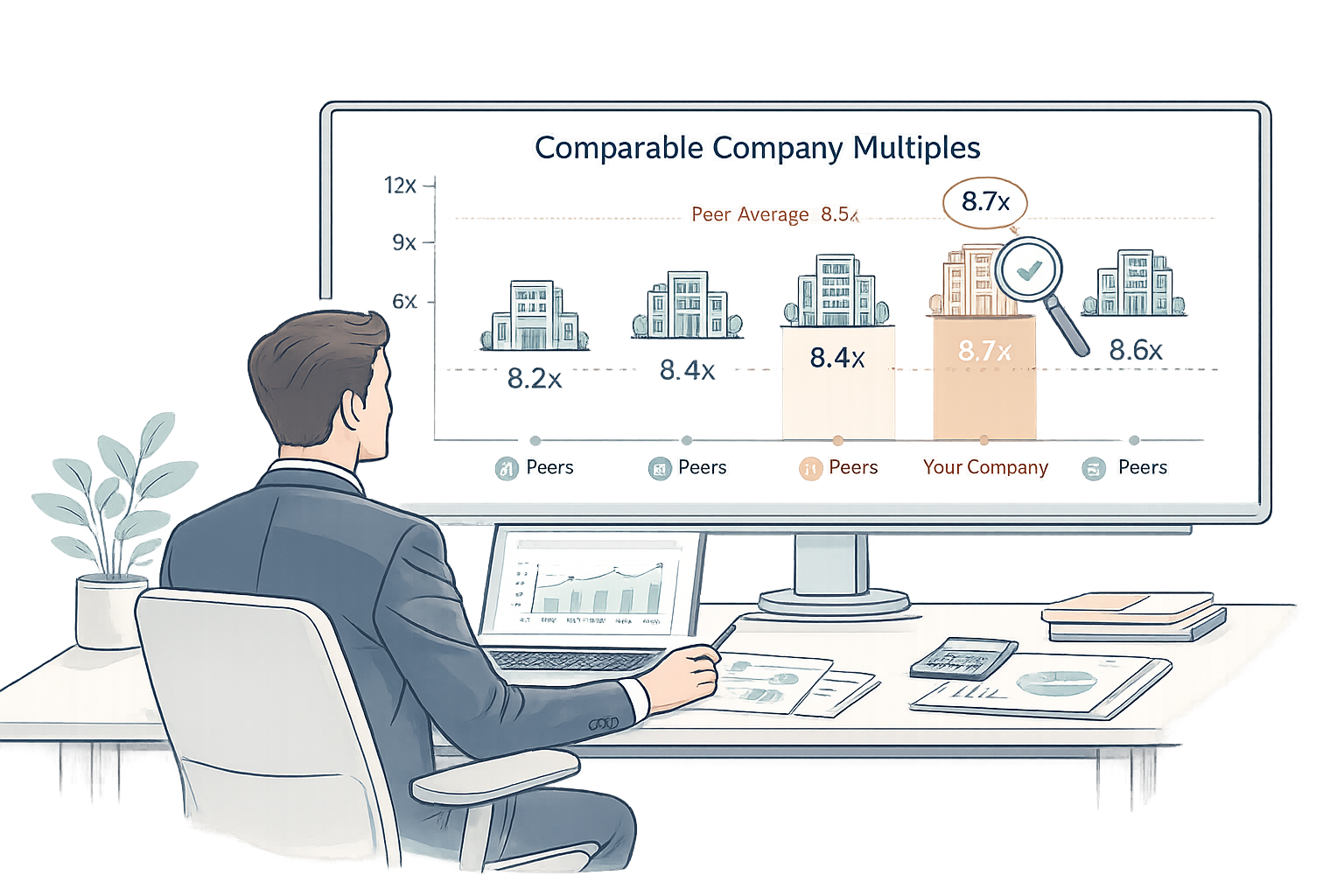
Table of Contents
- Why business owners need to understand comparable company analysis before selling?
- Comparable company analysis from a seller’s perspective
- How investors view this issue?
- Common seller mistakes
- Practical checklist or framework for business owners
- When should sellers start preparing?
- How this connects to the overall business sale journey
Why business owners need to understand comparable company analysis before selling?
Valuation isn’t arbitrary—it’s rooted in market realities. Comparable company analysis grounds your business’s worth in what similar firms trade for today. For sellers, ignoring it means flying blind.
Consider the stakes: A mismatched comp set can swing your valuation by 20-30%. Private equity buyers in dynamic regions like Asia-Pacific scrutinize comps meticulously, cross-referencing public peers to justify bids. If your EBITDA multiple lags peers due to unaddressed issues like high customer concentration, deals crumble.
Understanding comps empowers you to:
- Anticipate buyer math before they pitch a number.
- Challenge weak assumptions, like cherry-picked high-growth comps that don’t fit your profile.
- Proactively clean up financials to align with top-quartile peers.
Without this insight, you’re reactive. With it, you steer the process. Seasoned sellers use comps to benchmark internally years ahead, turning potential red flags into strengths.
Comparable company analysis from a seller’s perspective
From where you sit, comps demystify the “why” behind offers. It’s not about your gut feel for value—it’s multiples derived from traded companies.
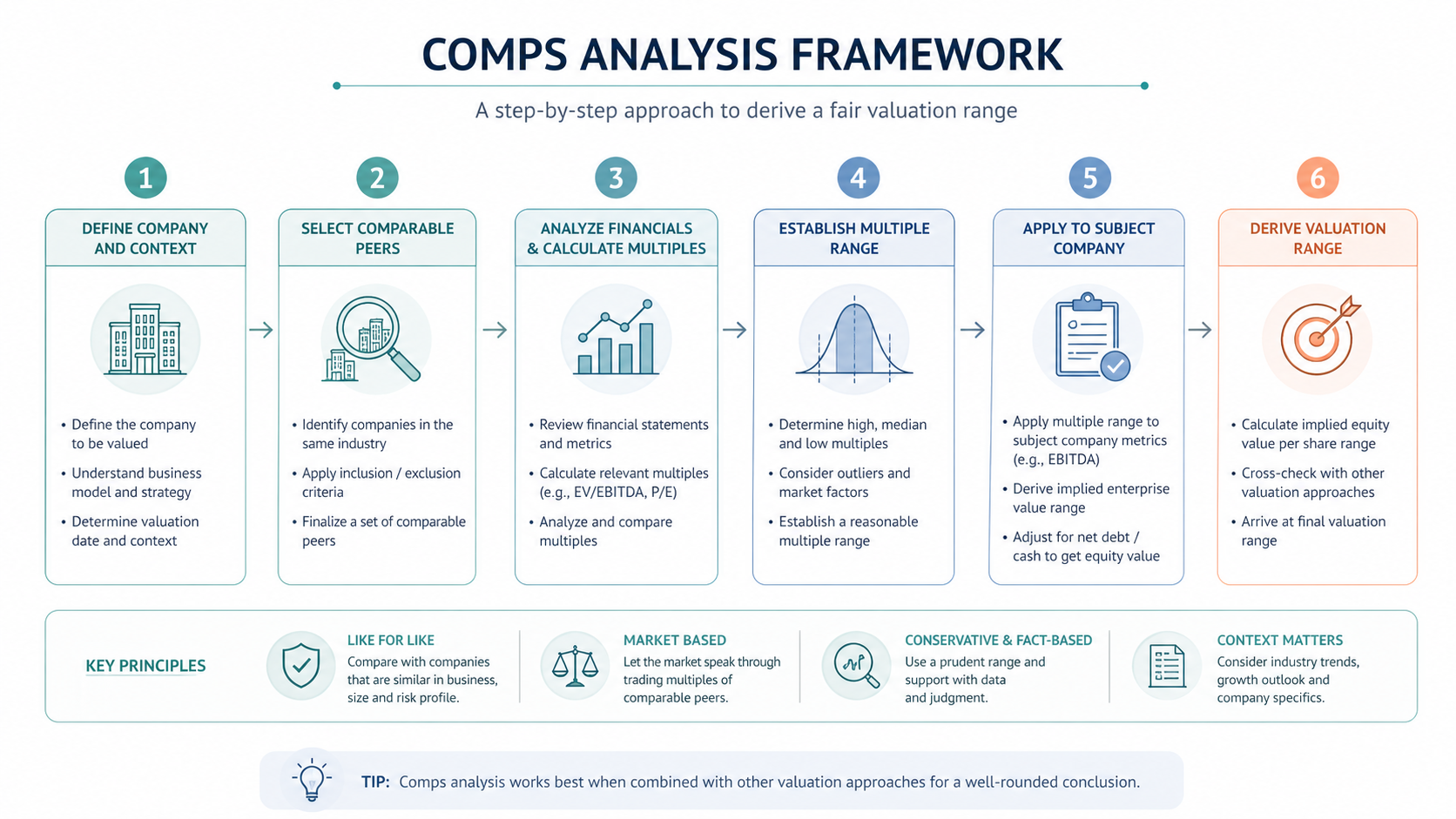
Core steps in a seller-led comps review:
- Select peers: Identify 5-10 public companies in your industry, geography, size, and growth stage. Tools like Capital IQ or Bloomberg help, but start with sector reports.
- Gather metrics: Pull trailing and forward EV/EBITDA, P/E, EV/Revenue. Focus on what’s relevant—EBITDA for mature firms, revenue for high-growth.
- Adjust for differences: Discount comps with superior margins or scale. Your private status warrants a 20-30% liquidity discount.
- Apply to your numbers: Multiply your EBITDA by the median multiple for a baseline value.
For example, if peers trade at 8x EBITDA and yours is $5M, expect $40M enterprise value—before adjustments. Sellers who run this exercise spot gaps early, like normalizing one-off expenses to boost EBITDA.
This perspective shifts you from seller to co-strategist, fostering trust with advisors and buyers alike.
How investors view this issue?
Buyers—strategics and private equity—treat comps as their North Star. It’s objective, market-driven proof for LPs and boards.
Private equity firms layer comps with precedent transactions for triangulation. They stress-test against downside scenarios, applying lower-quartile multiples if risks like founder dependency loom. In Asia-Pacific, where PE deployment accelerates, firms benchmark against regional public peers to gauge entry multiples.
Key investor lenses:
- Premiums for quality: Strong moats earn top-decile multiples.
- Risk discounts: Cyclicality or capex-heavy models drag ratios down.
- Forward-looking: Growth projections justify higher forwards vs. trailing multiples.
Investors dismiss seller comps that ignore these. They expect audited financials matching public standards—hence the push for normalized statements. Aligning early prevents surprises.
Common seller mistakes
Sellers trip up on comps routinely, eroding value. Here’s what to sidestep:
- Poor peer selection: Picking glamorous giants ignores size parity. A $100M firm isn’t comp to your $10M operation.
- Ignoring adjustments: Raw multiples overlook your private illiquidity or superior growth.
- Overreliance on outliers: Chasing 12x multiples from unicorns inflates expectations, killing credibility.
- Stale data: Markets shift; refresh comps quarterly.
- Financial mismatches: Unnormalized EBITDA (e.g., add-backs galore) gets rejected. See our guide on preparing financial statements before selling a business for details.
These errors lead to 15-25% valuation gaps. Proactive sellers audit comps with advisors, building defensible narratives.
Practical checklist or framework for business owners
Run your own comps with this seller-focused framework. No Wall Street budget required.
- Define your profile: Industry, revenue range ($10-100M?), growth (10-30%?), margins.
- Build comp set: 6-8 publics via Yahoo Finance or Edgar filings. Ensure 70% overlap in traits.
- Collect data:
- EV/EBITDA (trailing/forward)
- P/E
- EV/Revenue
- Size-adjusted where possible
- Calculate medians: Avoid averages—outliers skew.
- Normalize your financials: Recast EBITDA adding back owner perks, normalizing CapEx.
- Apply and range: Low/median/high multiples for $X-$Y range.
- Sensitivity test: +/-1% growth impact?
- Document: Spreadsheet ready for buyer DD.
Pro tip: Cross-check with industry multiples from S&P or Damodaran datasets. Download our seller checklist to integrate this into prep.
This yields a realistic range, arming negotiations.
When should sellers start preparing?
Don’t wait for LOIs. Begin 12-18 months pre-market. Early comps reveal fixes like margin expansion or diversification.
Timeline:
- 18 months out: Initial comps to set baseline.
- 12 months: Financial recast; peer benchmarking. Align with 12-month preparation checklist.
- 6 months: Advisor validation; stress-test.
- Market: Live comps for teasers.
Early action compounds: A 10% EBITDA lift via clean-up adds millions at 8x.
How this connects to the overall business sale journey
Comps thread through every stage. Pre-marketing: Shapes CIM financials. DD: Validates buyer models. Negotiation: Anchors multiples debate.
It dovetails with data room setup (essential seller guide here), financial audits, and even team building to reduce key-man risk.
Holistic prep maximizes multiples. For tailored advice, book a confidential call or start your M&A journey. Explore more at our M&A blog.
Ready to benchmark your value? Download our seller readiness checklist.
Take the first step toward exit success. Start here – the journey for business sellers.