Should You Value Your Business Before Talking to Buyers?

The Valuation Timing Dilemma That Could Cost You Millions
As a business owner eyeing an exit, you’ve built something valuable over years of hard work. But when buyers start circling, a nagging question arises: should you get a professional valuation before engaging them? Rush in without one, and you risk lowball offers or endless negotiations. Wait too long, and you might miss leverage points that boost your price.
This isn’t just theory. Many sellers dive into talks assuming they know their company’s worth, only to discover hidden adjustments that slash the final number. Others overprepare with valuations that become outdated by market shifts. The right timing sets the stage for stronger deals, higher multiples, and smoother closings. In this guide, we’ll break down the seller’s viewpoint, buyer psychology, pitfalls to dodge, and a step-by-step framework to time your valuation perfectly.
Understanding this empowers you to control the process rather than react to it. Let’s explore why getting ahead on valuation isn’t optional—it’s strategic.
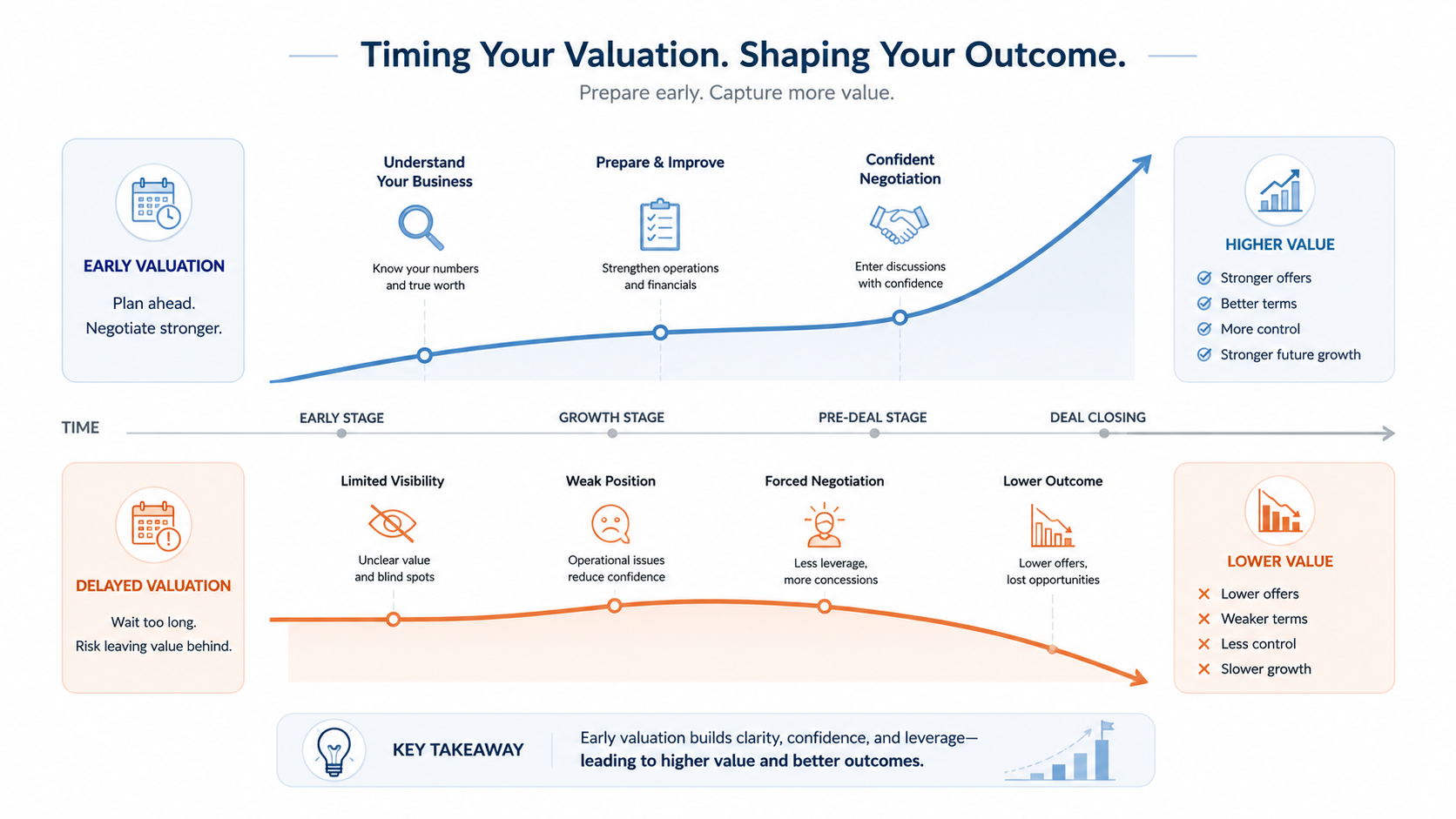
Table of Contents
- Why business owners need to understand valuation timing before selling
- Valuation timing from a seller’s perspective
- How investors view this issue
- Common seller mistakes
- Practical checklist for business owners
- When should sellers start preparing
- How this connects to the overall business sale journey
Why business owners need to understand valuation timing before selling
Valuation isn’t a one-off event—it’s a dynamic tool that evolves with your business and market conditions. Jumping into buyer conversations without a baseline figure leaves you vulnerable. Buyers armed with their own models will anchor negotiations low, forcing you to justify every dollar upward.
Consider the stakes: a premature or absent valuation can lead to accepting offers 20-30% below potential, based on misaligned expectations. On the flip side, an early professional assessment reveals strengths like recurring revenue or IP assets, giving you confidence to walk away from weak bids.
Timing mastery also uncovers preparation gaps. For instance, normalizing earnings for owner perks or one-time expenses requires time—months, not weeks. Starting early lets you address these, potentially lifting your multiple from 4x to 6x EBITDA.
Moreover, in competitive auctions, a prepped valuation signals professionalism to buyers, speeding due diligence and reducing discounts. Sellers who grasp this enter talks as equals, not supplicants.
Valuation timing from a seller’s perspective
From where you sit, valuation is your north star for exit planning. But when to pull the trigger? Too early (say, 24 months out), and figures stale amid growth or economic shifts. Too late (post-LOI), and buyers dictate terms with their comps.
Ideal window: 6-12 months pre-marketing. This captures recent financials while allowing tweaks. Use it to benchmark against peers—valuation multiples for similar firms reveal if you’re positioned well.
Sellers often undervalue intangibles like customer concentration risks or growth pipelines. A timed valuation quantifies these, arming you with data. It also informs earn-outs or seller notes, protecting downside.
Real-world angle: owners with clean, audited numbers close faster at premiums. Without timing, you chase validation reactively, eroding leverage.

How investors view this issue
Buyers—strategic or financial—scrutinize your preparedness. A seller without valuation? Red flag for disorganization, prompting deeper discounts for ‘unknowns.’
Financial buyers apply DCF or LBO models, stressing add-backs like EBITDA adjustments. They expect your figure to align; mismatches trigger renegotiations.
Strategics weigh synergies but demand proof of standalone value. Pre-discussions valuation shows realism, building trust. Investors respect sellers who’ve stress-tested assumptions, viewing them as low-risk.
They also gauge enterprise vs. equity value early—key distinctions that affect net proceeds. Timed insight here prevents surprises.
Common seller mistakes
Sellers trip up in predictable ways:
- DIY valuations: Online calculators ignore nuances, leading to inflated expectations or underpricing.
- Engaging buyers first: Without benchmarks, you reveal desperation, inviting aggressive bids.
- Ignoring market cycles: Valuing in a downturn locks in low multiples; time for upswings.
- Overlooking adjustments: Failing to normalize for non-recurring items tanks credibility.
- One-size-fits-all approach: Not tailoring for strategic vs. financial buyers.
These erode value—avoid by professional timing.
Practical checklist or framework for business owners
Follow this phased framework:
- Assess readiness (3-6 months out): Review financials, clean books, document governance.
- Engage valuator: Select advisor experienced in your sector for DCF, comps, precedent analysis.
- Validate key metrics: Scrutinize EBITDA, growth rates, working capital.
- Scenario model: Base, upside, downside cases.
- Update quarterly: Refresh as needed.
- Integrate into pitch: Use in teaser/ teaser without revealing full details.
Download our seller checklist for detailed steps.
When should sellers start preparing
Begin valuation groundwork 12-18 months before active sale. This covers financial cleanup, which takes 6+ months.
If opportunistic sale looms, fast-track with interim valuation. Monitor triggers: peer deals, sector M&A uptick.
Post-TEV? Rare, but useful for disputes. Proactively: tie to annual planning.
How this connects to the overall business sale journey
Valuation timing threads the M&A process. Preps due diligence, informs financial due diligence, shapes LOI terms.
It links to valuation factors, buyer selection, and exit optimization. Early action cascades benefits.
Visit our M&A blog for more.
Ready to benchmark your value? Start your M&A journey.
Need confidential advice? Book a confidential call with our advisors.