How to Prepare an Effective Data Room for Business Sales

Streamlining due diligence: Why your data room can make or break the deal
In the high-stakes world of mergers and acquisitions, the data room serves as the nerve center of due diligence. It’s where potential buyers dive deep into your company’s most sensitive information—from financial records and contracts to intellectual property and operational data. A poorly organized data room can signal disarray, erode buyer confidence, and even derail a promising deal. Conversely, a well-prepared one demonstrates professionalism, transparency, and readiness, accelerating negotiations and potentially boosting your valuation.
Business owners often underestimate the data room’s impact. What starts as a simple folder of documents can evolve into a comprehensive virtual repository that buyers scrutinize for weeks or months. With AI now influencing due diligence processes, expectations are higher than ever. Buyers expect quick access, robust security, and logical organization. If your data room falls short, it risks exposing gaps in your records, leading to prolonged scrutiny, price adjustments, or outright walkaways.
This guide equips you with practical insights to build an effective data room. Drawing from real-world M&A practices, we’ll cover everything from foundational setup to advanced considerations, ensuring you’re positioned for success.
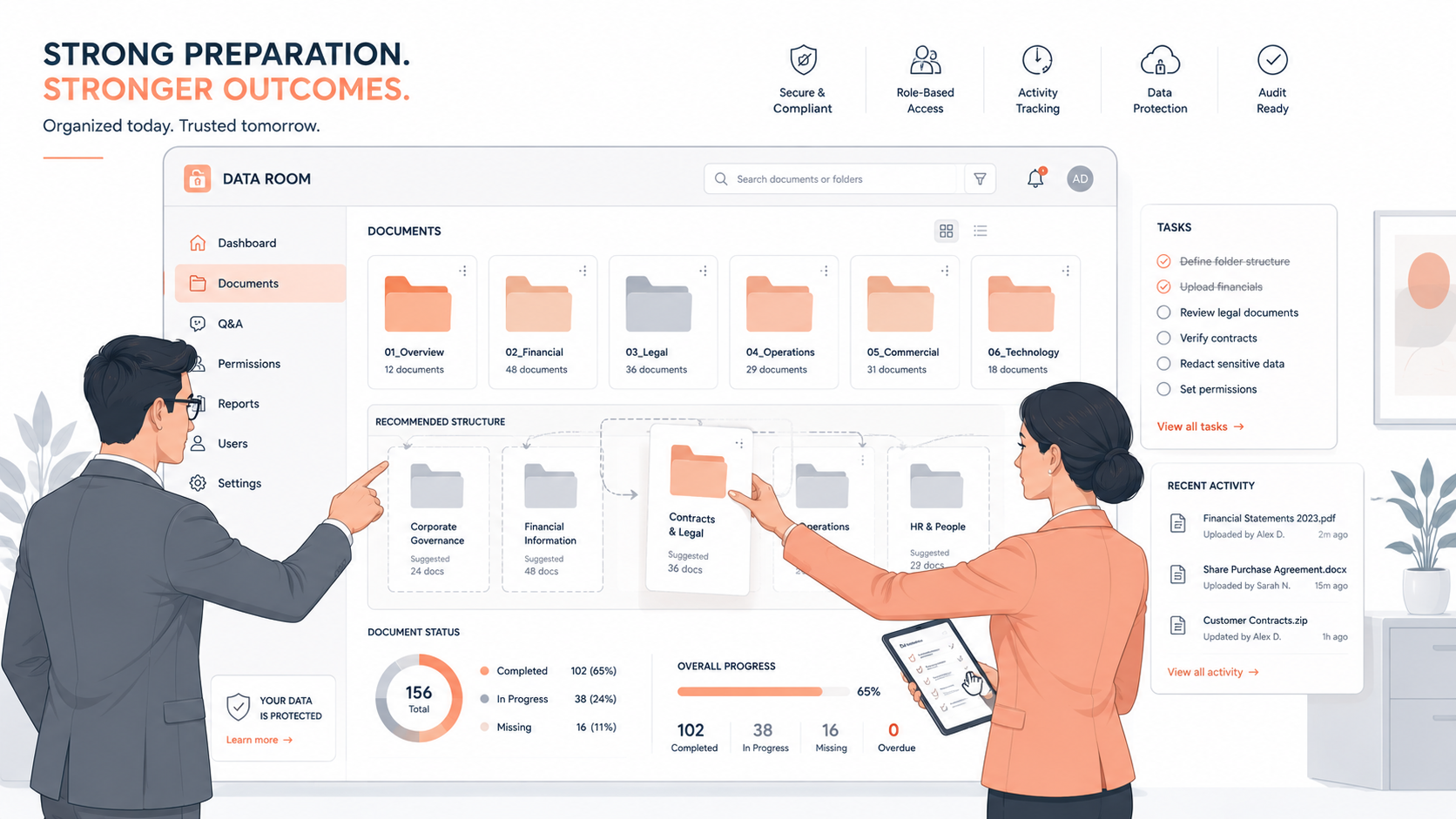
Table of Contents
- Why business owners need to understand data rooms before selling
- Data rooms from a seller’s perspective
- How investors view data rooms
- Common seller mistakes with data rooms
- Practical checklist for preparing an effective data room
- When should sellers start preparing a data room?
- How data rooms connect to the overall business sale journey
Why business owners need to understand data rooms before selling
Understanding data rooms isn’t just a technicality—it’s a strategic imperative for any business owner eyeing an exit. In M&A, due diligence is the phase where buyers validate your claims, uncover risks, and justify their offer. The data room is the gateway to this process. Without a solid grasp, sellers expose themselves to unnecessary vulnerabilities.
Consider the time factor: Due diligence can span 30 to 90 days, consuming resources on both sides. A disorganized data room prolongs this, frustrating buyers and increasing the chance of deal fatigue. Moreover, in today’s market, where AI tools are reshaping due diligence, buyers leverage automation to scan vast datasets rapidly. If your documents aren’t structured for machine readability—clean PDFs, consistent naming, indexed folders—you’ll lag behind.
Financially, a subpar data room can lead to valuation discounts. Buyers spotting incomplete records might haircut the price by 10-20% to account for unknowns. Legal and compliance issues hidden in messy files could trigger post-closing disputes. By mastering data room preparation, you protect your equity, build trust, and signal operational excellence.
From operations to assets, quantifying efficiencies in due diligence preparation pays dividends. Sellers who invest upfront in organization often close faster and at better terms. It’s about control: You dictate the narrative through curated, verifiable data rather than leaving it to buyer interpretation.
Data rooms from a seller’s perspective
For sellers, the data room is your story told through documents. It’s not merely a file dump; it’s a curated exhibit of your business’s health and potential. Start by viewing it as a sales tool. Every folder should reinforce why your company is a prime acquisition target.
Key categories include financials (audited statements, tax returns, forecasts), legal (contracts, IP filings, litigation history), commercial (customer lists, sales pipelines), operational (HR policies, IT infrastructure), and strategic (market analyses, growth plans). Prioritize completeness: Missing cap tables or unresolved vendor disputes can raise red flags.
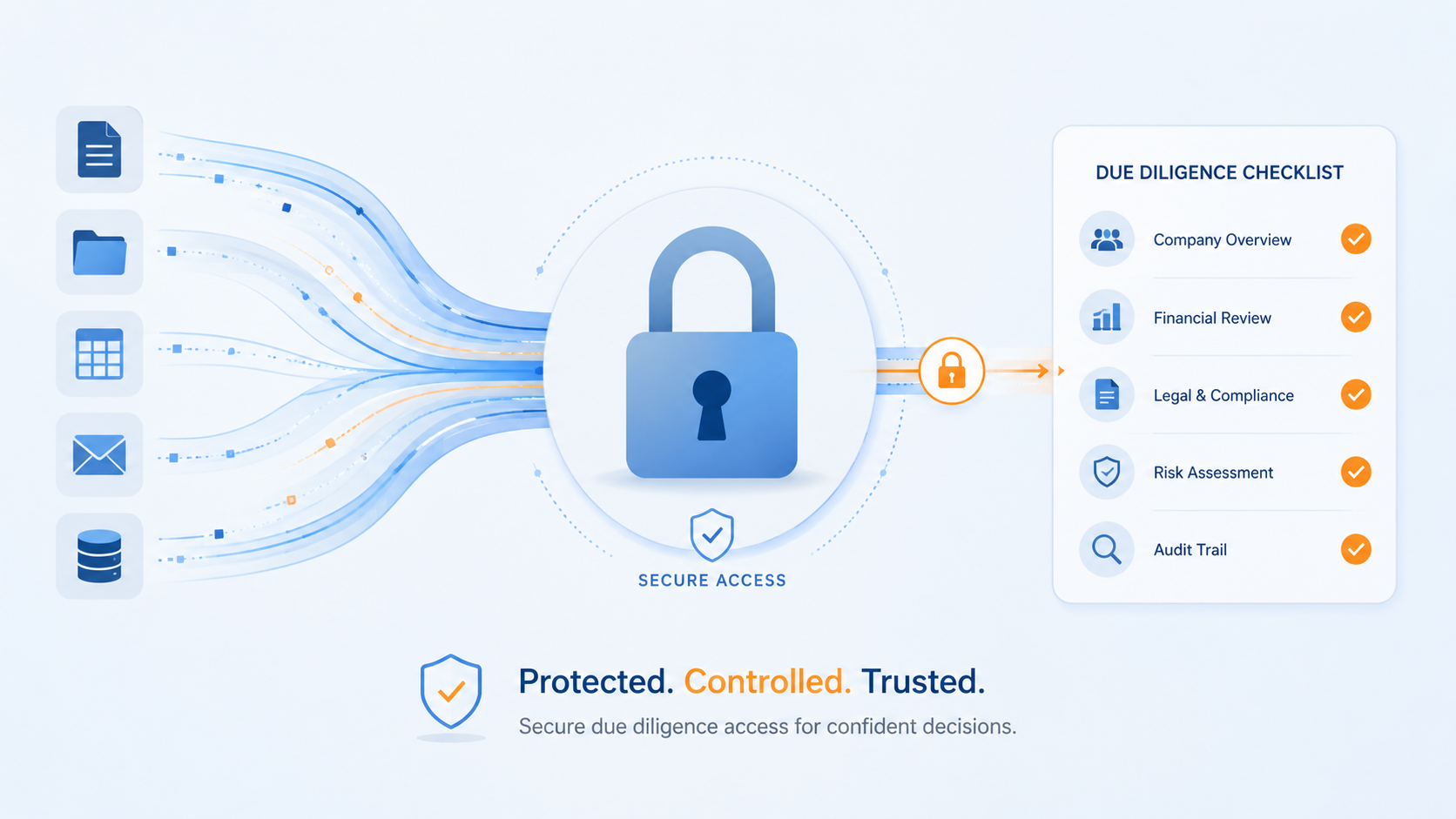
Security is paramount. Use virtual data rooms (VDRs) like DealRoom, Intralinks, or Merrill Datasite with features like watermarking, audit trails, and granular permissions. This protects sensitive data while providing analytics on buyer activity—who views what, how long they linger.
From a seller’s lens, the data room also reveals internal readiness. Auditing your files often uncovers issues like outdated policies or compliance gaps, which you can address pre-sale. This proactive approach enhances credibility. In private equity contexts, where value creation is key, a pristine data room underscores sustainable operations.
Finally, tailor to buyer type. Strategic buyers focus on synergies (e.g., customer overlap data); financial buyers drill into metrics (EBITDA drivers). Customize indexes accordingly for efficiency.
How investors view data rooms
Investors—whether private equity firms, strategics, or venture capitalists—approach data rooms with a risk lens. They seek confirmation of your numbers, validation of growth stories, and identification of liabilities. A first impression matters: Within hours of access, they form opinions on your professionalism.
Private equity investors, in particular, emphasize quantifiable value creation. They expect detailed financial due diligence data, including asset valuations and operational KPIs. AI’s role here is growing, enabling faster anomaly detection in ledgers or contracts. Investors using these tools penalize sellers whose data isn’t digitized or standardized.
Common investor priorities: Clean financial trails (no gaps in P&Ls), robust IP portfolios (patents, trademarks), and customer concentration analyses. They track Q&A resolution times—prompt responses signal strong management.
Partnership dynamics also play in. Investors view data rooms as collaboration hubs, where iterative diligence refines the deal. Poor organization suggests deeper issues, prompting deeper probes or lower bids. In contrast, intuitive navigation builds momentum toward closing.
Ultimately, investors measure ROI potential through your data. From operations to assets, they quantify efficiencies your data room enables or hinders.
Common seller mistakes with data rooms
Sellers frequently sabotage their deals with data room pitfalls. The most egregious is the ‘data dump’—uploading everything without structure. Buyers drown in chaos, losing patience quickly.
Another error: Inconsistent naming and versioning. Files like ‘Q3_Forecast_v2_final.xlsx’ confuse; use systematic conventions (e.g., ‘Financial_Forecasts_2023_Q3_v1.0.pdf’). Neglecting permissions leads to overexposure—sensitive HR data visible to all viewers breaches privacy.
Overlooking digitization: Scanned docs without OCR hinder AI analysis. Incomplete sets, like missing supporting schedules for financials, invite skepticism. Failing to update dynamically—static rooms ignore evolving Q&A.
Security lapses, such as weak passwords or no expiration, risk leaks. Not tracking access analytics means missing buyer signals (e.g., fixation on litigation folder). For startups eyeing exits akin to Series A prep, ignoring scalability data (user metrics, churn rates) misses growth narratives.
Avoid these by conducting mock diligence internally. Common traps erode trust, prolong timelines, and deflate offers.
Practical checklist for preparing an effective data room
Here’s a step-by-step framework to build a bulletproof data room:
- Gather and audit documents: Compile all categories. Scrub for accuracy, redacting personal data.
- Choose a VDR platform: Select based on security, ease-of-use, and analytics. Test with your team.
- Organize hierarchically: Main folders: Financial, Legal, Commercial, Operations, IP, HR, Strategic. Subfolders logically (e.g., Financial > Audits > 2022).
- Standardize formats: PDFs for finals, Excel for models. Consistent naming: Category_Document_Date_Version.
- Implement security: Role-based access, watermarks, NDA gates, download restrictions.
- Index and FAQ: Detailed index with hyperlinks. Preemptive FAQ for common queries.
- Test and train: Simulate buyer access. Train responders for Q&A.
- Monitor and update: Use analytics. Refresh data weekly.
- Prepare for AI diligence: Ensure data is searchable, structured for tools.
This checklist, applied diligently, positions you ahead. For deeper terms, check our M&A glossary.
When should sellers start preparing a data room?
Don’t wait for LOIs. Begin 6-12 months pre-marketing. Early auditing reveals fixes—like cleaning cap tables or resolving disputes—avoiding last-minute scrambles.
Align with sale timeline: For auctions, prep in parallel with teaser development. Integrate with financial cleansings for audits. In PE-backed sales, sync with value creation initiatives.
Trigger points: Post-valuation (link to common business valuation methods), upon advisor engagement. Continuous maintenance keeps you exit-ready, as factors boosting exit success include organized records (factors that increase chances of a successful business exit).
How data rooms connect to the overall business sale journey
The data room anchors the M&A process, bridging marketing to closing. It follows teasers/ CIMs, fueling diligence. Success here propels to SPA negotiations.
Integrates with valuation: Robust data supports multiples (visit our M&A blog for more). Ties to seller readiness—early prep maximizes value.
Post-close, analytics inform lessons. In holistic journeys, it’s one cog: Prep via checklists, engage advisors. Vietnam M&A Market resources aid throughout.
Ready to get started? Start your M&A journey.
Ensure you’re fully prepared. Download our seller checklist.
Need expert guidance? Book a confidential call.


