What Is the Discount Rate in Valuation? Guide for Sellers

The discount rate: Unlocking your business’s true sale value
As a business owner eyeing an exit, you’ve likely heard the term “discount rate” thrown around in valuation discussions. It sounds technical, but it’s the linchpin that determines how much your company is worth today based on its future earnings potential. Get this wrong, and you could leave millions on the table—or worse, scare off buyers with an inflated asking price.
Imagine pouring years into building your business, only to see its valuation slashed because of a poorly understood discount rate. Buyers apply this rate to discount your projected cash flows back to present value, accounting for time value of money and risks. A higher rate means lower valuation; a lower one boosts it. For sellers, mastering this concept isn’t optional—it’s essential to negotiate effectively and avoid deal-killing surprises.
In Vietnam’s dynamic M&A market, where foreign investors scrutinize every detail, understanding the discount rate empowers you to present a compelling case for your company’s value. It bridges the gap between your optimistic projections and a buyer’s risk-averse lens. This guide breaks it down practically, from seller pitfalls to actionable steps, ensuring you’re equipped for the valuation phase.
Table of Contents
- Why business owners need to understand discount rate in valuation before selling
- Discount rate in valuation from a seller’s perspective
- How investors view this issue
- Common seller mistakes
- Practical checklist for business owners
- When should sellers start preparing
- How this connects to the overall business sale journey
Why business owners need to understand discount rate in valuation before selling
Valuation isn’t just a number—it’s the culmination of your business’s story, risks, and growth trajectory. The discount rate sits at the heart of the most common method: discounted cash flow (DCF) analysis. Without grasping it, sellers risk blind spots that erode value during negotiations.
Consider the basics: future cash flows are worth less today due to uncertainty and opportunity cost. The discount rate quantifies that adjustment. For business owners, ignoring it means failing to challenge buyer assumptions that inflate perceived risks, directly hitting your exit multiple.
In practice, this understanding prevents valuation gaps. Buyers often start with conservative rates (say, 15-25% for mid-sized firms), baking in every conceivable risk. Sellers who know the components—risk-free rate, market premiums, and company-specific adjustments—can counter with evidence, potentially shaving points off the rate and lifting enterprise value by 20-30% or more.
Beyond numbers, it fosters credibility. When you discuss discount rates fluently, you signal professionalism, shifting talks from price haggling to strategic dialogue. Early preparation also uncovers internal issues, like volatile earnings, that inflate your effective rate.
Discount rate in valuation from a seller’s perspective
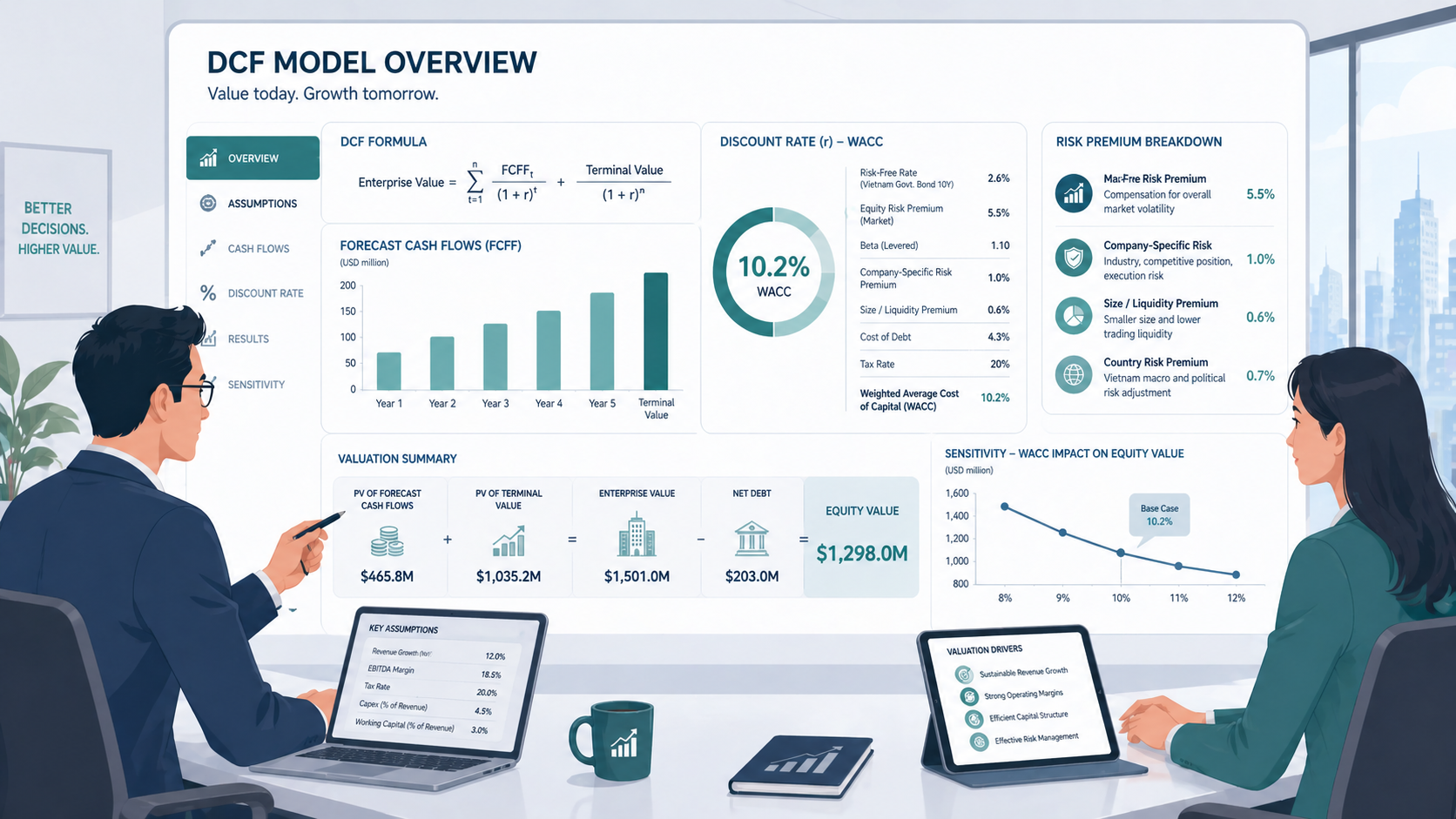
From where you sit, the discount rate is your valuation’s multiplier—or divisor. It’s derived primarily from the weighted average cost of capital (WACC) for DCF, blending debt and equity costs. Sellers focus on lowering it by mitigating risks that buyers will inevitably highlight.
Key components include:
- Risk-free rate: Based on government bond yields, currently hovering around 4-5% in stable markets.
- Equity risk premium: Compensation for stock market volatility, often 5-7%.
- Size premium: Extra for smaller firms, 3-6% depending on revenue scale.
- Company-specific risk: The big variable—customer concentration, regulatory exposure, or founder dependency can add 5-15%.
As a seller, your goal is to audit these. For instance, diversifying customers pre-sale reduces that specific risk premium. Documented processes and audited financials signal stability, justifying a lower rate.
In seller terms, a 2% rate reduction on a business with $10M in perpetual cash flow adds $1M to value ($10M / 0.10 vs. $10M / 0.12). Real-world exits show sellers who proactively address risks close at premiums over peers.
Check our M&A glossary for deeper dives into terms like WACC and beta, ensuring you’re speaking the buyer’s language.
How investors view this issue
Buyers wield the discount rate as a risk filter. Strategic acquirers or private equity firms calibrate it to their hurdle rates, often benchmarking against peers via CAPM (Capital Asset Pricing Model). They stress-test your projections with higher rates to model downside scenarios.
For Vietnam deals, investors layer in country risk premiums (2-4%) atop global benchmarks, viewing local factors like forex volatility or policy shifts as rate inflators. They scour your data room for red flags: inconsistent EBITDA, high capex needs, or key-man risks.
PE buyers target IRRs of 20-30%, back-solving for discount rates that deliver. Corporates might accept lower (12-18%) if synergies justify. Their view? Your rate reflects not just math, but post-acquisition execution probability.
Sellers counter by providing comps analysis alongside DCF, showing market rates for similar firms. Clean, audited financial statements build trust, nudging rates downward.
Common seller mistakes
Sellers often stumble here, inflating their own discount rate unwittingly.
- Overlooking company-specific risks: Founder dependency or single-client reliance can spike rates 10%. Mitigation starts years ahead.
- Ignoring market benchmarks: Using arbitrary rates without CAPM justification weakens your position.
- Flawed projections: Optimistic cash flows paired with low rates scream unrealistic—buyers hike rates accordingly.
- No sensitivity analysis: Failing to show how 1-2% rate changes impact value leaves you vulnerable.
- Delaying financial clean-up: Unaudited books force conservative rates.
Avoid these by simulating buyer scrutiny early. Many first-timers see 15-20% valuation hits from such errors.

Practical checklist or framework for business owners
- Assemble baseline data: Gather 3-5 years of audited financials, industry betas, and peer multiples.
- Calculate WACC components: Use risk-free rate (gov bonds), ERP (6%), beta (from comps), size premium (Damodaran tables), debt cost.
- Quantify specific risks: Score customer concentration (e.g., top client >30%?), management depth, capex predictability. Adjust rate upward per factor.
- Build DCF model: Project 5-year cash flows + terminal value. Test rates from 10-25%.
- Run sensitivities: Table showing value at rate ±2%. Cross-check with precedent transactions.
- Prepare narrative: Document mitigations (e.g., succession plan) to defend lower rate.
- Third-party validation: Get a valuation expert’s sanity check.
Download our seller readiness checklist for integrated prep steps.
When should sellers start preparing
Don’t wait for LOIs. Begin 12-18 months pre-market. Early audits normalize financials, reducing risk premiums. Address dependencies via team-building now, not reactively.
Align with the 12-month preparation checklist. Quarterly reviews keep your rate competitive as market conditions shift (e.g., rising rates compress multiples).
For mature firms, ongoing KPI tracking maintains low-rate readiness year-round.
How this connects to the overall business sale journey
The discount rate threads through every stage: teaser teases stability (low risk), CIM details mitigations, diligence validates assumptions, and SPA negotiations finalize the rate-implied price.
It links to data room prep, financial statements, and legal clean-up. A holistic approach—per our M&A blog insights—ensures consistency.
Visit Vietnam M&A Market for the full ecosystem.
Ready to assess your valuation? Start your M&A journey.
Need expert guidance? Book a confidential call with our advisors.