When Does the Seller Get Paid? Timing Your M&A Payout

Unlocking the mysteries of your M&A payout timeline
As a business owner eyeing an exit, you’ve poured years into building your company. The moment of truth comes when the deal closes—but when exactly does the money hit your account? Many sellers assume it’s a clean, immediate wire transfer at signing. Reality often tells a different story. Payments in M&A deals are rarely straightforward. They involve structured timelines, contingencies, and safeguards that protect both sides.
Picture this: You’ve negotiated a strong valuation, but 30% of your payout is held in escrow for 18 months. Or worse, an earn-out tied to post-sale performance leaves you waiting years for the full amount. These structures are standard, yet they catch first-time sellers off guard, leading to cash flow surprises, tax headaches, and even deal disputes. Understanding payment timing isn’t just about knowing when you’ll get paid—it’s about maximizing your net proceeds, minimizing risks, and ensuring the deal aligns with your life plans.
In this guide, we’ll break down the typical payment mechanisms, from upfront cash to deferred components. You’ll learn how buyers structure deals to manage risk, common pitfalls that erode seller value, and a practical framework to negotiate better terms. Whether you’re six months or six years from selling, grasping these dynamics empowers you to exit on your terms.
Table of Contents
- Why business owners need to understand payment timing before selling
- Payment structures from a seller’s perspective
- How buyers view payment timing
- Common seller mistakes
- Practical checklist for negotiating payment terms
- When should sellers start preparing
- How this connects to the overall business sale journey
Why business owners need to understand payment timing before selling
Payment timing directly impacts your financial security post-sale. A deal valued at $10 million might net you only 60% upfront, with the rest trickling in over time. Without foresight, you risk overcommitting to personal plans—like buying a vacation home or retiring early—only to face delays.
Consider liquidity needs. If you’re bridging to a new venture, deferred payments can strain cash flow. Tax implications vary too: Upfront cash triggers immediate capital gains, while earn-outs spread liability. Misjudging this can inflate your tax bill by tens of thousands.
Moreover, payment structures reveal buyer intent. Strategic buyers (corporates seeking synergies) often pay more upfront for integration speed. Financial buyers (private equity) favor earn-outs to align incentives. Ignoring these signals leads to mismatched expectations and failed negotiations.
From experience advising sellers, those who prioritize payment clarity close 40% faster and retain 15-20% more value. It’s not just money—it’s control over your exit narrative. Early understanding lets you model scenarios, consult advisors, and negotiate from strength.
Payment structures from a seller’s perspective
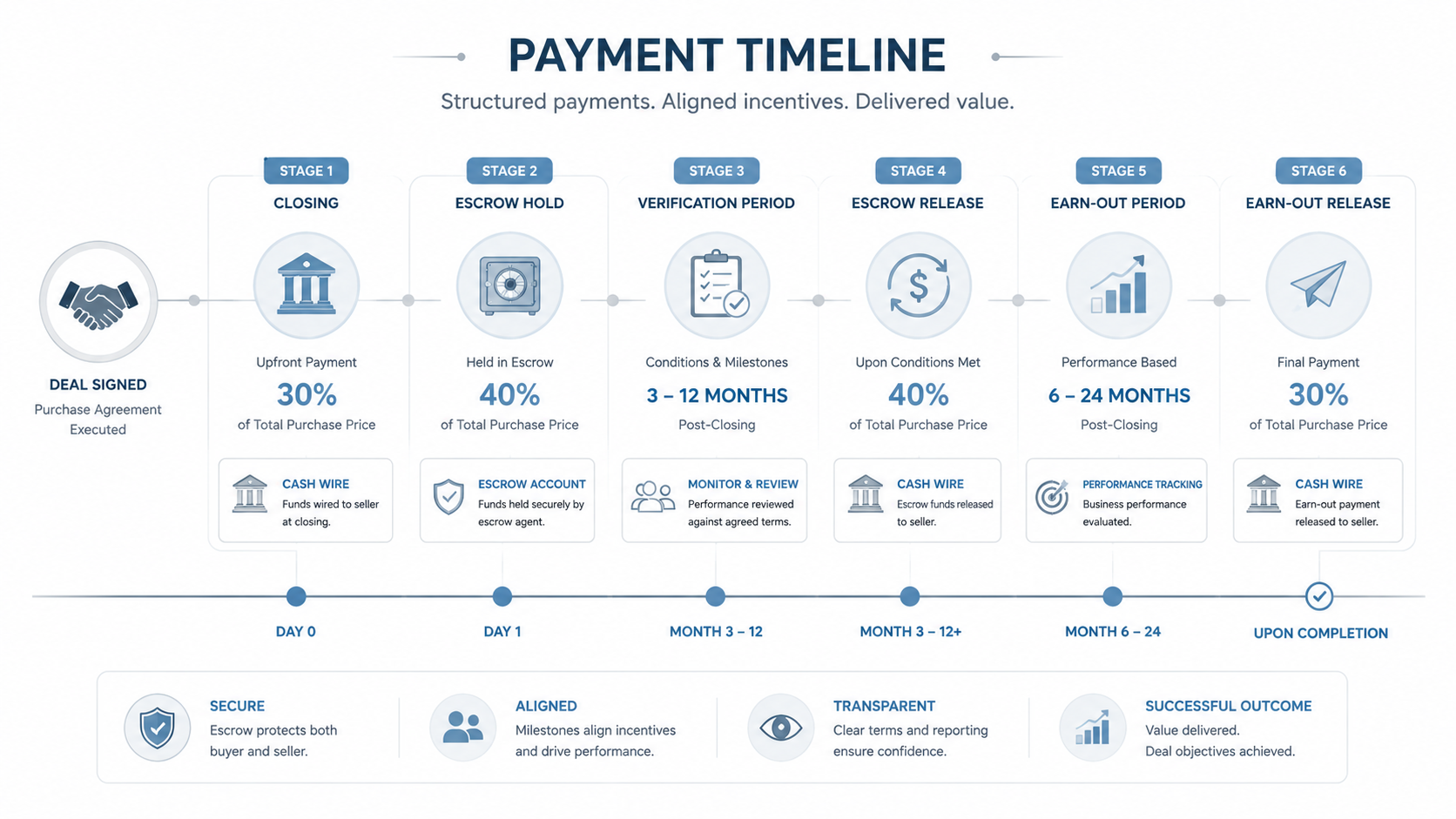
Sellers encounter several payment vehicles, each with pros and cons. Here’s a breakdown:
- Upfront Cash (Closing Payment): Typically 60-80% of enterprise value, wired at closing. Pros: Immediate liquidity. Cons: Buyer deducts working capital adjustments first.
- Escrow Holdbacks: 10-20% retained for 12-24 months against indemnities. Released upon claim resolution. Sellers hate the uncertainty but accept it as table stakes.
- Earn-Outs: 10-40% contingent on future metrics (e.g., revenue targets). Common in growth-stage firms. Risk: Buyer influence post-close can sabotage targets.
- Seller Notes/Deferred Payments: Interest-bearing promissory notes over 1-5 years. Useful for tax deferral but ties you to buyer solvency.
- Equity Rollovers: 10-30% reinvested in buyer stock. Upside potential but illiquid and volatile.
For most owners, the ideal is maximizing upfront cash while capping contingencies. In practice, deals average 70% cash at close, 15% escrow, 15% earn-out. Your leverage depends on business stability—predictable EBITDA commands better terms.
Check our valuation multiples guide to see how strong financials boost upfront payouts.
How buyers view payment timing
Buyers structure payments to mitigate risk. Post-close surprises—like hidden liabilities or customer churn—cost them dearly. Hence, escrows cover reps and warranties, earn-outs verify projections.
Strategic buyers prioritize speed, offering higher upfront for quick integration. Financial buyers, focused on IRR, stretch payments to preserve debt capacity. In competitive auctions, upfront cash rises as bidders vie for the asset.
Buyers also consider seller motivation. Distressed sellers accept heavy deferrals; trophy assets get premium cash. They model worst-case scenarios: If EBITDA drops 20%, does the earn-out pay out? This informs their bid.
Understanding buyer psychology helps sellers counter. Propose data rooms with audited trailing 12 months to build trust and unlock cash.
Common seller mistakes
Sellers often stumble here, eroding value:
- Overlooking Adjustments: Net debt or working capital swings can shave 10-15% off closing cash. Fix: Normalize balances pre-LOI.
- Weak Earn-Out Language: Vague metrics lead to disputes. Always define caps, acceleration on change-of-control.
- Ignoring Escrow Release: Negotiate milestone releases (e.g., 50% at 12 months).
- Tax Inefficiency: Lump-sum cash maximizes immediate taxes. Structure for installments if possible.
- No Post-Closing Oversight: For earn-outs, retain board observer rights.
One seller I advised lost $500K to a poorly drafted earn-out—buyer redefined “revenue” post-close. Lesson: Scrutinize every clause.
Explore factors boosting exit success to sidestep these traps.
Practical checklist for negotiating payment terms
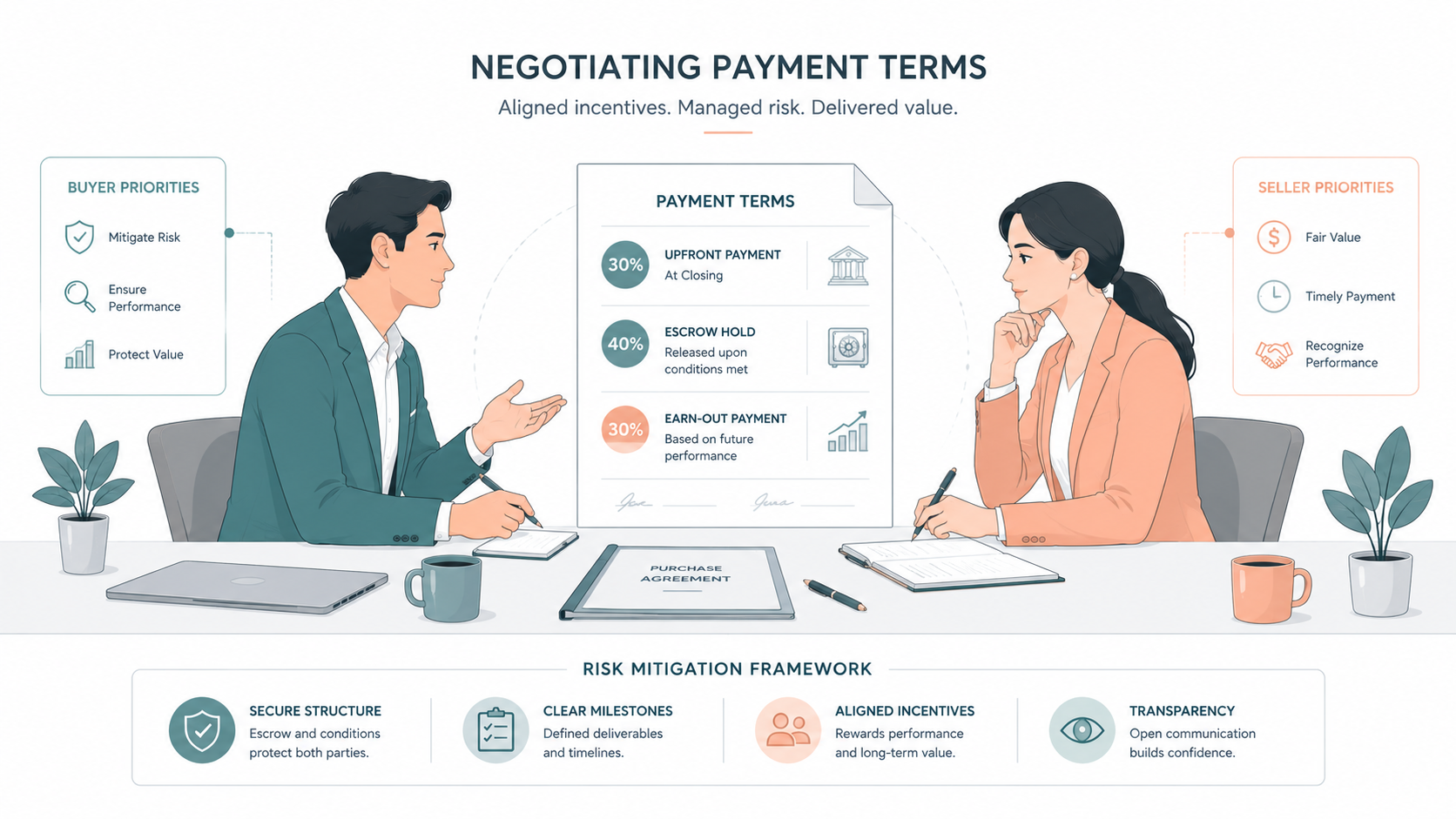
Follow this step-by-step framework:
- Pre-LOI: Model three scenarios (base, upside, downside) with advisor input.
- LOI Stage: Demand 70%+ upfront; cap escrow at 10%, 18 months max.
- Diligence: Provide clean financials to minimize adjustments.
- SPA Draft: Review payment annexes. Push for pro-rata escrow releases, earn-out protections (e.g., no adverse changes).
- Closing: Confirm wire instructions; track escrow metrics.
- Post-Close: Monitor earn-outs quarterly; prepare for disputes.
Bonus Tip: Use a M&A glossary for terms like “basket” (claim thresholds) and “survival periods.”
When should sellers start preparing
Begin 12-24 months out. Early normalization of financials (add-backs, owner perks) justifies higher valuations and cash terms. Build a “seller story” with audited projections to support earn-outs.
If exit is imminent (3-6 months), focus on balance sheet cleanup. Download our seller readiness checklist for a detailed roadmap.
How this connects to the overall business sale journey
Payment timing threads through every phase: Prep builds credibility for cash-heavy deals; marketing attracts upfront payers; diligence resolves contingencies. It’s the capstone of value maximization.
Integrate it with valuation work—strong multiples mean better structures. See our M&A blog for more on the full process.
Ready to map your payout? Book a confidential call with an M&A advisor.
Take the first step today. Start your M&A journey.