The CEO Conversation Can Make or Break a Deal
During due diligence, buyers are not only reviewing contracts, financial statements, tax filings, and customer data. They are also testing the judgment, credibility, and preparedness of the CEO. For many business owners, this is the first time they experience such a direct, structured, and sometimes uncomfortable level of questioning about the company they have built.
That pressure is understandable. A buyer may have already liked the market, the financial performance, and the strategic fit. But before signing, they still need to understand whether the business can perform without surprises after completion. The CEO interview is where many hidden issues become visible: customer concentration, weak reporting, informal decision-making, founder dependency, margin pressure, management gaps, and assumptions behind future growth.
For sellers, the goal is not to memorize perfect answers. It is to prepare truthful, consistent, evidence-backed responses that build buyer confidence. In modern M&A, due diligence questions are becoming sharper, faster, and more data-driven. Artificial intelligence is also changing how buyers review information, identify inconsistencies, and compare management claims against documents. That makes preparation more important, not less.
This guide explains the due diligence questions buyers typically ask CEOs, why those questions matter, and how owners can prepare without sounding defensive or over-rehearsed.
Table of Contents
- Why Business Owners Need to Understand Due Diligence Questions Before Selling
- Due Diligence Questions from a Seller’s Perspective
- How Investors View This Issue
- Common Seller Mistakes
- Practical Checklist or Framework for Business Owners
- When Should Sellers Start Preparing?
- How This Connects to the Overall Business Sale Journey
Why Business Owners Need to Understand Due Diligence Questions Before Selling
Many owners assume due diligence is mainly a document exercise. They expect the buyer to review the data room, ask the finance team for clarification, and then negotiate the final contract. In reality, the CEO conversation often becomes one of the buyer’s most important decision points.
There are three reasons for this. First, the CEO is expected to explain the business beyond the numbers. Financial statements show what happened. The CEO must explain why it happened, whether it is repeatable, and what could change after ownership transfers.
Second, buyers use CEO meetings to test consistency. If the management presentation says revenue growth is driven by recurring customers, but the CEO later explains that several major clients are one-off projects, the buyer will notice. If the forecast assumes margin improvement, but the CEO cannot explain the operational levers behind it, confidence weakens.
Third, the CEO’s answers influence perceived risk. A buyer may accept many imperfections if they are clearly disclosed, well understood, and manageable. The real problem is uncertainty. When a CEO appears vague, dismissive, or surprised by basic questions, the buyer may worry that more issues will emerge later.
This is why due diligence questions should not be treated as an interrogation to survive. They are a structured opportunity to show that the business is professionally run, commercially realistic, and ready for transition. Owners who prepare early usually sound calmer, more balanced, and more credible. Owners who prepare late often become reactive, and reactive sellers rarely protect valuation well.
Preparation also matters because the process is becoming more sophisticated. Buyers increasingly expect fast access to organized information, clear explanations, and evidence that supports management’s claims. Technology can accelerate document review and highlight gaps, but it cannot replace the CEO’s commercial judgment. The strongest sellers combine good records with thoughtful leadership answers.
Due Diligence Questions from a Seller’s Perspective
From the seller’s side, buyer questions can feel personal. When someone asks why margins declined, why a major customer left, or why the company depends heavily on the founder, it may sound like criticism. But in a transaction context, these questions are usually about risk allocation, value protection, and post-closing execution.
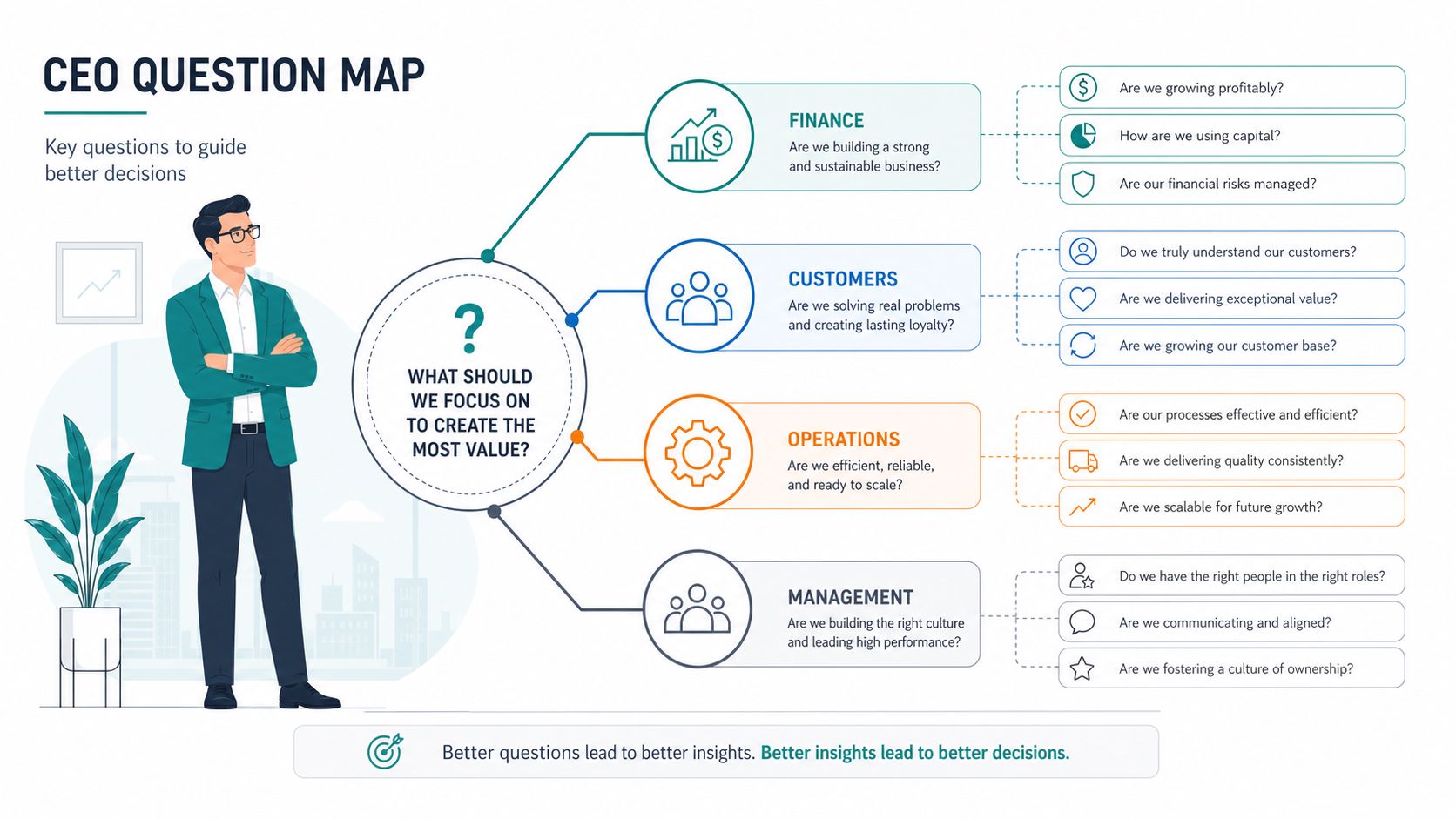
A practical way to understand CEO due diligence is to group questions into core themes. Each theme tells the buyer something different about the business.
1. Strategy and Market Position
Buyers commonly ask CEOs to explain the company’s positioning in simple, direct language. They want to know why customers choose the business, how durable that advantage is, and whether the company can defend its position if competitors become more aggressive.
Typical questions include:
- What is the company’s core value proposition?
- Which customer segments are most attractive, and why?
- Who are your strongest competitors?
- What would cause customers to switch away from you?
- Which growth opportunities are realistic over the next three to five years?
The best answers are specific without becoming overly technical. A CEO should be able to connect market position to customer behavior, pricing power, sales conversion, retention, and operational capability. Broad statements such as we have a strong brand or customers trust us are not enough unless supported by evidence.
2. Revenue Quality and Customer Risk
Revenue is one of the first areas buyers examine. They are not only asking how much revenue the business generates; they are asking how reliable, diversified, and defensible that revenue is.
Typical questions include:
- How much revenue is recurring, repeat, or project-based?
- Who are the largest customers, and how long have they been with the company?
- Are any customer relationships dependent on the CEO personally?
- What is the customer churn pattern?
- Are there any customers at risk of reducing or ending their relationship?
This is where many sellers underestimate the level of detail expected. If a company has customer concentration, it should not try to hide it. Instead, the CEO should explain the nature of the relationship, contract terms, historical behavior, renewal discussions, and mitigation plans. Buyers are generally more comfortable with known risks than unexplained risks.
For owners who want to understand this topic more deeply before entering a process, the guide on what investors look for during due diligence is a useful starting point.
3. Financial Performance and Forecast Assumptions
Buyers will ask the CEO to explain the financial story, even if the CFO or accountant handles the detailed numbers. The CEO does not need to answer every accounting question, but they must understand the commercial drivers behind revenue, margins, working capital, and capital expenditure.
Typical questions include:
- What caused revenue growth or decline in the last few years?
- Are margins sustainable at the current level?
- What costs are one-off, discretionary, or owner-related?
- What assumptions support the forecast?
- Where could actual performance differ materially from the plan?
The most credible CEOs are balanced. They do not present every forecast as guaranteed. Instead, they distinguish between contracted revenue, visible pipeline, likely renewals, and aspirational growth. This helps buyers assess probability rather than simply debating optimism.
4. Operations and Scalability
Operational questions are designed to test whether the business can grow without breaking. A company may have attractive revenue, but if processes are informal, systems are outdated, or key knowledge sits with a few people, the buyer may apply a heavier risk discount.
Typical questions include:
- Which processes are documented and which rely on individual experience?
- Where are the main capacity constraints?
- What systems does the company rely on?
- How does management monitor quality, delivery, and customer service?
- What operational improvements would you prioritize with more capital?
For sellers, this is an opportunity to show maturity. Even if the company is not perfect, the CEO should demonstrate awareness of operational bottlenecks and a credible plan to address them. Buyers do not expect every mid-market business to operate like a multinational corporation. They do expect the owner to understand the machine they are selling.
5. Management Team and Founder Dependency
One of the most sensitive areas is management depth. Buyers will ask whether the company can function without the founder or current CEO. This does not mean they expect the owner to disappear immediately after closing. It means they need to understand how much value is tied to one person.
Typical questions include:
- Which decisions require CEO approval today?
- Who owns key customer relationships?
- Which managers are ready for more responsibility?
- Are there any retention risks within the leadership team?
- What transition support would be needed after completion?
A seller should avoid saying, the business can run without me unless that is demonstrably true. A better answer explains the current level of dependency, what has already been delegated, and what transition structure would protect continuity. Buyers respect realism.
6. Legal, Tax, and Compliance Matters
CEO-level legal questions are not about replacing legal counsel. They are about understanding whether management is aware of material risks. Buyers may ask about major contracts, licensing, employment issues, pending disputes, related-party arrangements, or tax exposures.
Typical questions include:
- Are there any disputes, claims, or unresolved regulatory issues?
- Do major contracts contain change-of-control restrictions?
- Are all licenses, permits, and approvals current?
- Are there related-party transactions the buyer should understand?
- Have there been any past tax issues or audits?
The CEO should not improvise legal conclusions. If a matter requires counsel, say so clearly. But the CEO should know the business context and should never appear unaware of a material issue that later appears in the documents.
How Investors View This Issue
Investors view CEO due diligence as a credibility test. The question behind the question is often: Can we trust the management narrative? If the answer is yes, the buyer can spend more time on deal structure and value creation. If the answer is no, they may slow the process, expand diligence, reduce valuation, add protections, or walk away.
Buyers usually evaluate CEO answers across five dimensions.
Clarity
A strong CEO can explain complex issues simply. Clarity does not mean oversimplifying the business. It means knowing the drivers well enough to separate what matters from noise. When a CEO gives long, unfocused answers to straightforward questions, buyers may wonder whether the underlying business is equally unclear.
Consistency
Buyers compare what the CEO says with the information memorandum, data room, financial model, management accounts, customer contracts, and prior meeting notes. Inconsistencies do not always indicate dishonesty; they may reflect poor preparation. But from a buyer’s perspective, inconsistency increases risk.
Evidence
Professional buyers prefer answers supported by data or documents. For example, if the CEO says customer retention is strong, the buyer may ask for cohort analysis, renewal history, or customer-level revenue trends. If the CEO says a margin decline was temporary, the buyer may ask for cost breakdowns and subsequent recovery evidence.
Self-awareness
Buyers do not expect a flawless business. They do expect the CEO to understand weaknesses. A seller who acknowledges a risk and explains the mitigation plan often creates more confidence than a seller who insists there are no issues. In M&A, the statement there are no risks is rarely persuasive.
Transition Logic
Investors are already thinking about what happens after closing. They want to know whether customers will stay, employees will remain engaged, systems will continue operating, and the seller will support a smooth handover. CEO answers help buyers estimate the level of integration and transition risk.
This is also where AI-enabled due diligence changes the dynamic. As tools become better at reviewing documents, summarizing large volumes of information, and flagging inconsistencies, CEOs should assume that unsupported statements will be tested quickly. Technology may make the process faster, but it also raises the standard for organized, internally consistent information.
Common Seller Mistakes
Most due diligence problems are not caused by one bad answer. They come from patterns that reduce trust. Sellers can avoid many valuation and negotiation issues by recognizing these mistakes early.
Mistake 1: Treating Questions as Challenges Instead of Risk Analysis
Some owners become defensive when buyers ask detailed questions. They feel the buyer is questioning their competence or trying to find reasons to reduce price. Sometimes buyers do negotiate aggressively, but most diligence questions have a legitimate purpose. They help the buyer understand what they are acquiring.
A defensive tone can damage the process. It may suggest that the seller is hiding something or is not ready for institutional scrutiny. A better approach is calm, factual, and transparent: answer what you know, acknowledge what needs verification, and provide supporting material promptly.
Mistake 2: Overpromising the Forecast
Sellers naturally want to present the future positively. But overconfident forecasts can create problems later. If the CEO cannot explain the assumptions behind growth, margin expansion, or new customer wins, buyers may discount the forecast heavily.
The strongest approach is to separate the forecast into categories: contracted, recurring, pipeline, management initiatives, and upside opportunities. This allows the buyer to assess risk more fairly and reduces the chance of a credibility gap.
Mistake 3: Minimizing Founder Dependency
Many CEOs say the business is not dependent on them because they want to reassure the buyer. But if the CEO still approves pricing, negotiates with key customers, manages supplier disputes, and makes all senior hiring decisions, the buyer will find out quickly.
Founder dependency is manageable when it is openly discussed. It becomes dangerous when the seller denies it. A realistic transition plan, delegated authority, documented processes, and retention of key managers can all reduce the perceived risk.
Mistake 4: Giving Different Answers to Different Advisors
During a sale process, the CEO may speak with the buyer, buyer’s advisors, accountants, lawyers, lenders, and internal management. If answers vary across conversations, the buyer may lose confidence. This often happens when the seller has not prepared a clear fact base before diligence begins.
Before formal diligence, sellers should align internally on core messages, financial explanations, risk disclosures, and forecast assumptions. This is not about scripting artificial responses. It is about ensuring the company’s story is accurate and consistent.
Mistake 5: Waiting Until the Data Room Is Open to Prepare
By the time the data room is live, the buyer’s questions may arrive quickly. If documents are incomplete or explanations are unclear, the process can become chaotic. Sellers should prepare well before launching a transaction. A well-structured data room reduces avoidable friction and gives the CEO more time to focus on commercial discussions.
If your materials are not yet organized, the article on how to structure an M&A data room can help you think through the practical foundation.
Practical Checklist or Framework for Business Owners
A CEO does not need to prepare for every possible question individually. A better method is to build a diligence response framework. This framework helps the seller answer with clarity, evidence, and consistency.
Step 1: Build the Core Business Narrative
Start with a concise explanation of the company. This should include what the business does, who it serves, why customers buy, how the company makes money, and where future growth can realistically come from.
The narrative should be honest. If growth has slowed, explain why. If margins improved because of temporary cost reductions, say so. If the company has recently changed strategy, explain the rationale and early evidence.
Step 2: Prepare the CEO Question Bank
Create a question bank around the topics buyers are most likely to raise. At minimum, include:
- Market position and competitive advantage
- Revenue quality and customer concentration
- Pricing, margins, and cost structure
- Forecast assumptions and downside risks
- Management team strength and retention
- Operational scalability and systems
- Legal, tax, compliance, and contract issues
- Founder dependency and transition planning
For each topic, prepare a short answer, supporting evidence, and any documents that may be needed. This prevents the CEO from relying on memory under pressure.
Step 3: Match Claims to Evidence
Every important claim should connect to a document, metric, or observable fact. For example:
- If you claim strong retention, prepare customer history and churn analysis.
- If you claim pricing power, prepare examples of price increases and customer response.
- If you claim management depth, prepare an organization chart and responsibility matrix.
- If you claim scalable operations, prepare process documentation and system reports.
- If you claim forecast visibility, prepare pipeline data and signed contracts where applicable.
This discipline is especially important as diligence becomes more data-driven. Buyers can review larger volumes of information more quickly than before. A seller who makes unsupported claims may lose credibility faster than expected.
Step 4: Identify Red Flags Before the Buyer Does
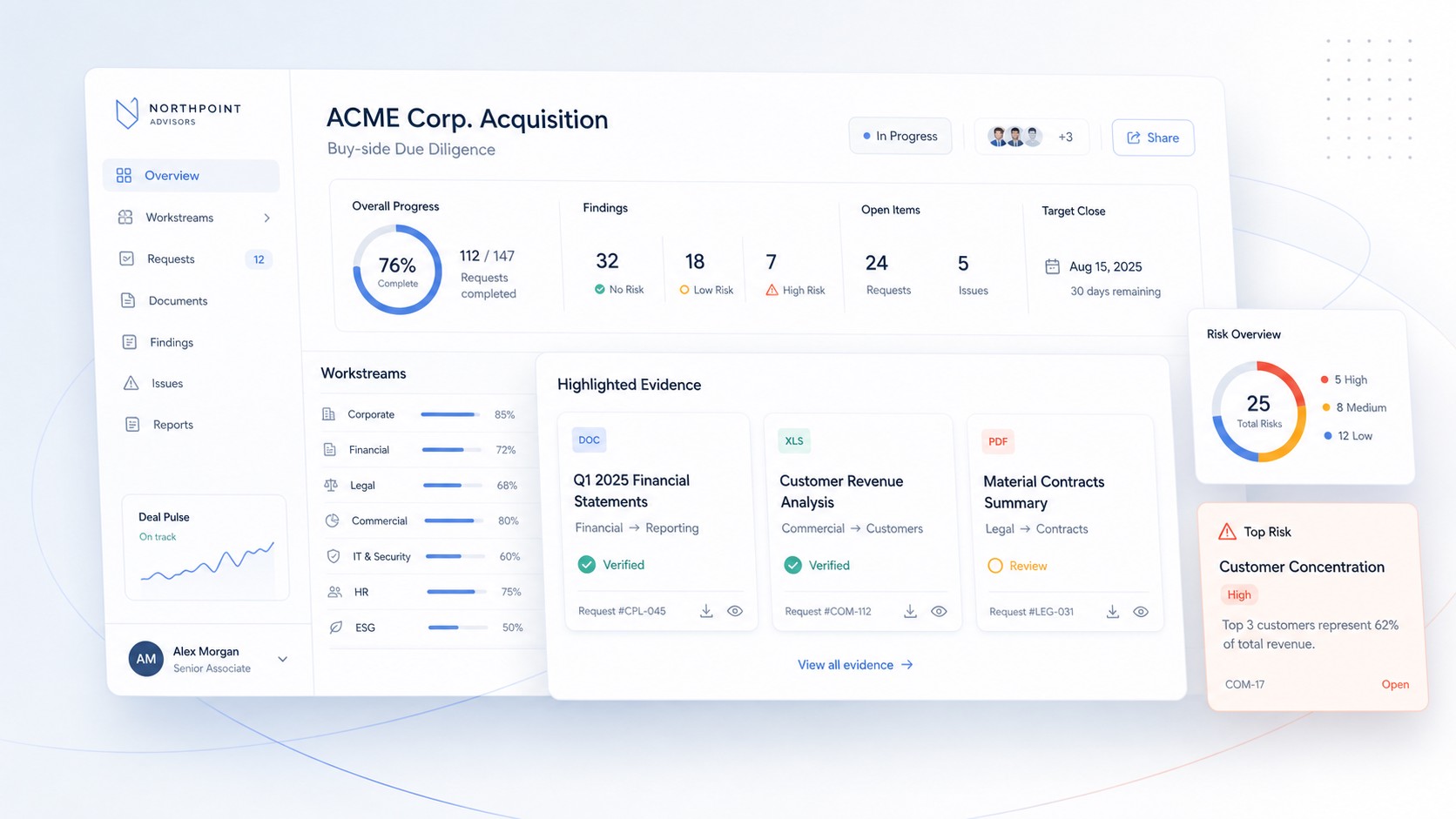
Sellers should conduct their own red flag review before entering the market. Common areas include customer concentration, expired contracts, informal employee arrangements, related-party transactions, revenue recognition issues, tax exposures, weak management reporting, and undocumented operational processes.
The purpose is not to eliminate every issue. Some issues cannot be fully solved before a sale. The purpose is to understand them, quantify them where possible, and prepare a credible explanation. For a deeper view, see common red flags in due diligence.
Step 5: Rehearse Without Sounding Rehearsed
CEO preparation should include practice sessions. However, the goal is not to sound scripted. Buyers can usually detect overly polished answers. The goal is to become comfortable with the facts, anticipate difficult questions, and answer with a calm executive tone.
A useful format is to rehearse three types of questions:
- Direct questions: Questions with clear factual answers, such as customer concentration or contract length.
- Judgment questions: Questions requiring interpretation, such as competitive threats or market timing.
- Pressure questions: Questions about weaknesses, disputes, declining performance, or dependency risks.
The CEO should practice saying, I do not want to speculate; we will verify that and come back with the document. This is far better than guessing.
When Should Sellers Start Preparing?
The best time to prepare for buyer questions is long before a buyer enters the room. Ideally, owners should begin at least 12 months before a planned sale. This gives enough time to improve reporting, clean up contracts, reduce obvious risks, and build a stronger management story.
Six to twelve months before sale, the CEO should focus on readiness. This includes organizing financial records, reviewing customer contracts, documenting key processes, assessing management depth, and identifying any legal or tax matters that need attention. It is also the right time to consider whether the business depends too heavily on the owner.
Three to six months before sale, the focus should shift to transaction materials. The seller should prepare the management narrative, data room structure, forecast support, and internal alignment. Advisors can help pressure-test the story and identify questions buyers are likely to ask.
Once due diligence begins, preparation becomes more tactical. The CEO must manage meetings, answer follow-up questions, coordinate with advisors, and maintain business performance at the same time. This is why early preparation is so valuable. A seller who waits until diligence begins is trying to build the aircraft while flying it.
Owners who are early in the process can download our seller checklist to structure the preparation work before buyer conversations become time-sensitive.
How This Connects to the Overall Business Sale Journey
CEO due diligence questions are not isolated from the rest of the sale process. They connect directly to valuation, negotiation, deal structure, warranties, indemnities, transition planning, and closing certainty.
If the CEO answers well, the buyer is more likely to trust the information provided. That trust can support cleaner negotiations and reduce the temptation to overprotect through price reductions or heavy contractual protections. If the CEO answers poorly, even a financially attractive business may become harder to sell on favorable terms.
The CEO conversation also affects buyer psychology. A buyer wants to feel that they are acquiring not only assets and earnings, but also an understandable business with manageable risks. When the seller can explain the company clearly, disclose weaknesses responsibly, and support claims with evidence, the buyer has a stronger basis to proceed.
This does not mean sellers should reveal every minor internal detail without structure. Confidentiality and process control still matter. Sensitive information should be disclosed at the right stage, under appropriate protections, and with advisor support. But withholding material issues or giving vague answers usually creates more risk than it avoids.
For many owners, selling a company is the largest financial and professional transaction of their lives. The CEO’s role in due diligence is therefore not a formality. It is a central part of value preservation. The way the CEO explains the business can either reinforce the price already negotiated or give the buyer reasons to reopen it.
A practical mindset helps: buyers are not only buying the past; they are underwriting the future. The CEO’s answers help them decide whether that future is credible.
Prepare before buyers start asking. Download the Seller Readiness Checklist.
Thinking about a sale in the next 12 to 24 months? Start Here – The journey for business sellers.