EBITDA Adjustments Explained: A Guide for Business Sellers

Unlocking hidden value: Why EBITDA adjustments can make or break your business sale
As a business owner eyeing an exit, you’ve likely heard the term EBITDA thrown around in M&A conversations. Earnings Before Interest, Taxes, Depreciation, and Amortization serves as the cornerstone metric for valuing your company. But here’s the catch: the raw EBITDA figure from your financials often doesn’t tell the full story. Enter EBITDA adjustments—or “add-backs” as they’re commonly called. These are legitimate tweaks that normalize your earnings to reflect the true operational performance of the business, stripped of owner-specific or one-off expenses.
Without a solid grasp of EBITDA adjustments, sellers risk leaving millions on the table. Buyers pore over these numbers to gauge sustainable profitability under their ownership. Overstated add-backs can erode trust and kill deals, while underutilized ones undervalue your enterprise. In my years advising on transactions across Southeast Asia, I’ve seen firsthand how meticulous preparation here separates successful exits from frustrating failures.
This guide demystifies EBITDA adjustments for sellers like you. We’ll explore their mechanics, buyer perspectives, pitfalls to dodge, and a step-by-step framework to get them right. Whether you’re 12 months out or just starting to think about selling, mastering this will sharpen your valuation and smooth the path to closing.
Table of Contents
- Why business owners need to understand EBITDA adjustments before selling
- EBITDA adjustments from a seller’s perspective
- How investors view this issue
- Common seller mistakes
- Practical checklist or framework for business owners
- When should sellers start preparing
- How this connects to the overall business sale journey

Why business owners need to understand EBITDA adjustments before selling
EBITDA adjustments aren’t just accounting exercises—they’re your leverage in negotiations. Most valuations multiply adjusted EBITDA by a multiple (typically 4x to 8x for mid-market deals) to arrive at enterprise value. A 10% swing in adjusted EBITDA can boost your sale price by hundreds of thousands, if not millions.
Consider a typical scenario: Your P&L shows $2 million in EBITDA, but after add-backs for personal expenses, non-recurring costs, and market-rate owner compensation, it climbs to $2.5 million. At a 5x multiple, that’s a $2.5 million uplift. Sellers who skip this step sell themselves short.
Beyond valuation, understanding adjustments builds credibility. Buyers expect normalized earnings; anything less signals sloppy management or hidden risks. In competitive auctions, precise adjustments differentiate your business as investment-ready.
Moreover, tax implications lurk here. Certain add-backs might trigger IRS or local tax authority scrutiny post-sale. Early mastery ensures compliance and preserves deal value.
Finally, in today’s market, where economic headwinds pressure multiples, strong adjusted EBITDA showcases resilience. It proves your business thrives independently of you—the ultimate buyer reassurance.
EBITDA adjustments from a seller’s perspective
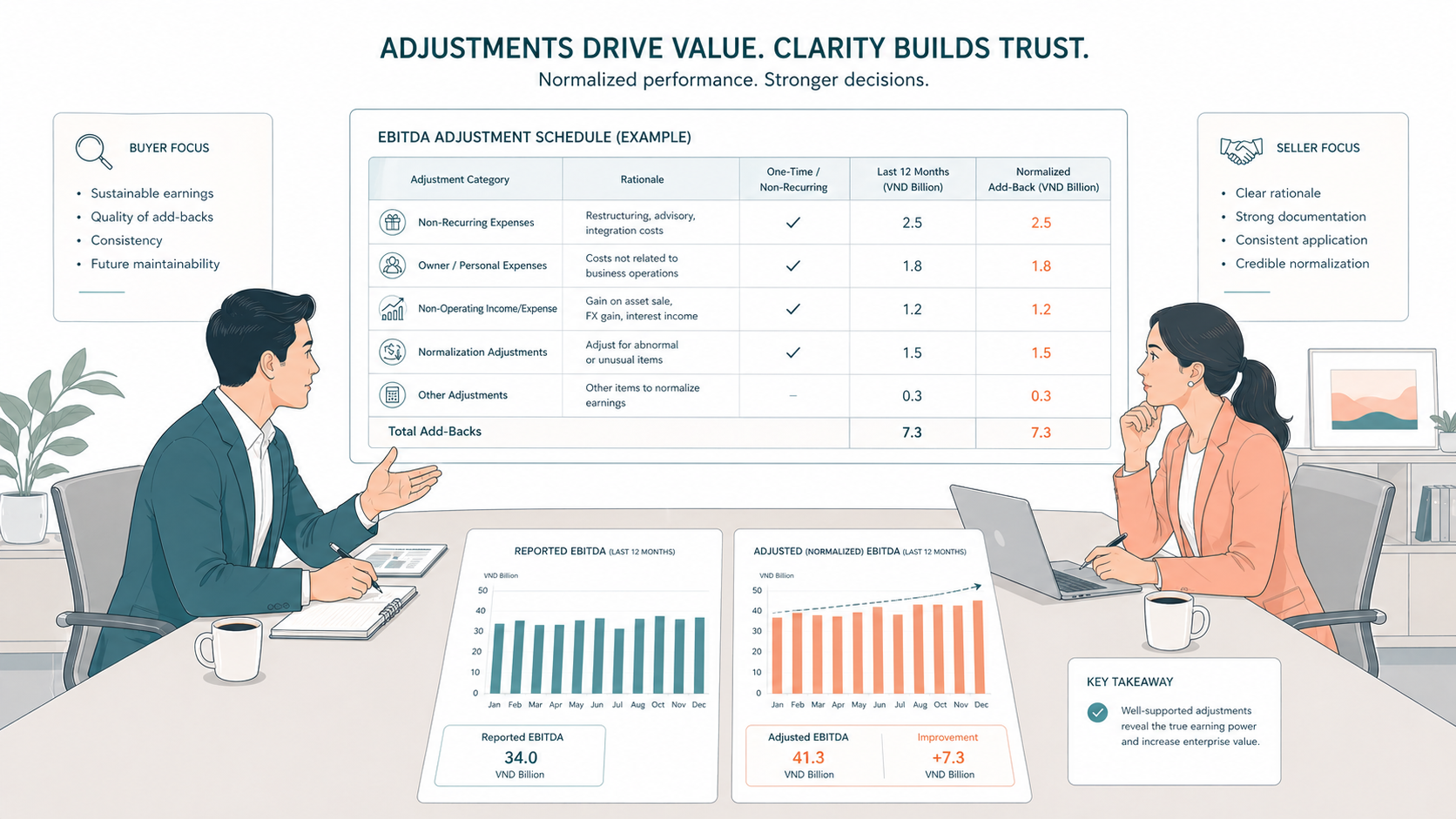
From where you sit, EBITDA adjustments recast your financials to spotlight recurring, owner-agnostic profitability. Common categories include:
- Owner compensation: Normalize to market rates for your industry and role. If you’re drawing 20% above peers as salary and perks, add back the excess.
- Non-recurring expenses: One-off legal fees, restructuring costs, or bad debt write-offs get stripped out.
- Personal expenses: Company-paid vehicles, club memberships, or family travel—legitimate if documented as non-operational.
- Above-market rents: If leasing from yourself at inflated rates, adjust to fair market value.
- Depreciation/amortization tweaks: Sometimes normalized for replacement capex.
Sellers often view these as “low-hanging fruit,” but precision matters. Document everything with receipts, contracts, and comparables. Vague add-backs invite buyer pushback.
In practice, aim for conservatism. Buyers will haircut aggressive claims, so build a defensible case. Tools like quality of earnings (QoE) reports from CPAs validate your numbers, adding weight to your ask.
For family businesses or founder-led firms, adjustments highlight scalability. Reducing founder dependency through normalized comp shows the business runs on its own merits.
How investors view this issue
Buyers approach EBITDA adjustments with skepticism—they’re protecting their investment thesis. Strategic acquirers focus on synergies, while financial buyers (PE firms) obsess over cash flow predictability.
Expect rigorous due diligence: They’ll demand three years of audited financials, bank statements, and vendor invoices to verify add-backs. Red flags include inconsistent expense patterns or undocumented personal items.
Investors categorize adjustments into “Type A” (universally accepted, like one-offs) and “Type B” (controversial, like owner perks). They’ll concede Type A fully but negotiate Type B down 50-100%.
In Asia-Pacific deals, cultural nuances play in. Family-run firms with embedded personal expenses face steeper scrutiny, as buyers seek clean, corporate governance.
Ultimately, buyers recalculate EBITDA themselves. Your goal: Provide data so their version aligns closely with yours, minimizing valuation gaps.
Common seller mistakes
Sellers trip up here more than anywhere else. Top pitfalls:
- Over-aggressive add-backs: Claiming 30% of expenses as personal without proof. Buyers dismiss these outright, damaging trust.
- Ignoring run-rate adjustments: Failing to annualize recent improvements, like cost cuts or revenue ramps.
- No documentation: Verbal justifications won’t cut it. Always back claims with evidence.
- Forgetting buyer synergies: Don’t add back costs the buyer won’t eliminate, like redundant staff they’ll retain.
- Tax blindness: Some add-backs create taxable events; consult advisors early.
- Last-minute rushes: Adjustments require historical data cleanup—don’t start post-LOI.
Avoid these by engaging a QoE expert pre-marketing. It preempts disputes and signals professionalism.
Read our detailed guide on preparing financial statements before selling a business for deeper financial prep tips.
Practical checklist or framework for business owners
Here’s a battle-tested framework to nail EBITDA adjustments:
Step 1: Gather Data
- Compile 3-5 years of P&L, balance sheets, tax returns, and bank statements.
- Segment expenses by category: operational, owner-related, non-recurring.
Step 2: Identify Add-Backs
- Comp analysis: Benchmark CEO pay via Salary.com or local surveys.
- Personal scan: Review for non-arm’s-length transactions.
- One-offs: Flag anomalies exceeding 5% of EBITDA.
Step 3: Quantify and Document
- Create a detailed schedule: Description, amount, years affected, justification.
- Attach proofs: Invoices, market comps, board minutes.
Step 4: Normalize and Project
- Adjust for run-rate: Prorate Q4 efficiencies across the year.
- Forecast sustainable EBITDA under buyer ownership.
Step 5: Validate Externally
- Hire a CPA for QoE report.
- Test with mock buyer diligence.
Pro tip: Use our M&A glossary to master terms like “add-backs” and “quality of earnings.” For a full prep plan, check the 12-month preparation checklist.
When should sellers start preparing
Start 12-18 months before marketing. Early cleanup reveals issues like weak internal controls, giving time to fix them.
If you’re founder-dependent, use this period to build team depth—crucial for comp normalization. Align with financial audits and data room setup.
In fast-growing markets, don’t wait for a buyer to emerge. Proactive sellers command premiums.
How this connects to the overall business sale journey
EBITDA adjustments anchor the valuation phase but ripple throughout. They inform CIMs, teasers, and NDAs. Strong numbers attract better buyers and higher multiples.
Link to broader prep: Clean financials (data room ready), legal compliance, and management stability reduce risk discounts.
Post-adjustment, expect buyer QoE to refine further. Transparent sellers close faster.
Explore more at our M&A blog.
Ready to optimize your EBITDA? Download our seller checklist.
Take the first step today. Start your M&A journey.
Need personalized advice? Book a confidential call with our team.