Enterprise Value vs Equity Value: What Sellers Must Know

Why Enterprise Value and Equity Value Matter More Than You Think
As a business owner eyeing an exit, you’ve likely heard terms like enterprise value and equity value thrown around in M&A conversations. But do you truly grasp how they differ and why that distinction could make or break your deal? Many sellers assume they’re interchangeable, leading to mispriced offers, prolonged negotiations, or outright deal collapses. Enterprise value captures the total worth of your operations, while equity value focuses on what shareholders actually pocket. In Vietnam’s reviving M&A market, where foreign investors scrutinize every metric amid subdued regional dealmaking, getting this wrong means leaving millions on the table.
Consider how R&D costs influence enterprise value, drawing lessons from listed European businesses applicable to Vietnamese firms. Or the tragic end of a famous Vietnamese brand like TRI, which underscores how operational missteps erode both values over time. With market reforms positioning Vietnam at a turning point and foreign cash fleeing stocks despite economic booms, sellers must align their financials to highlight true enterprise strength. This isn’t academic—it’s the foundation of maximizing your payout in a bottom-up stock market approach.
In this guide, we’ll break it down practically: from seller perspectives to investor lenses, common pitfalls, and actionable steps. Whether you’re in textiles facing cash conversion cycle pressures or navigating capital gains tax on share transfers, understanding enterprise value vs equity value equips you to negotiate confidently.
Table of Contents
- Why business owners need to understand enterprise value vs equity value before selling
- Enterprise value vs equity value from a seller’s perspective
- How investors view this issue
- Common seller mistakes
- Practical checklist for business owners
- When should sellers start preparing
- How this connects to the overall business sale journey

Why business owners need to understand enterprise value vs equity value before selling
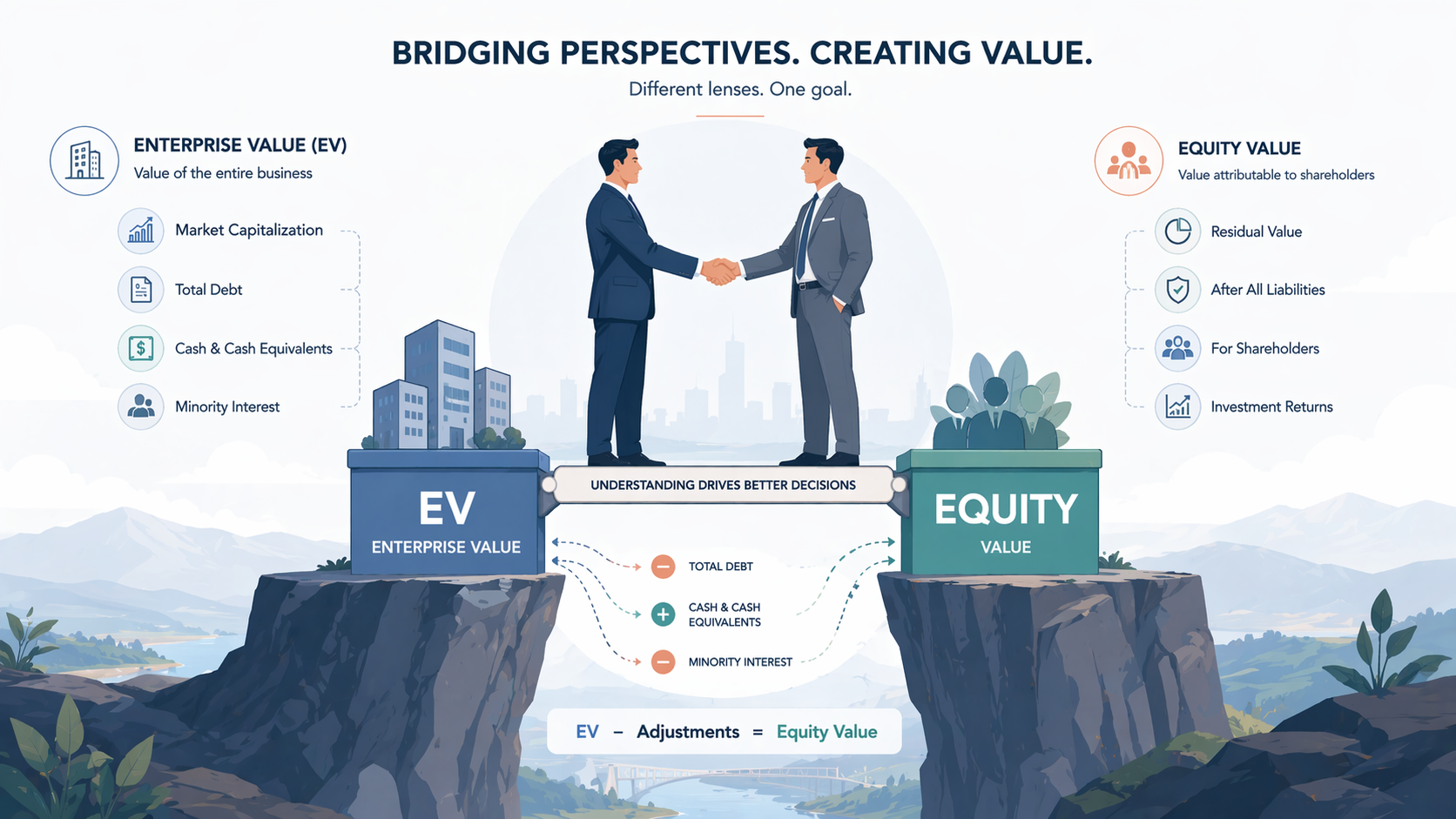
Before diving into an M&A process, every seller should master the core difference: enterprise value (EV) represents the total value of your business as a going concern, encompassing equity, debt, and cash adjustments. Equity value, on the other hand, is what remains for shareholders after settling debts—essentially EV minus net debt.
Why does this matter pre-sale? Valuation isn’t just a number; it’s your leverage in negotiations. Misunderstanding leads to accepting lowball equity offers that ignore operational value. In Vietnam, where Circular 99 pushes toward IFRS alignment, precise EV calculations become crucial for transparent financials that attract serious buyers.
Take optimal capital structures from NYSE-listed firms: they directly impact financial performance by balancing debt and equity, boosting EV. Vietnamese businesses, especially in textiles, see profitability tied to cash conversion cycles from 2020-2024. A stretched cycle drags EV down, compressing equity value even if sales look robust.
Moreover, in a market showing M&A revival amid Southeast Asia’s slowdown, investors use EV multiples to compare apples-to-apples across borders. Sellers ignorant of this face discounted offers. Bond market confidence relies on live data, mirroring how real-time EV metrics build buyer trust. Without this knowledge, you’re flying blind in a bottom-up stock market where fundamentals drive prices.
Ultimately, grasping enterprise value vs equity value empowers you to present a holistic picture, justifying premiums and avoiding surprises like capital gains tax on share transfers during exits.
Enterprise value vs equity value from a seller’s perspective
From where you sit, equity value is the prize—what you walk away with. But buyers fixate on EV because it reveals the full cost of acquiring your operations. Formula-wise: EV = Equity Value + Net Debt + Minority Interest + Preferred Stock. Normalizing this ensures you’re not penalized for past financing choices.
For Vietnamese sellers, R&D investments exemplify EV drivers. European listed examples show how consistent spending elevates EV, with suggestions for local firms to emulate. Neglect it, and your EV stagnates, shrinking equity payouts.
Cash conversion cycles hit textiles hard: prolonged periods erode profitability, directly hitting EV. Sellers must optimize inventory, receivables, and payables to inflate EV, thereby lifting equity value. Asia’s mid-year outlooks highlight regional growth, but Vietnam’s stock flight by foreigners demands strong EV stories to lure them back.
Brand failures like TRI’s tragic end remind us: intangible value folds into EV via multiples on EBITDA. Sellers viewing only equity miss opportunities to groom assets that amplify both. In share transfers, capital gains tax applies to equity proceeds, but a robust EV justifies higher bases.
Your perspective shift: treat EV as the engine propelling equity. Clean balance sheets—low debt, high cash—bridge the gap seamlessly.
How investors view this issue
Buyers approach enterprise value vs equity value through an operational lens. EV tells them the takeover price for 100% control, independent of capital structure. They apply multiples (EV/EBITDA) to forecast synergies post-acquisition.
In Vietnam’s reforming market, investors eye bottom-up opportunities where EV reveals undervalued gems. Foreign cash flees stocks, but M&A revives as a backdoor entry. Optimal capital structures from NYSE insights guide them: too much debt inflates EV artificially, risking equity dilution.
Circular 99’s IFRS push means investors demand EV recalculations under global standards, spotting discrepancies. Bond market live data parallels this—transparency builds confidence. For textiles, cash cycles signal EV sustainability; poor management flags risks.
R&D impacts shine here: European cases prove it sustains EV growth, vital for Vietnamese scalability. Market reforms position Vietnam pivotally, with investors betting on EV uplifts from reforms. They view equity value as a residual—strong EV ensures healthy equity after adjustments.
Pro tip: Investors discount EV for founder dependency or unproven scalability, compressing equity. Showcase normalized EV to align views.
Common seller mistakes
Sellers often conflate the two, quoting equity as EV, inviting low offers. Another pitfall: ignoring net debt adjustments. High-interest loans bloat EV, scaring buyers despite solid equity potential.
In Vietnam, overlooking tax on share transfers bites: equity gains are taxed, but unoptimized EV leads to lower bases. R&D underinvestment, per European-Vietnamese contrasts, caps EV growth.
Cash cycle mismanagement in garments erodes profitability, tanking EV. Brand missteps like TRI’s downfall highlight EV fragility from reputational hits. Failing to normalize for one-offs—extraordinary gains inflating equity—leads to post-due diligence clawbacks.
Neglecting market context: amid foreign outflows, weak EV stories fail. Not preparing IFRS under Circular 99 mismatches investor expectations. Optimal structure ignorance, unlike NYSE firms, suboptimalizes performance.
Avoid these by annual EV audits, tying back to broader readiness like business sale processes.
Practical checklist or framework for business owners
Here’s a step-by-step framework to master enterprise value vs equity value:
- Calculate baseline EV: Market Cap (if public) or estimated equity + net debt. Use EV/EBITDA peers.
- Normalize earnings: Adjust EBITDA for owner perks, one-offs. Boosts EV multiples.
- Optimize capital structure: Reduce high-cost debt; build cash reserves. Minimizes EV-equity gap.
- Invest in value drivers: R&D, per European models, for sustainable EV growth.
- Shorten cash cycles: Especially textiles—target 2020-2024 benchmarks for profitability lift.
- Prepare tax scenarios: Model capital gains on equity transfers.
- Audit intangibles: Brands, IP—avoid TRI-like erosion.
- IFRS align: Via Circular 99 for credible EV.
- Scenario test: Stress EV under reforms, foreign flows.
Track quarterly. For details, check our M&A glossary.
When should sellers start preparing
Start 12-24 months out, aligning with 12-month checklists. Early EV tuning captures market upswings like Vietnam’s revival.
If bonds need confidence via live data, so does your EV. Pre-reform wave, act now. Textiles: post-2024 cycles. Brands: post-stability.
How this connects to the overall business sale journey
EV/equity anchors valuation in M&A types, from asset to share deals. Ties to financial prep, due diligence, closing.
Integrates with M&A vs capital raises—EV signals scalability.
Ready to assess your values? Download our seller checklist.
Begin your exit. Start your M&A journey.
Need guidance? Book a confidential call.